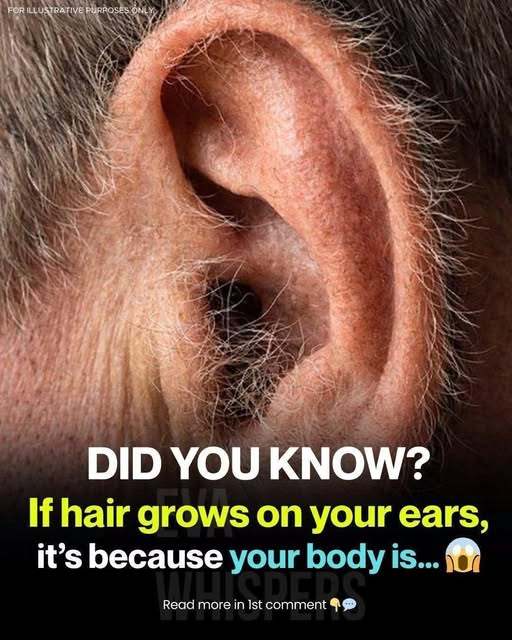
Wondering why hair grows on your ears? Learn what causes ear hair, how genetics and aging influence it, whether it signals a health problem, and when you should talk to a doctor.
Have you ever noticed a few coarse hairs growing around your ears and wondered why they suddenly appeared?
Ear hair is surprisingly common, especially as people get older. A few hairs around the outer ear or inside the ear canal are usually nothing to worry about. In most cases, they are simply part of the body’s normal hair-growth pattern and are influenced by genetics, hormones, and aging.
Despite popular claims online, ear hair does not automatically mean that your body is lacking a particular vitamin or that you have a hidden disease.
Why Does Hair Grow on the Ears?
Hair follicles are naturally present on many parts of the body, including the ears. As we age, some of these follicles can become more active or produce thicker, darker hairs.
Several factors can influence this process.
1. Aging Can Change Hair Growth
One of the most common reasons ear hair becomes noticeable is getting older.
As hormone levels and hair-growth patterns change over time, certain hairs may become thicker or grow for longer periods. Hair around the outer ear can therefore become much more visible than it was when you were younger.
This is a normal biological change for many people.
2. Genetics Play a Major Role
If men or women in your family tend to develop noticeable facial or ear hair as they age, you may be more likely to experience it too.
Genetics influence:
- Where hair grows
- How thick individual hairs become
- Hair color
- How quickly hair grows
- How much body hair you naturally have
So if ear hair seems to run in your family, there may be a simple genetic explanation.
3. Hormones Can Affect Hair
Hormones influence the growth of hair throughout the body.
In particular, changes in androgen activity can cause some previously fine hairs to become thicker and more noticeable. This is one reason certain types of facial and body hair may become more prominent with age.
For men, this can be a normal part of aging. Women can also experience increased facial or body hair when hormone levels change.
Is Ear Hair a Sign of a Health Problem?
Usually, no.
Having a few hairs on or around your ears is generally considered a normal variation. It doesn’t automatically mean that something is wrong with your health.
There are many misleading social-media claims suggesting that ear hair indicates poor circulation, heart disease, vitamin deficiency, or another hidden condition. Ear hair by itself isn’t a dependable way to diagnose any of these problems.
It’s better to look at the complete picture of your health rather than using one physical characteristic as a diagnosis.
What If Ear Hair Suddenly Becomes Much Thicker?
A noticeable change in hair growth can sometimes be related to hormonal changes, medications, or other factors.
For example, women who suddenly develop significantly more coarse facial or body hair—particularly when accompanied by irregular periods, significant acne, scalp hair thinning, or other hormonal symptoms—may want to discuss the changes with a healthcare professional.
Similarly, if excessive hair growth develops soon after starting a medication, mention it to your doctor or pharmacist.
That doesn’t mean the hair itself is dangerous. It simply means a sudden change may be worth investigating.
Should You Remove Ear Hair?
If ear hair bothers you cosmetically, there are several ways to manage it.
Trimming
Carefully trimming visible hair around the outer ear is often the simplest option. Use an appropriate grooming tool and avoid inserting sharp objects deeply into the ear canal.
Electric Ear-Hair Trimmers
Purpose-designed trimmers can be useful for managing visible hair around the entrance of the ear.
Always follow the manufacturer’s instructions and avoid pushing the device too deeply into the ear.
Professional Removal
If you prefer longer-lasting cosmetic results, a qualified professional can discuss options such as waxing or other hair-removal methods.
However, the sensitive skin around the ear can become irritated, so gentle methods are generally preferable.
What You Should Avoid
The ear is delicate, so aggressive hair removal isn’t a good idea.
Avoid using sharp objects deep inside the ear canal. You should also avoid digging around inside the ear simply to remove a few hairs.
Earwax is also normal and helps protect the ear canal. Trying to completely clean the inside of your ears can sometimes cause irritation or injury.
If you have excessive hair inside the ear canal and it is causing a problem, ask a healthcare professional about the safest way to manage it.
Does Ear Hair Protect the Ear?
Small amounts of hair around the ear can provide a minor physical barrier against dust and debris. However, you don’t need to grow or preserve excessive ear hair for your ears to remain healthy.
The ear has several natural protective mechanisms, including earwax and the skin lining the ear canal.
When Should You Talk to a Doctor?
Ear hair alone usually isn’t something that requires medical treatment.
However, consider speaking with a healthcare professional if you notice sudden or unusually rapid changes in body hair, particularly when they occur with other symptoms.
For women, new excessive facial or body hair accompanied by menstrual changes, severe acne, scalp hair loss, or other hormonal symptoms may deserve medical evaluation.
Likewise, if you notice a new growth, lump, persistent skin irritation, bleeding, or a changing mole around the ear, don’t assume it is simply related to hair growth. Have it examined.
The Bottom Line
If hair grows on your ears, it usually means your hair follicles are responding to normal genetics, aging, and hormonal changes.
A few coarse hairs around the ears are common and generally harmless. They aren’t a reliable sign that your body has a vitamin deficiency or a serious disease.
If you don’t like the appearance, careful trimming is usually enough. And if hair growth changes suddenly or comes with other unusual symptoms, it’s better to discuss the change with a healthcare professional rather than relying on internet health claims.