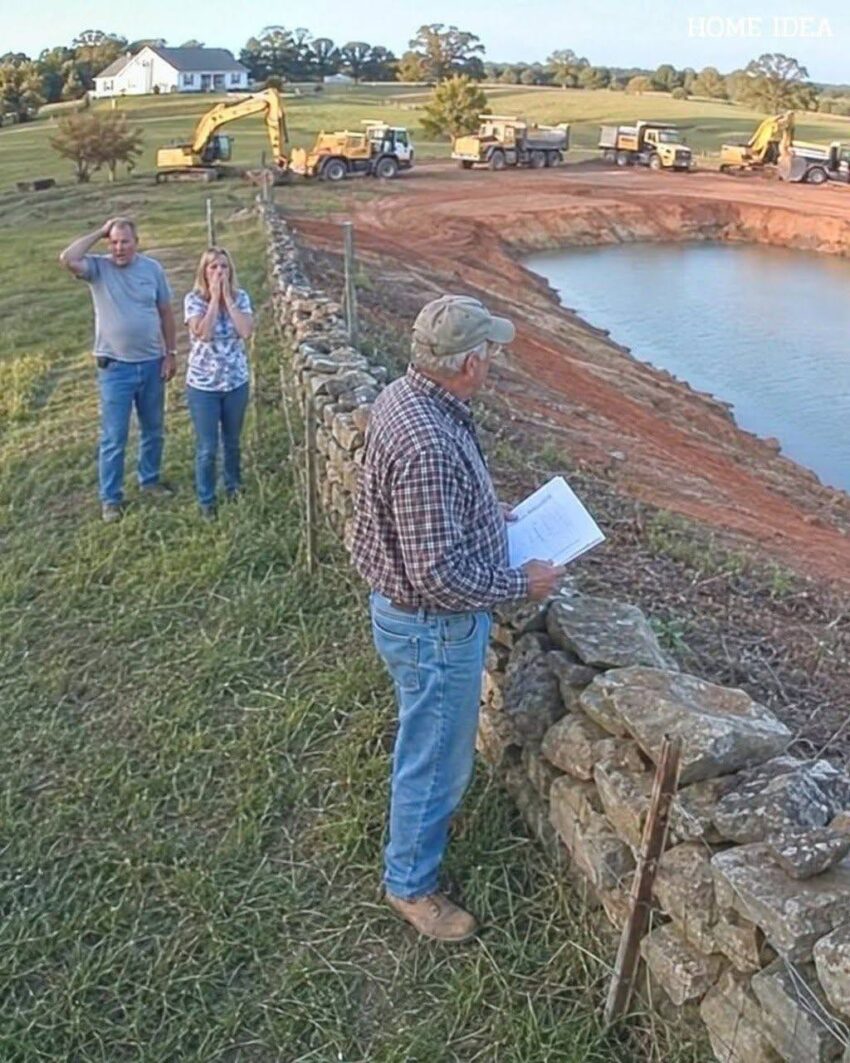
When I left town for three weeks, I expected to come home to an overgrown lawn, a stack of mail, and maybe a few weeds pushing through the gravel driveway.
I did not expect to come home to a lake.
Not a pond.
Not a drainage ditch.
A lake.
And not on my neighbor’s property.
On mine.
Two acres of mine, to be exact.
The first sign that something was wrong was the sound.
As soon as I turned onto the gravel road leading to my property, I could hear heavy machinery somewhere beyond the tree line.
At first, I assumed my neighbor, Rick, was finally doing the landscaping project he’d been talking about for years.
Then I saw the water.
I actually stopped the truck.
For a few seconds, I couldn’t process what I was looking at.
Where there had been a flat section of pasture when I left, there was now an enormous body of muddy water reflecting the afternoon sun.
There was a dirt berm running along one side.
Freshly disturbed earth.
Heavy equipment tracks.
A brand-new culvert.
And, unbelievably, a little dock.
A dock.
I got out of my truck and stared.
My first thought was that there had been some kind of flood.
Then I noticed the excavator parked near the far bank.
That’s when Rick came walking toward me.
He was smiling.
“Looks good, doesn’t it?” he said.
I honestly thought he was joking.
“What’s this?”
“The lake.”
“I can see that. Why is there a lake here?”
He looked confused by the question.
“Because we built one.”
“We?”
“Me and my wife.”
I looked at him.
Then at the lake.
Then back at him.
“On my property?”
His smile disappeared.
“No.”
I pulled my phone out.
“I have the survey.”
Rick sighed as if I were being difficult.
“Look, there’s been a misunderstanding.”
“A misunderstanding?”
“Our contractor checked everything.”
“Your contractor checked my property?”
“He checked the boundaries.”
“And?”
“He said this section belongs to us.”
That was the moment I stopped being confused and became angry.
I had owned that land for eleven years.
I had the deed.
I had a professional survey.
I had the county parcel map.
I had paid property taxes on it every year.
And now my neighbor was standing in front of me, calmly explaining that his contractor had apparently rewritten the county records with an excavator.
I told Rick I wanted the work stopped immediately.
He laughed.
Actually laughed.
“You’re not seriously going to make a big deal about this.”
I looked at the lake again.
“Rick, you excavated roughly two acres of my land.”
“It’s an improvement.”
“You dug a lake.”
“It’s going to increase both our property values.”
“Both?”
“Yes.”
I stared at him.
He apparently thought this was a reasonable argument.
Then his wife came outside.
She waved.
“Do you like it?”
I didn’t answer.
She walked closer.
“We’ve always wanted a lake.”
“That’s wonderful,” I said. “You should have built one on your land.”
She frowned.
“Technically, this area was part of our parcel.”
“Technically?”
I pulled up the survey on my phone.
“This line is the boundary.”
She looked at it.
Rick glanced over her shoulder.
Neither said anything.
Then Rick shrugged.
“That’s not what our contractor said.”
I remember that sentence very clearly.
Because over the next few months, it became extremely expensive.
For them.
I called my attorney the next morning.
He asked me to send everything I had.
The deed.
The survey.
The tax records.
Photographs from before I left.
Aerial images.
Property maps.
Anything showing the condition of the land before the excavation.
Luckily, I had plenty.
I also had something my neighbors didn’t know about.
Before leaving town, I’d hired a local company to photograph the pasture because I was considering putting up fencing.
The photographs were timestamped.
They showed exactly what the land looked like before the excavation.
Flat grass.
A few trees.
No lake.
No dock.
No berm.
Nothing.
My attorney looked at the documents and said something I’ll never forget.
“Don’t touch anything.”
“What do you mean?”
“Don’t drain it. Don’t fill it. Don’t move their equipment. Don’t confront them. Don’t do anything.”
“Why?”
“Because they’ve just created evidence.”
He was right.
The next step was a professional survey.
The surveyor walked the property with GPS equipment and boundary markers.
When he finished, he handed me the map.
The lake was unmistakably on my parcel.
Not partly.
Not on a disputed boundary.
Entirely.
Almost the entire lake was on my land.
The only thing on Rick’s property was the access path they’d created to reach it.
My attorney sent them a formal demand.
The response came three days later.
Rick’s attorney claimed the excavation had been performed “in good faith.”
They argued that the property line was “unclear.”
They demanded that I grant them continued access to the lake.
I nearly laughed.
They had dug a two-acre lake without permission and were now asking me to give them an easement so they could enjoy it.
I said no.
Then things got serious.
We discovered that the excavation wasn’t just a trespass.
They had removed thousands of cubic yards of soil.
They had altered drainage.
They had redirected runoff.
They had installed the culvert without my permission.
They had constructed the dock.
They had cleared trees.
And, according to the contractor’s invoices, they had spent a substantial amount of money doing it.
My attorney filed suit.
That’s when Rick stopped smiling.
The lawsuit sought damages for trespass, destruction of property, restoration costs, and other losses.
Rick’s attorney tried to argue that because my property had “benefited” from the lake, I hadn’t suffered damages.
My attorney had a simple response.
“Someone can’t demolish your garage and then charge you for the privilege because they think the new swimming pool is an improvement.”
The court wasn’t impressed with their argument either.
Then came the part that really changed the situation.
The county got involved.
Because once officials saw the scale of the excavation, there were questions about permits, drainage, environmental requirements, and whether the work had been properly authorized.
Rick suddenly had a much bigger problem than an angry neighbor.
He had a regulatory problem.
And the contractor had a problem too.
The contractor’s defense was that he had relied on information supplied by the property owners.
That phrase came up repeatedly.
The property owners.
Except Rick and his wife weren’t the property owners.
I was.
The contractor had apparently been given an outdated or incorrect boundary description.
But instead of stopping when the work approached the disputed line, they kept digging.
For weeks.
Eventually, the judge ordered a determination of what had to happen with the lake.
This was where things became complicated.
You might think the obvious solution would be to make them fill it back in.
But a two-acre excavation isn’t a swimming pool.
Filling it would require an enormous amount of material, heavy equipment, engineering work, and regulatory approval.
And because they had altered drainage patterns, simply dumping dirt into the hole could create another environmental and property problem.
So the parties brought in engineers.
The restoration estimate came back.
It was enormous.
Much larger than what Rick had originally spent building the lake.
And suddenly, the “improvement” he had bragged about wasn’t looking like such a bargain.
There were additional costs for correcting the drainage.
Additional costs for removing unauthorized structures.
Additional costs for repairing disturbed areas.
Legal fees.
Engineering fees.
Survey fees.
Potential regulatory penalties.
And damages for the use and alteration of my property.
Rick’s attorney eventually approached mine about settlement.
My attorney called me.
“They want to talk.”
“What do they want?”
“They want to buy the portion of the property containing the lake.”
I laughed.
“Absolutely not.”
“You sure?”
“Yes.”
He asked why.
I told him, “Because they didn’t want to buy it when it was pasture. They wanted it after they destroyed it.”
That became my position.
I wasn’t interested in rewarding them for trespassing.
Eventually, the negotiations became less about whether they could keep the lake and more about how much it would cost them to resolve the damage.
The final agreement required them to pay substantial damages and cover restoration-related expenses.
They also had to remove the unauthorized structures and correct the drainage alterations.
The lake itself remained subject to an engineered resolution approved by the appropriate authorities rather than simply being filled in overnight.
And yes, they paid.
A lot.
I won’t give the exact figure because the settlement was confidential.
But I will say this:
It was enough that Rick had to sell another piece of property he’d been planning to keep in the family.
The contractor also wasn’t thrilled.
As for me?
I eventually stood on the bank of that lake again.
Only this time, I wasn’t shocked.
I was strangely calm.
The water was still.
Birds had started using the shoreline.
The grass around the disturbed areas had begun growing back.
And I thought about something my grandfather used to say:
“Never confuse someone’s confidence with being right.”
Rick had been confident.
His wife had been confident.
Their contractor had apparently been confident.
But none of them had bothered to verify the one thing that mattered.
Who owned the land.
They had spent weeks digging a two-acre lake because someone had told them it was theirs.
They never knocked on my door.
They never called me.
They never checked my deed.
They never commissioned a survey.
They simply believed what they wanted to believe.
And when I came home, they expected me to accept it.
Instead, they learned a very expensive lesson.
A property line isn’t a suggestion.
A deed isn’t a rumor.
And a contractor saying something doesn’t magically transfer ownership.
The funniest part?
A year after everything was resolved, I received a letter from a realtor asking whether I would consider selling the property.
The realtor mentioned that the lake had “significant recreational potential.”
I smiled.
Then I filed the letter away.
Because I still owned the land.
And after everything they’d done, I had no intention of letting anyone else tell me what was mine.