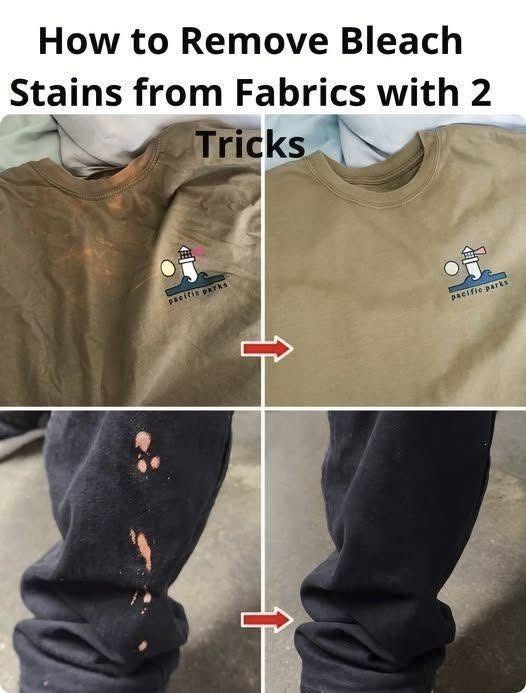
Learn two practical ways to deal with bleach marks on clothing and fabrics. Discover why bleach stains cannot truly be washed out and how to restore or disguise the damaged area.
Bleach stains are frustrating because, unlike ordinary food or dirt stains, bleach usually doesn’t leave a substance behind—it removes or changes the fabric’s original dye.
That means a bleach mark cannot usually be “washed out.” However, you may be able to make the damaged area much less noticeable or restore the color using the right technique.
Here are two useful tricks to try.
Trick 1: Use a Fabric Marker or Matching Fabric Dye
This is one of the easiest solutions for a small bleach mark.
What You Need
- A fabric marker in a matching color, or suitable fabric dye
- A clean cloth
- Mild detergent
- Cotton swab or small brush
How to Do It
- Wash and dry the fabric first.
Make sure there is no remaining bleach or other cleaning product. - Choose a closely matching color.
For a small spot, a fabric marker can be easier to control than liquid dye. - Test the color first.
Try the marker or dye on an inconspicuous area of the fabric. - Apply a small amount to the bleach mark.
Work gradually rather than covering the entire area at once. - Let it dry completely.
- Repeat if necessary.
Several thin applications usually look more natural than one heavy application.
This method works best for small marks on colored cotton or other suitable fabrics.
Trick 2: Turn the Bleach Mark Into a Design
If the damaged area is too large to disguise perfectly, consider making it intentional.
You can use fabric dye, fabric paint, patches, embroidery, or intentional bleaching to create a new design.
For example, a small bleach spot on a dark shirt can sometimes be incorporated into:
- A tie-dye pattern
- A distressed design
- Decorative lettering
- A geometric pattern
- A fabric patch
- Embroidery
A Simple Pattern Approach
If the bleach marks are scattered across the fabric, you can create additional intentional marks so the original stain becomes part of the overall design.
For safety, don’t add more bleach casually. If you choose to use bleach as part of a deliberate clothing design, follow the product instructions, protect your skin and eyes, ensure good ventilation, and never mix bleach with ammonia, acids, vinegar, or other cleaning products.
What About Baking Soda, Vinegar, or Lemon?
You may see advice claiming that baking soda, vinegar, lemon juice, or other household ingredients can “remove” bleach stains.
Unfortunately, these ingredients cannot restore dye that bleach has already removed.
In fact, mixing bleach with acids such as vinegar can produce dangerous chlorine gas. Never combine them.
Can Black Clothes Be Repaired?
Black garments can sometimes be among the easiest to disguise because fabric dye or a black fabric marker may closely match the original color.
However, the result depends on the fabric, the original dye, and how extensively the bleach damaged the material.
For valuable clothing, professional fabric dyeing may provide a better result.
Final Tip
The most important thing to remember is that a bleach mark isn’t an ordinary stain. The color has usually been removed from the fabric.
So instead of trying to wash it away, focus on recoloring, covering, or creatively incorporating the damaged area into the design.
And always rinse and wash bleach-damaged clothing thoroughly before applying another product.