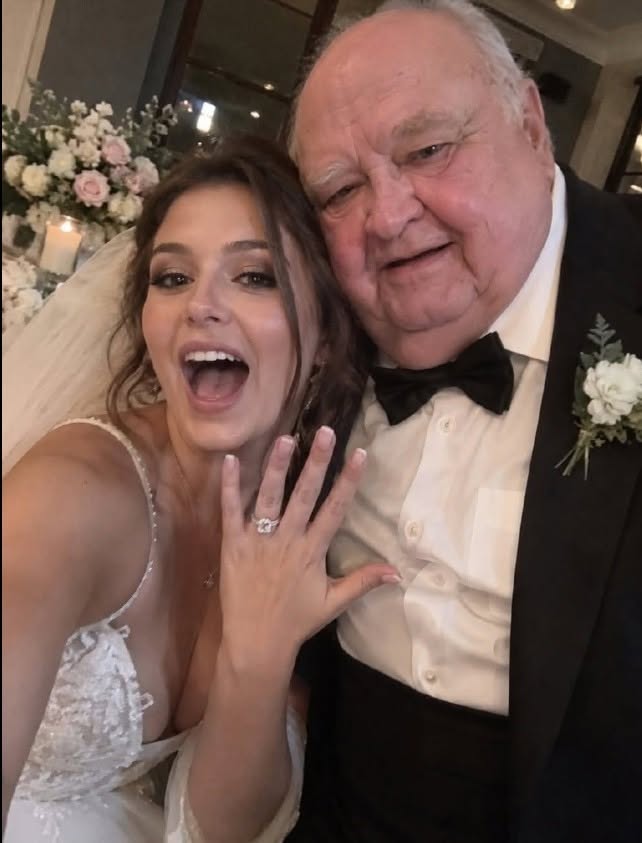
When I married a man forty-one years older than me, everyone assumed I was in love. Some people congratulated me with forced smiles, while others whispered behind my back. My friends thought I had lost my mind, and his family made no effort to hide their suspicions.
But I knew what I wanted.
He was wealthy, influential, and old enough to be my grandfather. He owned a magnificent mansion, several properties, and investments worth millions. I was young, ambitious, and tired of struggling to make ends meet.
Love, I told myself, was overrated. Security was what mattered.
His name was Richard Whitmore, and he was seventy-two when we met. Despite his age, he was sharp-minded, impeccably dressed, and accustomed to getting exactly what he wanted. He never promised me a fairy tale. Instead, he offered me a comfortable life, financial security, and a place beside him in a world I had only dreamed of entering.
Our marriage took place six months later.
At the wedding, Richard’s children barely looked at me. His eldest daughter, Catherine, was only three years younger than I was. She shook my hand without smiling and whispered, “I hope you understand what you’ve gotten yourself into.”
I smiled politely.
“I understand perfectly.”
For the next four years, I lived the life I had imagined. I wore designer clothes, traveled to beautiful destinations, attended exclusive parties, and never once worried about paying a bill.
Richard was not a cruel husband. In fact, he was surprisingly considerate. He remembered small details about my preferences, sent flowers on ordinary days, and listened when I spoke.
Yet something about him always made me uneasy.
He rarely discussed his finances, and he never allowed me to see his will. Whenever I asked about our future, he would give me a strange smile.
“Money reveals people’s character,” he once told me. “Sometimes, it takes a lifetime to discover who someone really is.”
I assumed he was talking about his children.
I was wrong.
Two months before his death, Richard became seriously ill. His doctors tried everything, but his condition deteriorated rapidly. I stayed beside him through the long nights, holding his hand and pretending I wasn’t frightened.
One evening, he asked me to sit beside his bed.
“Tell me something honestly,” he said.
“Anything.”
“If I lost every penny tomorrow, would you still stay with me?”
The question caught me off guard.
I could have lied. I could have told him that I loved him more than anything in the world.
Instead, I remained silent.
Richard studied my face for several seconds. Then he nodded, almost as though my silence had confirmed something he had suspected for years.
“I see,” he murmured.
He never asked me that question again.
Three weeks later, Richard died peacefully in his sleep.
At his funeral, the mansion filled with relatives, business associates, and people who had known him for decades. I wore a black dress and accepted their condolences while trying to understand how quickly my carefully arranged life had changed.
I was now a widow at thirty-one.
And, according to what I believed, I was about to inherit a fortune.
Richard’s lawyer contacted me four days after the funeral. He requested that I come to his office alone for the reading of the will.
When I arrived, Catherine and her brothers were already seated around the conference table. None of them greeted me.
The lawyer, Mr. Harrison, opened a thick folder and began reading the document.
Richard had left substantial assets to his children, charitable organizations, and several long-standing employees. I listened carefully, waiting for my name to appear beside the mansion, the investments, or the properties.
But it never did.
When the lawyer finished, I stared at him in disbelief.
“I’m his wife,” I said. “Surely there has been some mistake.”
Mr. Harrison folded his hands.
“There is no mistake, Mrs. Whitmore. Your husband made his decisions very carefully.”
Catherine let out a quiet laugh.
I turned toward her, but before I could speak, the lawyer reached beneath his desk and brought out a small wooden box.
It was old, dark, and secured with a brass clasp.
He placed it in front of me.
“Your husband left specific instructions that this box be delivered to you personally, after his funeral.”
I looked at the box, then back at him.
“What is inside?”
“I was instructed not to open it.”
He pushed it closer.
Then he looked directly into my eyes and said the words that made my stomach tighten.
“He made sure you received exactly what you deserved.”
My hands trembled as I opened the clasp.
Inside was a sealed envelope, a small key, and a photograph of Richard standing beside a young woman I had never seen before.
On the back of the photograph, someone had written a date from more than forty years earlier.
I opened the envelope.
The first sentence made my heart stop.
“My dear wife, if you are reading this, then I am gone—and you have finally discovered the truth about the man you married.”
I read the sentence again.
Then I continued.
And with every line, the comfortable world I had built around myself began to crumble.
Because Richard had known why I married him.
He had known from the very beginning.
But what he had discovered about me—and what he had secretly arranged before his death—was something I could never have imagined.
I looked at the key in the box.
There was one final instruction written at the bottom of the letter:
“Go to the house on Willow Lane. Open the bedroom door with this key. What you find there will tell you whether you ever truly knew me.”
I lifted my eyes toward the lawyer.
“Where is Willow Lane?”
For the first time since I had entered his office, Mr. Harrison looked uncomfortable.
“It’s an address your husband kept private for more than forty years,” he replied. “And Mrs. Whitmore, before you go there, you should understand one thing.”
“What?”
He hesitated.
“Your husband didn’t leave you without anything. He left you something far more personal than money.”
I closed my fingers around the key.
For the first time in four years, I wondered whether I had ever truly understood Richard Whitmore.
And I was about to discover that the greatest secret in his life had nothing to do with his fortune.