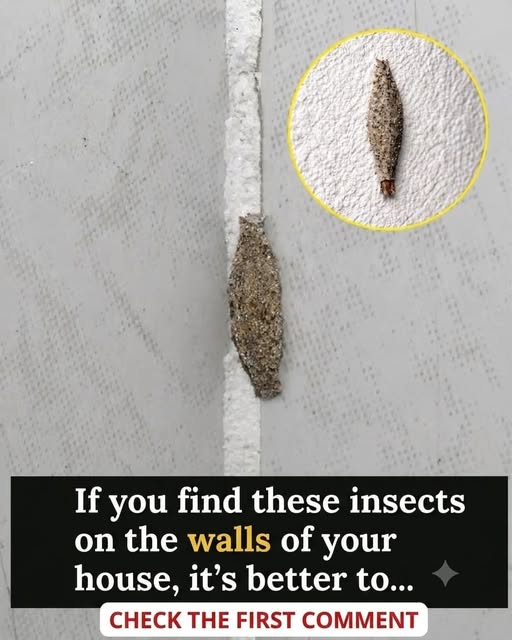
Found a strange, seed-like case attached to your wall? It may be a case-bearing moth larva, often called a plaster bagworm. Learn what it is, why it appears indoors, whether it is dangerous, and how to get rid of it.
At first glance, I thought it was simply a piece of dirt stuck to the wall.
It looked like a tiny piece of dried plant material or debris. But when I looked closer, I realized it was something completely different.
The strange, elongated object in the photo is consistent with a case-bearing moth larva, commonly called a plaster bagworm or household casebearer. These little creatures build portable cases around themselves using silk mixed with dust, fibers, hair, and other bits of material they find around the house.
And surprisingly, finding one doesn’t necessarily mean your home is dirty.
What Is That Strange Thing on the Wall?
The object isn’t simply an insect sitting on the wall.
It is essentially a protective case built by a tiny moth larva.
The larva lives inside the case and carries it around as it moves. When it stops on a wall or other surface, it can look remarkably similar to a tiny piece of lint, dirt, seed, or dried insect remains.
That’s why many people don’t notice them at first.
The case can be gray, brown, beige, or covered with tiny particles that help camouflage it against walls and other surfaces.
Why Are They Inside the House?
These larvae generally prefer humid, quiet areas where they can find suitable food and materials for their cases.
You may find them around:
- Bathroom walls
- Closets
- Bedrooms
- Under furniture
- Corners and ceilings
- Around windows
- Behind or underneath stored items
- Areas with accumulated dust or spider webs
Humidity is particularly important.
A house with poor ventilation or persistently damp areas can provide a more favorable environment for them.
Are They Dangerous?
The good news is that these little cases are not generally dangerous to people.
They don’t behave like mosquitoes or bedbugs, and finding one doesn’t mean you’re dealing with an insect infestation that threatens your health.
However, seeing several of them repeatedly may be a sign that the environment is providing conditions they like—especially humidity, dust, lint, hair, or spider webs.
So the insect itself may not be the biggest concern.
The conditions that are attracting it may deserve attention.
Why Do They Look Like Little Pieces of Dirt?
That’s actually part of their survival strategy.
The larva constructs its case from material available in its surroundings. Because the case can contain dust, fibers, and other debris, it blends into walls and household surfaces remarkably well.
This explains why someone might walk past one for days without realizing that the “piece of dirt” is actually a living creature.
What Should You Do If You Find One?
If you only find one or two, there’s usually no reason to panic.
Simply remove them and clean the surrounding area.
A vacuum cleaner can be useful for removing cases from walls, corners, ceilings, and other surfaces. Follow up by wiping away dust and accumulated debris.
Pay special attention to areas that don’t get cleaned regularly.
The Most Important Step: Reduce Humidity
If you keep finding these cases, don’t focus only on removing the visible insects.
Look at the environment.
Improve bathroom ventilation, repair leaks, allow damp areas to dry, and avoid leaving wet towels or clothing in poorly ventilated rooms.
A dehumidifier can also help in persistently humid areas.
Reducing moisture can make the environment less attractive to many household pests.
Don’t Immediately Reach for Strong Chemicals
If you’ve discovered a few of these cases, spraying the entire room with strong insecticide may be unnecessary.
Start with:
- Removing visible cases.
- Vacuuming corners and hidden areas.
- Cleaning dust and spider webs.
- Checking for excessive moisture.
- Improving ventilation.
- Keeping closets and storage areas clean and dry.
If the problem becomes extensive or keeps returning despite cleaning and moisture control, professional pest-control advice may be appropriate.
What If You Keep Finding Them?
One or two cases occasionally appearing on a wall isn’t necessarily a serious problem.
But if you repeatedly discover large numbers throughout the house, investigate possible sources of moisture and accumulated organic debris.
Look around bathrooms, closets, storage spaces, window areas, and behind furniture.
Also check for spider webs because these larvae can sometimes feed on materials associated with old webs and accumulated debris.
The Bottom Line
That strange object on the wall may look alarming when you first discover it, but a case-bearing moth larva is generally more unpleasant than dangerous.
The best response isn’t panic.
Remove it, clean the area, reduce humidity, and look for the conditions that allowed it to appear in the first place.
And next time you see what looks like a tiny piece of dirt attached to your wall, take a closer look before brushing it away—you might discover that it isn’t dirt at all.