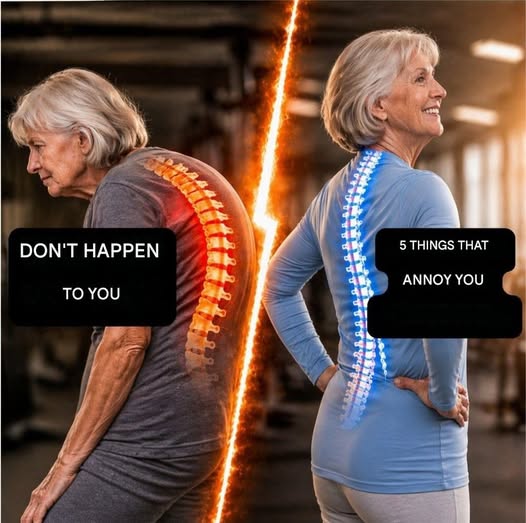
Poor posture, muscle weakness, bone loss, and inactivity can contribute to a rounded or hunched appearance with age. Learn which everyday habits may increase the risk and what you can do to protect your posture.
Getting older does not automatically mean you will become hunched over.
A rounded upper back can develop for several reasons, including age-related changes in the spine, osteoporosis, muscle weakness, arthritis, poor posture, and certain spinal conditions. Some of these factors can be modified, while others require medical evaluation.
That is why one simple habit should not be blamed for causing a hunched back.
1. Don’t Spend All Day Sitting
Long periods of sitting can encourage poor posture and reduce the amount of movement your back and core muscles receive.
Sitting itself doesn’t permanently “bend” your spine, but a sedentary lifestyle can contribute to muscle weakness and poor postural habits.
Try getting up regularly, walking around, and changing positions throughout the day.
2. Don’t Always Look Down at Your Phone
Hours spent looking downward can place your neck in a prolonged flexed position.
This doesn’t mean your phone will permanently curve your spine, but constantly holding your head and neck in one position can contribute to neck and upper-back discomfort.
Raise the screen closer to eye level and take frequent breaks.
3. Don’t Ignore Strength Training
Strong back, abdominal, hip, and leg muscles help support movement and posture.
As we age, muscle mass and strength can decline if we don’t remain physically active.
Activities such as resistance exercises, walking, balance exercises, and appropriately challenging strength training can help maintain physical function.
If you’re new to exercise or have medical conditions, start gradually and ask a healthcare professional what level of activity is appropriate.
4. Don’t Ignore Bone Health
One of the most important causes of a progressively rounded upper back in older adults is vertebral compression fractures, which can occur with osteoporosis.
Osteoporosis weakens bones, sometimes allowing the vertebrae to fracture with relatively little force.
These fractures can cause height loss, back pain, and increasing curvature of the spine.
That’s why bone health matters—not simply for posture, but for preventing potentially serious fractures.
5. Don’t Assume Back Pain Is “Just Aging”
Persistent back pain, noticeable height loss, or a new change in posture shouldn’t automatically be dismissed as normal aging.
A healthcare professional can assess whether osteoporosis, spinal degeneration, arthritis, a compression fracture, or another condition could be responsible.
Sudden severe back pain, particularly after a minor fall or movement in someone at risk for osteoporosis, deserves prompt medical attention.
6. Don’t Forget Balance and Flexibility
Maintaining flexibility and balance becomes increasingly important with age.
Gentle stretching, regular walking, balance exercises, and activities such as appropriately modified yoga or tai chi can help maintain mobility.
The goal isn’t to force the spine into a perfectly straight position. It’s to preserve strength, mobility, balance, and independence.
A Simple Daily Posture Check
Several times a day, pause and ask yourself:
- Are my shoulders relaxed?
- Is my head comfortably positioned rather than constantly pushed forward?
- Am I sitting or standing in the same position for too long?
- Have I moved around recently?
- Am I doing regular strengthening exercises?
Small habits repeated consistently can make a bigger difference than trying to “fix” your posture for five minutes once a week.
The Bottom Line
A hunched posture isn’t simply the result of getting older, and there isn’t one everyday activity that guarantees you’ll become hunched.
Protecting your posture means staying active, maintaining muscle strength, supporting bone health, avoiding prolonged inactivity, and taking persistent pain or changes in height and posture seriously.
The goal isn’t to stop aging—it’s to give your bones, muscles, and spine the best chance of staying strong and functional as you age.