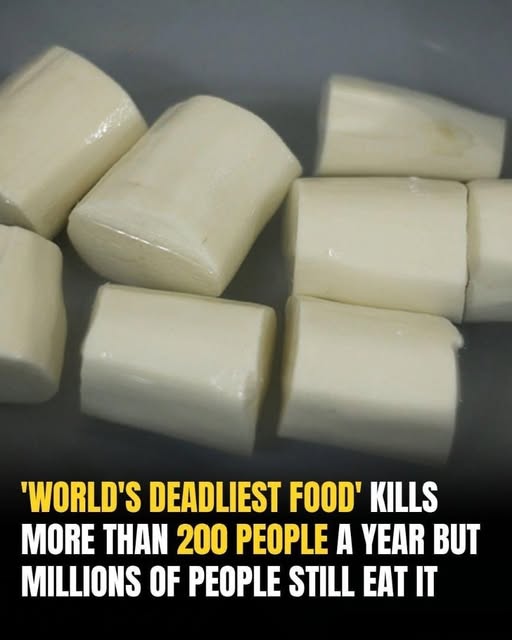
Cassava is a staple food for hundreds of millions of people, but raw or improperly processed cassava can release toxic cyanide. Learn why it can be dangerous and how proper processing makes it safer to eat.
At first glance, cassava looks like an ordinary root vegetable.
It is starchy, filling, inexpensive, drought-tolerant, and incredibly important to food security in tropical regions. Yet this humble root has a surprising danger: cassava naturally contains compounds that can release cyanide if it isn’t processed correctly.
That’s why sensational headlines sometimes call cassava the “world’s deadliest food.” The nickname is misleading, however. Cassava is not inherently deadly, and millions of people eat properly processed cassava safely. The real danger comes from consuming raw or inadequately processed varieties.
What Is Cassava?
Cassava, also known as manioc or yuca, is a starchy root that originated in South America and is now widely cultivated throughout tropical regions.
It is particularly important in parts of Africa, Asia, and Latin America. Historical research has described cassava as a staple for more than 500 million people, although modern estimates vary depending on whether the figure refers to people eating cassava, depending on it substantially for calories, or participating in its production.
The root can be processed into many familiar foods, including flour, starch, porridge, and other traditional dishes.
So why would such an important food be dangerous?
The Hidden Threat: Cyanogenic Compounds
Cassava contains naturally occurring cyanogenic glycosides, particularly a compound called linamarin.
When cassava tissue is damaged or processed inadequately, these compounds can break down and ultimately release hydrogen cyanide.
Cyanide interferes with the body’s ability to use oxygen at the cellular level. A sufficiently high exposure can therefore cause severe poisoning and can be fatal.
The concentration isn’t the same in every cassava plant.
Some varieties contain considerably more cyanogenic compounds than others, with so-called bitter cassava generally presenting a greater cyanide risk than lower-cyanide varieties.
Does That Mean You Should Never Eat Cassava?
No.
This is the most important point.
Cassava has been safely prepared and consumed for generations. Traditional processing methods are specifically designed to reduce the cyanogenic compounds.
Depending on the variety and the food being prepared, processing can involve steps such as:
- Peeling
- Grating
- Soaking
- Fermentation
- Drying
- Boiling
- Roasting
Research shows that appropriate processing can substantially reduce cyanide levels in cassava products.
The exact preparation method matters because different cassava varieties and products require different approaches.
Why Is Improperly Prepared Cassava So Dangerous?
The greatest concern arises when people consume cassava that has not been adequately processed.
This risk can become particularly serious during drought, famine, or food shortages. Under those circumstances, people may turn to more bitter, higher-cyanide varieties or shorten traditional processing steps because they urgently need food.
That can increase cyanide exposure.
Cassava cyanide exposure has been associated not only with acute poisoning but also with neurological disorders in communities where inadequately processed cassava is consumed regularly.
What Does Cyanide Poisoning Feel Like?
Acute cyanide exposure can cause symptoms such as:
- Headache
- Dizziness
- Nausea
- Vomiting
- Stomach pain
- Diarrhea
- Weakness
- Confusion
- Difficulty breathing
- Loss of consciousness
Severe poisoning can be fatal.
If someone becomes seriously ill after eating suspected improperly processed cassava, this should be treated as a medical emergency.
What Is Konzo?
One particularly concerning condition associated with high cyanide exposure from inadequately processed cassava is konzo.
Konzo is a neurological disorder characterized by sudden, irreversible weakness or paralysis, particularly affecting the legs. It has been documented primarily in vulnerable populations consuming high-cyanide cassava, especially when dietary protein and other nutrients are inadequate.
This is one reason cassava safety is an important public-health issue rather than simply an unusual food fact.
So Where Did the “200 Deaths” Figure Come From?
The frequently repeated claim that cassava poisoning causes around 200 deaths annually appears in recent viral articles and is attributed there to the World Health Organization.
However, it is worth being cautious with that number.
WHO’s broader foodborne-disease material confirms that cassava contains cyanogenic compounds and that cassava-related cyanide exposure can cause serious neurological disease, but the precise global annual death toll is difficult to establish because poisoning is not uniformly reported worldwide.
So “more than 200 deaths every year” should not be presented as a precise, universally established global statistic.
The underlying danger, however, is real.
Cassava Isn’t the Villain
Calling cassava the “world’s deadliest food” makes for a dramatic headline, but it misses the bigger story.
Cassava is also an important source of calories and carbohydrates and plays a major role in food security for millions of people. Modern research continues to emphasize that appropriate processing is essential for reducing cyanide exposure.
The lesson isn’t “never eat cassava.”
It’s:
Never eat raw or improperly processed cassava.
If you’re unfamiliar with preparing fresh cassava, don’t improvise. Follow an established preparation method appropriate for the particular variety and traditional food being made.
The Bottom Line
Cassava is a fascinating example of how a food can be both essential and potentially dangerous.
Its naturally occurring cyanogenic compounds mean that improper preparation can result in serious poisoning. But when cassava is appropriately processed, it can be—and has long been—a valuable staple food for millions of people.
So the next time you hear that the “world’s deadliest food” is eaten by half a billion people, remember the important part of the story:
The danger isn’t simply the cassava itself. It’s consuming cassava that hasn’t been properly prepared.