Found a tiny bug in your friend’s hair? Learn what this insect may be, how to recognize head lice, what nits look like, and what to do if an infestation is suspected.
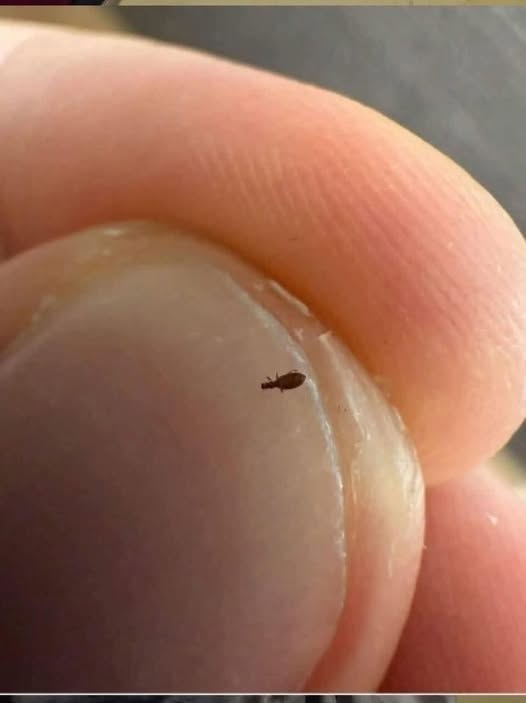
Finding a tiny insect in someone’s hair can be surprising, especially when it is small enough to fit on a fingernail. The insect shown in the photograph appears to be a small louse-like insect, and head lice are one possibility if it was found crawling through human hair.
However, a photograph alone cannot confirm the species, particularly when the insect is extremely small. Other tiny insects can occasionally become trapped in hair, so it is important to look for additional clues before assuming there is a head-lice infestation.
What Does the Insect in the Photo Look Like?
The insect appears very small, dark, and elongated, with several tiny legs visible along its body.
Its size relative to the fingernail gives an idea of how tiny it is. The photograph does have limitations, however, because details such as the exact body structure, claws, antennae, and segmentation aren’t sufficiently clear for a definitive identification.
If it came directly from the scalp or was repeatedly found crawling through the hair, head lice would be one of the possibilities worth checking for.
What Are Head Lice?
Head lice are tiny, wingless insects that live on the human scalp and feed on small amounts of blood.
They are adapted specifically to living among human hair. Adult head lice are generally only a few millimeters long, which makes them difficult to see without close inspection.
They don’t jump or fly. Instead, they crawl from one hair to another.
Head lice are most commonly spread through direct head-to-head contact. Sharing combs, brushes, hats, or other personal items can also contribute to transmission, although direct contact is the main route.
How Can You Tell If It Is Head Lice?
Finding one tiny insect isn’t enough to establish an infestation.
Look for several signs.
1. More Live Crawling Insects
Carefully inspect the hair under bright light.
Pay particular attention to:
- Behind the ears
- Around the neckline
- Near the temples
- Close to the scalp
Finding additional live crawling insects makes head lice more likely.
2. Nits Attached to Hair
Female lice lay eggs called nits.
Nits are tiny and oval-shaped and are attached firmly to individual hairs. They are usually found relatively close to the scalp.
This is different from dandruff, dry skin, or ordinary debris, which can generally be brushed or moved much more easily.
3. Scalp Itching
Itching is a common symptom of head lice, although not everyone develops noticeable itching immediately.
Repeated scratching can leave small irritated areas on the scalp or neck.
4. A Crawling Sensation
Some people describe feeling as though something is moving through their hair.
This sensation can occur with lice, but it is not enough by itself to diagnose an infestation.
Could It Be Something Other Than Lice?
Absolutely.
Small insects can accidentally become caught in hair after someone has been outdoors, around pets, plants, bedding, or other environments.
A flea, tiny beetle, plant insect, or another small arthropod can sometimes be mistaken for a louse.
This is why the circumstances in which the insect was found matter.
If it was simply discovered once and there are no additional insects, eggs, or symptoms, an infestation is not necessarily present.
What Should You Do If You Suspect Lice?
Start by carefully examining the hair and scalp.
A fine-toothed lice comb can help. Wet the hair and work through small sections from the scalp toward the ends, checking the comb after each pass.
If live lice are confirmed, use a lice treatment that is appropriate for the person’s age and follow the product instructions carefully.
Some treatments require a second application because they may not kill every newly hatched louse.
Household members who have had close head-to-head contact should also be checked.
Don’t Treat Everyone Just Because One Bug Was Found
It is tempting to immediately use lice medication on everyone in the household.
That isn’t necessarily appropriate.
First confirm that the insect is actually a louse. Unnecessary use of medicated lice products can irritate the scalp and does not solve the problem if the insect is something else.
If identification is uncertain, a pharmacist, doctor, school nurse, or other healthcare professional may be able to help.
Don’t Use Dangerous Home Remedies
Avoid putting gasoline, kerosene, pesticides intended for surfaces, insecticides, or other harsh chemicals on someone’s scalp.
These substances can cause serious skin irritation, poisoning, or other injuries.
Likewise, don’t use excessive amounts of essential oils or concentrated household chemicals as a substitute for an appropriate lice treatment.
Can Head Lice Cause Serious Illness?
Head lice are generally not considered a dangerous medical condition, but an infestation can be uncomfortable and highly contagious.
Persistent scratching can damage the skin and occasionally lead to secondary bacterial infection.
The bigger practical concern is preventing transmission and treating confirmed infestation correctly.
How Can Lice Be Prevented From Spreading?
If head lice are confirmed, avoid unnecessary head-to-head contact until treatment has been started according to appropriate guidance.
It is also sensible to avoid sharing:
- Combs
- Brushes
- Hair accessories
- Hats
- Headphones that contact the hair
- Towels
Items that have recently been in close contact with the affected person’s head should be handled according to current lice-control guidance.
There is generally no need to obsessively disinfect the entire home. Head lice survive best on the human scalp and do not live for long away from it.
When Should You Ask a Healthcare Professional?
Get professional advice if:
- You cannot determine what the insect is
- There are many insects in the hair
- The scalp has significant sores or inflammation
- There is pus, increasing redness, or pain
- Symptoms continue after appropriate treatment
- You are unsure which treatment is suitable for a child
- The insect appears attached to the skin rather than simply crawling through the hair
The Bottom Line
The tiny insect shown in the photograph looks louse-like, but the image isn’t clear enough to definitively identify it as a head louse.
If it was found in human hair, the best next step is to inspect the scalp and hair for additional live insects and firmly attached nits. Don’t assume that one tiny insect automatically means an infestation, and don’t apply harsh chemicals or unnecessary treatments.
A clear, close-up photograph showing the insect from above and from the side would provide much better information for identification.