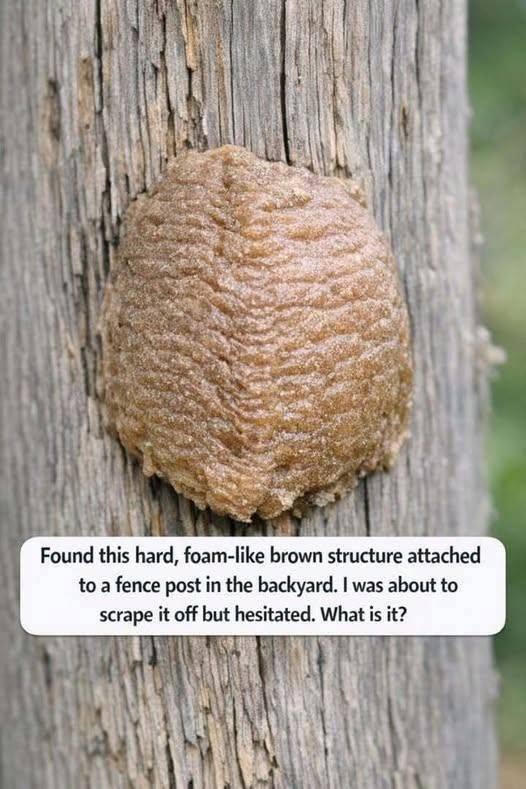
Found a strange brown, foam-like structure attached to a fence post? Learn what it could be, whether it contains insects or eggs, and how to safely identify and remove it.
Finding an unusual hard, brown, foam-like lump attached to a fence post can be alarming—especially if it looks like something out of a horror movie. Before scraping it away, it’s worth identifying it because several insects and fungi can create structures that look surprisingly similar.
1. It Could Be an Insect Egg Mass
One possibility is a moth or other insect egg mass. Some insects cover their eggs with a protective material that hardens as it dries. The resulting structure can look like brown foam, dried mud, or a rough patch of insulation.
These masses may remain attached to:
- Fence posts
- Tree trunks
- Wooden sheds
- Garden furniture
- Walls and other outdoor surfaces
If it is an egg mass, scraping it away could spread or damage the eggs, so identification is best done first.
2. It Could Be a Wasp or Hornet Nest
Some wasp nests become brown or gray and papery as they age. From a distance, an abandoned nest can look like a hard, foamy lump.
Look closely for a layered or paper-like texture. An active nest may also have insects entering and leaving through a small opening.
Don’t poke, shake, burn, or spray an unfamiliar nest, especially if you aren’t sure whether it’s active.
3. It May Be a Slime Mold or Fungal Growth
Wood exposed to moisture can develop unusual fungal or slime-mold structures. Some start out soft or foamy and later become dry, crusty, brown, or hardened.
This is more likely if the structure:
- Is directly growing from damp or decaying wood
- Has an irregular shape
- Doesn’t have an obvious entrance or layered paper texture
- Appears to be part of the fence rather than sitting on its surface
How to Tell What You Found
Before touching it, take a close photo from several angles. Look for:
Honeycomb or paper layers: possible wasp nest.
Foamy, bubbly or sponge-like texture: possible insect egg mass.
Very hard, woody texture: possible fungus.
Tiny holes or insect activity: could indicate an active nest or developing insects.
Should You Remove It?
If you’re unsure what it is, don’t scrape it off immediately. Keep children and pets away and observe it from a safe distance.
If you can upload a clear close-up photo, preferably showing the entire structure and its attachment to the fence, I can narrow down the identification considerably and explain whether it is harmless, whether it may contain eggs, and the safest way to remove it.