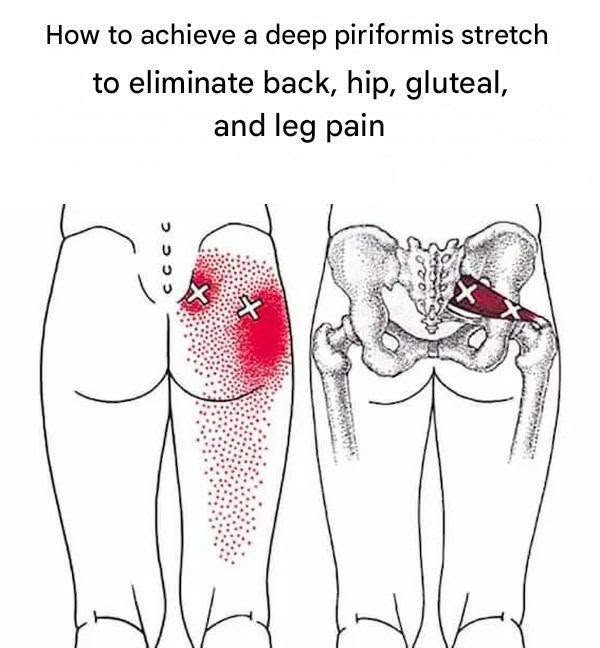
Discover effective piriformis stretches that may help relieve pain, improve hip flexibility, and reduce muscle tension associated with piriformis syndrome.
Piriformis syndrome can cause pain, tingling, or discomfort in the buttocks and sometimes along the back of the leg. Because the piriformis muscle is located deep within the buttock and sits close to the sciatic nerve, irritation or tightness in this muscle may contribute to symptoms that resemble sciatica.
Gentle stretching is often used as part of a broader approach to improving flexibility, reducing muscle tension, and supporting comfortable movement. The following piriformis stretches can be incorporated into a regular mobility routine when performed gently and without forcing painful movements.
What Is the Piriformis Muscle?
The piriformis is a small, pear-shaped muscle located deep in the buttock. It connects the lower spine to the upper portion of the thigh bone and helps with hip rotation and stabilization.
The sciatic nerve usually passes beneath the piriformis muscle, although its exact anatomical path can vary from person to person. When the area becomes irritated or overly tight, some people may experience symptoms such as buttock pain, discomfort with prolonged sitting, or pain that travels down the leg.
1. Seated Piriformis Stretch
The seated piriformis stretch is a simple option that can be performed at home or at work.
How to do it:
- Sit upright in a sturdy chair with both feet flat on the floor.
- Place your right ankle over your left knee.
- Keep your back relatively straight and gently lean forward from your hips.
- Stop when you feel a comfortable stretch in the right buttock.
- Hold for about 20–30 seconds.
- Return to the starting position and repeat on the opposite side.
Avoid bouncing or forcing your knee downward.
2. Lying Figure-Four Stretch
The lying figure-four stretch targets the muscles around the hip and buttock while allowing you to control the intensity easily.
How to do it:
- Lie on your back with both knees bent.
- Place your right ankle across your left thigh, just above the knee.
- Reach behind your left thigh and gently draw the leg toward your chest.
- Keep your head and shoulders relaxed.
- Hold the stretch for 20–30 seconds.
- Slowly release and switch sides.
You should feel a gentle stretch rather than sharp pain.
3. Supine Piriformis Stretch
This variation can provide a deeper stretch to the outer hip and buttock.
How to do it:
- Lie comfortably on your back.
- Bend both knees.
- Bring one knee toward your chest.
- Gently guide that knee toward the opposite shoulder.
- Hold for approximately 20–30 seconds.
- Return to the starting position and repeat on the other side.
Keep the movement slow and controlled.
4. Standing Figure-Four Stretch
A standing variation may be useful for people who prefer stretching without getting down on the floor. Because it requires balance, perform it near a wall or sturdy surface if necessary.
How to do it:
- Stand upright and hold a stable surface for support.
- Cross one ankle over the opposite thigh.
- Slowly bend the supporting knee and push your hips slightly backward.
- Keep your chest lifted as you lower into the stretch.
- Hold for 15–30 seconds.
- Carefully return to standing and switch sides.
Do not continue if the position causes significant pain or makes you feel unstable.
5. Child’s Pose With a Gentle Hip Variation
A modified child’s pose can provide a gentle stretch through the hips and buttocks.
How to do it:
- Begin on your hands and knees.
- Slowly move your hips backward toward your heels.
- Extend your arms comfortably in front of you.
- Keep your breathing slow and relaxed.
- Hold for 20–30 seconds.
- Return to the starting position.
If this position increases hip, knee, or back discomfort, choose another stretch.
How Often Should You Stretch the Piriformis?
For many people, gentle stretching can be incorporated into a daily mobility routine. Start with one or two comfortable stretches and gradually increase the duration as tolerated.
A useful approach is to:
- Hold each stretch for about 20–30 seconds.
- Repeat each stretch 2–3 times if comfortable.
- Breathe normally instead of holding your breath.
- Avoid bouncing or aggressive stretching.
- Stop if symptoms become sharper, stronger, or begin traveling farther down the leg.
Stretching should feel controlled and manageable. More intense stretching is not necessarily more effective.
Other Ways to Support Piriformis Health
Stretching is only one part of maintaining healthy hip movement. Depending on the underlying cause of symptoms, a healthcare professional or physical therapist may also recommend strengthening exercises, posture and movement adjustments, activity modification, or other forms of rehabilitation.
Regular movement can also be helpful for people who spend long periods sitting. Taking brief movement breaks, maintaining comfortable sitting positions, and gradually returning to activities can help support overall mobility.
When Should You See a Healthcare Professional?
Not all buttock or leg pain comes from the piriformis muscle. Similar symptoms can occur with problems involving the lower back, hip, or sciatic nerve.
Consider seeking professional evaluation if pain is severe, persistent, repeatedly returning, or interfering with normal activities. You should also seek prompt medical attention for symptoms such as significant weakness, loss of bladder or bowel control, numbness around the groin or saddle area, or rapidly worsening neurological symptoms.
A physical therapist can assess your movement, identify contributing factors, and develop an individualized exercise program when appropriate.
Final Thoughts
Piriformis stretches may be a useful component of a mobility and rehabilitation routine for people experiencing tightness or discomfort around the buttocks. Seated figure-four, lying figure-four, supine, and standing variations allow you to choose an option that fits your comfort level and mobility.
The key is to stretch gently and consistently rather than forcing the muscle into a painful position. If symptoms persist or you are unsure whether piriformis syndrome is responsible for your pain, professional assessment is the safest way to determine the appropriate treatment.
Important: This article is for general educational purposes and does not replace an examination or individualized medical advice from a qualified healthcare professional.