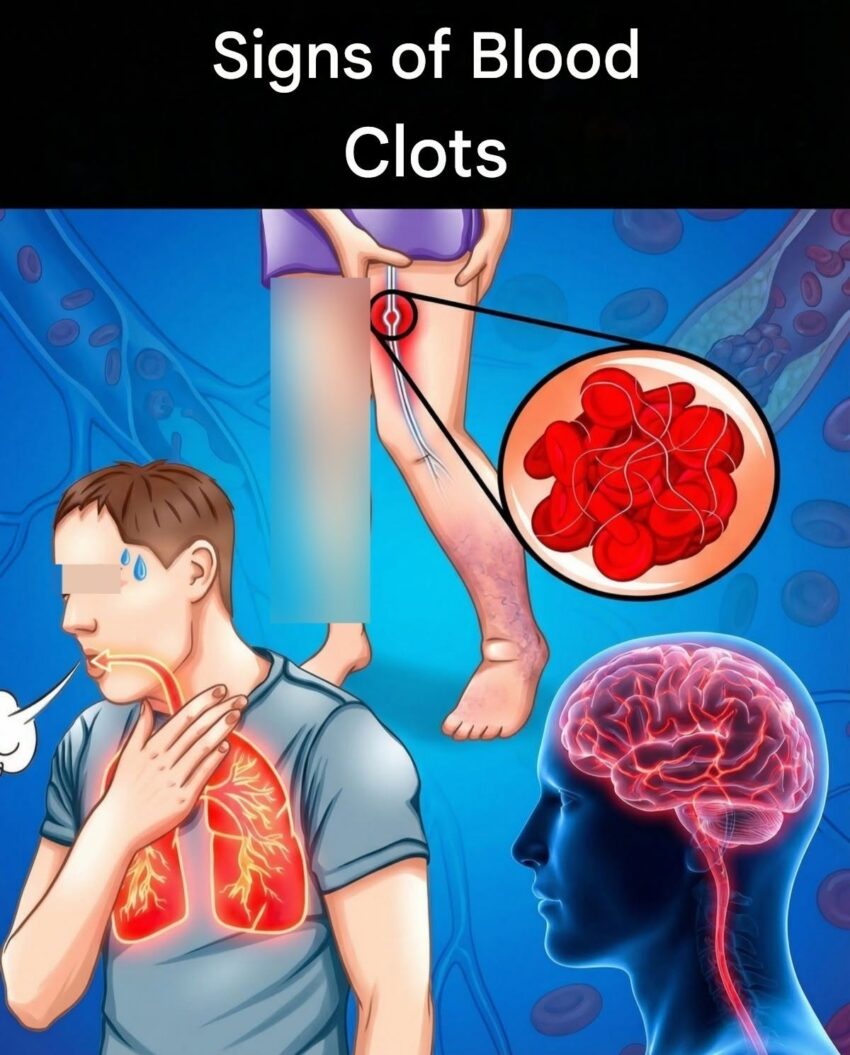
Learn the warning signs of blood clots, including symptoms of deep vein thrombosis and pulmonary embolism, and when sudden symptoms require emergency medical attention.
Warning Signs of Blood Clots You Should Never Ignore
A blood clot can form when blood changes from a liquid into a solid mass. Clotting is a normal process that helps stop bleeding after an injury, but a clot that develops inside a blood vessel can sometimes block normal blood flow and become dangerous.
Two important types to recognize are deep vein thrombosis (DVT), usually involving a deep vein in the leg, and pulmonary embolism (PE), which occurs when part of a clot travels to the lungs.
Warning Signs of a Blood Clot in the Leg
A DVT may cause symptoms in one leg, although not everyone experiences obvious symptoms.
1. Swelling in One Leg
One of the more common signs is swelling, particularly when it appears suddenly and affects one leg more than the other.
The swelling may involve the calf, ankle, or entire leg.
2. Pain or Tenderness
A blood clot can cause pain, tenderness, or cramping in the affected leg.
Some people describe it as a persistent ache or soreness that becomes more noticeable when standing or walking.
3. Warmth
The skin over the affected area may feel warmer than the surrounding skin.
This can occur alongside swelling and discomfort.
4. Skin Color Changes
The affected leg may appear red, reddish, bluish, or darker than usual.
However, skin color changes aren’t present in every case.
5. A Feeling of Heaviness or Tightness
Some people notice that the affected leg feels unusually heavy, tight, or uncomfortable.
These symptoms can be subtle and may resemble an ordinary muscle problem.
Warning Signs of a Blood Clot in the Lungs
A clot that travels to the lungs can cause a pulmonary embolism, which can be life-threatening.
Seek emergency medical attention if you suddenly experience:
6. Sudden Shortness of Breath
Difficulty breathing that appears suddenly—especially without an obvious explanation—can be an important warning sign.
7. Chest Pain
A pulmonary embolism can cause sharp chest pain that may become worse when taking a deep breath or coughing.
Chest pain should never be assumed to be “just a clot,” however, because heart attacks and other serious conditions can cause similar symptoms.
8. Rapid or Irregular Heartbeat
A suddenly racing or pounding heartbeat can occur when the body is responding to reduced blood flow or strain on the lungs.
9. Coughing, Sometimes With Blood
A pulmonary embolism may cause coughing. In some cases, the cough can produce blood.
Coughing up blood requires urgent medical evaluation.
10. Dizziness or Fainting
A significant pulmonary embolism can interfere with circulation and may cause severe lightheadedness, weakness, or loss of consciousness.
These symptoms require emergency care.
When Should You Get Emergency Help?
Don’t wait for symptoms to become severe if you have sudden:
- Difficulty breathing
- Chest pain
- Coughing up blood
- Fainting or severe dizziness
- Very rapid heartbeat
- Severe unexplained weakness
These symptoms can have several causes, but some are medical emergencies.
Who May Have a Higher Risk?
Blood-clot risk can increase in situations such as:
- Long periods of sitting or immobility
- Recent surgery or hospitalization
- Certain injuries
- Previous blood clots
- Some cancers
- Certain inherited clotting conditions
- Pregnancy and the period after giving birth
- Use of estrogen-containing medications
- Increasing age
- Certain chronic medical conditions
Having a risk factor does not mean that you have a blood clot, but it can make new symptoms more important to evaluate.
Don’t Try to Diagnose a Blood Clot at Home
Leg pain or swelling doesn’t automatically mean you have DVT. Muscle injuries, infections, inflammation, and other conditions can produce similar symptoms.
Likewise, shortness of breath and chest pain can have many causes.
Doctors may use your symptoms and medical history along with tests such as an ultrasound or blood tests to determine whether a clot is present.
The Bottom Line
Blood clots can sometimes develop with few obvious symptoms, but one-sided leg swelling, pain, warmth, and skin changes can be warning signs of DVT.
If a clot travels to the lungs, sudden shortness of breath, chest pain, coughing up blood, rapid heartbeat, severe dizziness, or fainting can signal a pulmonary embolism and require emergency medical attention.
Don’t ignore sudden or unexplained symptoms—especially when breathing or circulation is affected.