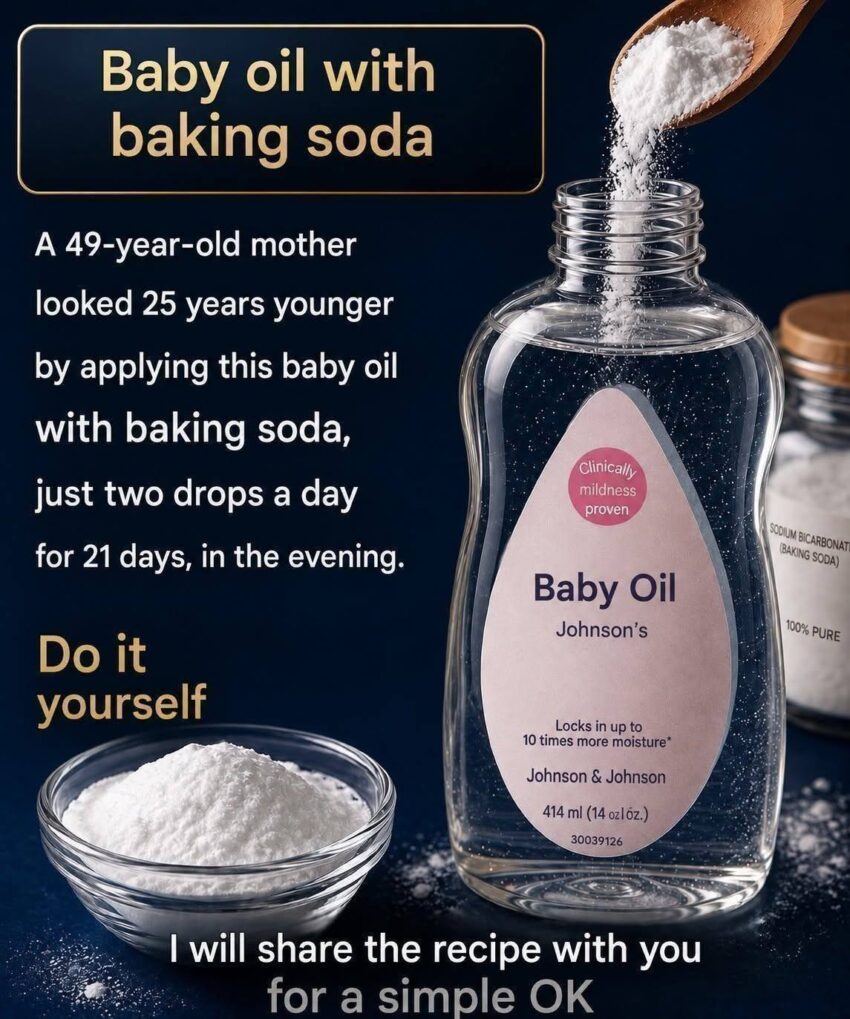
Beauty and skincare videos often promote simple mixtures made from household ingredients. One popular combination is baby oil and bicarbonate of soda (baking soda), sometimes claimed to exfoliate the skin, remove dark spots, soften rough areas, or create a brighter-looking complexion.
While both ingredients are inexpensive and widely available, mixing them does not automatically make a safe or effective skincare treatment.
What Does Baby Oil Do?
Most baby oils are mineral-oil-based products designed to help reduce moisture loss from the skin.
Mineral oil is an occlusive ingredient: it forms a barrier that can help keep water from evaporating from the skin’s surface. This is why baby oil can leave skin feeling smooth and moisturized.
However, baby oil isn’t necessarily a treatment for pigmentation, acne scars, wrinkles, or other underlying skin conditions.
What Is Bicarbonate of Soda?
Bicarbonate of soda—also called sodium bicarbonate or baking soda—is mildly alkaline.
It is sometimes used in DIY skincare recipes because its fine particles can provide physical exfoliation.
The problem is that facial skin has a naturally acidic surface environment. Applying alkaline substances can disrupt the skin barrier, particularly when they are used repeatedly or left on the skin for extended periods.
This can result in:
- Dryness
- Stinging
- Redness
- Irritation
- Increased sensitivity
- Barrier damage
And irritating the skin can sometimes make pigmentation concerns appear worse rather than better.
Does Baby Oil + Baking Soda Remove Dark Spots?
There isn’t good evidence that this mixture reliably removes hyperpigmentation or dark spots.
If a dark mark is caused by acne, sun exposure, inflammation, or another skin condition, physically scrubbing the area doesn’t necessarily address the underlying cause.
In fact, aggressive exfoliation can irritate the skin and potentially contribute to post-inflammatory hyperpigmentation, particularly in people whose skin is prone to developing dark marks after irritation.
Is It a Good Facial Scrub?
I’d be cautious.
A homemade baking-soda scrub can be abrasive, and combining it with an oil doesn’t eliminate the potential for irritation.
If your goal is smoother skin, a properly formulated exfoliating product is generally preferable because its ingredients, concentration, texture, and pH can be controlled.
What About Using the Mixture on the Body?
Body skin can sometimes tolerate products that facial skin doesn’t, but that doesn’t mean baking soda is automatically appropriate.
If someone nevertheless considers using a DIY mixture, it should not be applied to broken, irritated, sunburned, or freshly shaved skin, and it should be stopped immediately if burning, swelling, or significant irritation occurs.
A patch test can reduce—but cannot eliminate—the possibility of a reaction.
A Safer Approach to Dry Skin
If the goal is simply softer, less dry skin, you don’t need baking soda.
A fragrance-free moisturizer or an appropriate emollient can help support the skin barrier. Petroleum jelly or mineral-oil-based products can also be useful for reducing moisture loss.
For persistent dryness, itching, rashes, or unexplained changes in the skin, it’s better to determine the cause rather than repeatedly exfoliating it.
The Bottom Line
Baby oil can help reduce moisture loss, but adding baking soda doesn’t turn it into a proven treatment for dark spots, aging, or other skin problems.
Because baking soda can be irritating and alkaline, using it repeatedly on the skin—especially the face—may do more harm than good.
When a viral beauty recipe promises dramatic results from two inexpensive household ingredients, remember: simple doesn’t always mean safe, and viral doesn’t mean scientifically proven.