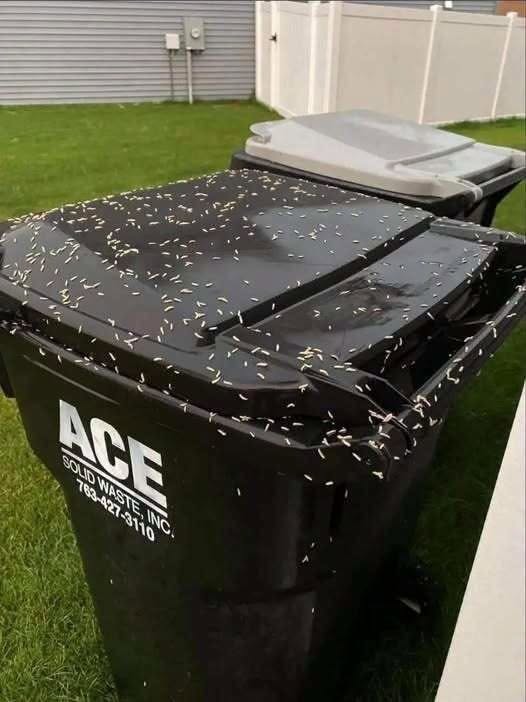
Found tiny rice-like creatures moving inside your garbage can? They may be fly larvae, commonly known as maggots. Learn where they come from, why they appear, and how to get rid of them safely.
You take out the trash, glance inside the garbage can—and suddenly notice what looks like a handful of tiny grains of rice.
Then one of them moves.
And another.
Within seconds, what looked like ordinary food debris becomes something much more disturbing.
If you’ve ever experienced this, you’re definitely not alone.
Those tiny, wriggling creatures are very likely maggots, the larval stage of flies. They commonly appear when flies have access to moist garbage, leftover food or other decomposing organic material.
Why Do They Look Like Rice?
Fly eggs can be extremely small and may resemble tiny grains of rice. Once they hatch, the larvae become cream-colored, soft-bodied and worm-like.
House-fly larvae commonly develop in garbage, rotting food and other moist organic material.
So if you initially thought you were looking at scattered rice, the movement is the big clue that you’re dealing with something biological rather than food.
How Did They Get There?
The explanation is unpleasant but surprisingly simple.
A fly found something attractive inside or around your garbage can—possibly food scraps, meat, pet food or another source of decaying organic material.
The fly then laid eggs on or near the waste.
Those eggs can hatch remarkably quickly under favorable conditions. Some local-government guidance notes that fly eggs may hatch into maggots within about 24 hours.
That’s why it can sometimes feel as though the maggots appeared overnight.
Why Are There So Many?
Once flies find a suitable food source, multiple flies may use the same area.
Warm conditions can also speed up their development.
Garbage cans are particularly attractive because food waste provides both moisture and nutrients. Research and extension guidance identifies garbage and rotting organic material as important breeding sites for household flies.
This is also why maggot problems tend to become more noticeable during warmer weather.
Are Maggots Dangerous?
Finding maggots in a garbage can is certainly disgusting, but their presence does not automatically mean that your home is infested or that you are in immediate danger.
The bigger concern is the contaminated waste and the flies associated with it. Household flies can carry microorganisms from garbage and other dirty environments onto surfaces and food.
So the best response is good sanitation rather than panic.
Keep the garbage contained, remove the source and clean the bin afterward.
What Should You Do First?
If you discover maggots, avoid touching them with bare hands.
Wear gloves, secure the garbage bag and remove the waste according to your local disposal rules.
After the garbage has been removed, thoroughly clean the inside of the container with water and an appropriate household cleaner or disinfectant.
Then allow the bin to dry completely.
Keeping the container clean and dry helps make it less attractive to flies.
Don’t Forget the Source
Simply killing the visible larvae may not solve the underlying problem.
Check the garbage for anything that could have attracted flies.
Look for:
- Meat or fish scraps
- Leftover food
- Fruit or vegetables that have started to rot
- Pet food
- Leaking garbage bags
- Food residue at the bottom of the bin
Even a small amount of decomposing food can provide an attractive breeding site.
How to Prevent It From Happening Again
Prevention is much easier than dealing with another surprise infestation.
Keep your garbage bags tightly closed and avoid allowing food waste to sit exposed.
Make sure the garbage-can lid closes properly so flies have less opportunity to reach the waste.
If possible, keep the container away from direct sunlight because heat can accelerate decomposition and make garbage more attractive to flies.
Some waste-management guidance also recommends securely bagging food waste and keeping bins closed.
What About the Tiny Things Crawling Outside the Bin?
Don’t be surprised if you see some larvae outside the garbage can.
Mature larvae may leave their food source and crawl toward a drier, more protected location before entering the pupal stage. This behavior is documented in blow flies and other garbage-associated flies.
That means seeing a few larvae on the ground doesn’t necessarily mean they originated there.
They may have come from the garbage can.
When Should You Investigate Further?
If you clean the garbage can thoroughly but continue finding maggots around your home without an obvious source, investigate further.
Persistent maggots can sometimes indicate another source of decaying organic material, such as forgotten food, animal waste or—in unusual cases—a dead animal in an inaccessible location.
If there is a persistent foul odor or a continuing infestation that you cannot locate, professional pest control may be appropriate.
The Bottom Line
So, those mysterious “rice grains” moving around your garbage can are probably not rice at all.
If they’re small, pale and wriggling, they are most likely fly larvae—commonly called maggots.
The good news is that the cause is usually straightforward: flies found accessible organic waste, laid eggs, and the eggs developed into larvae.
Remove the waste, clean and dry the bin, keep food waste securely contained, and make it difficult for flies to access your garbage.
And next time you see something that looks suspiciously like scattered rice in the trash…
Don’t assume it’s rice until it stops moving.