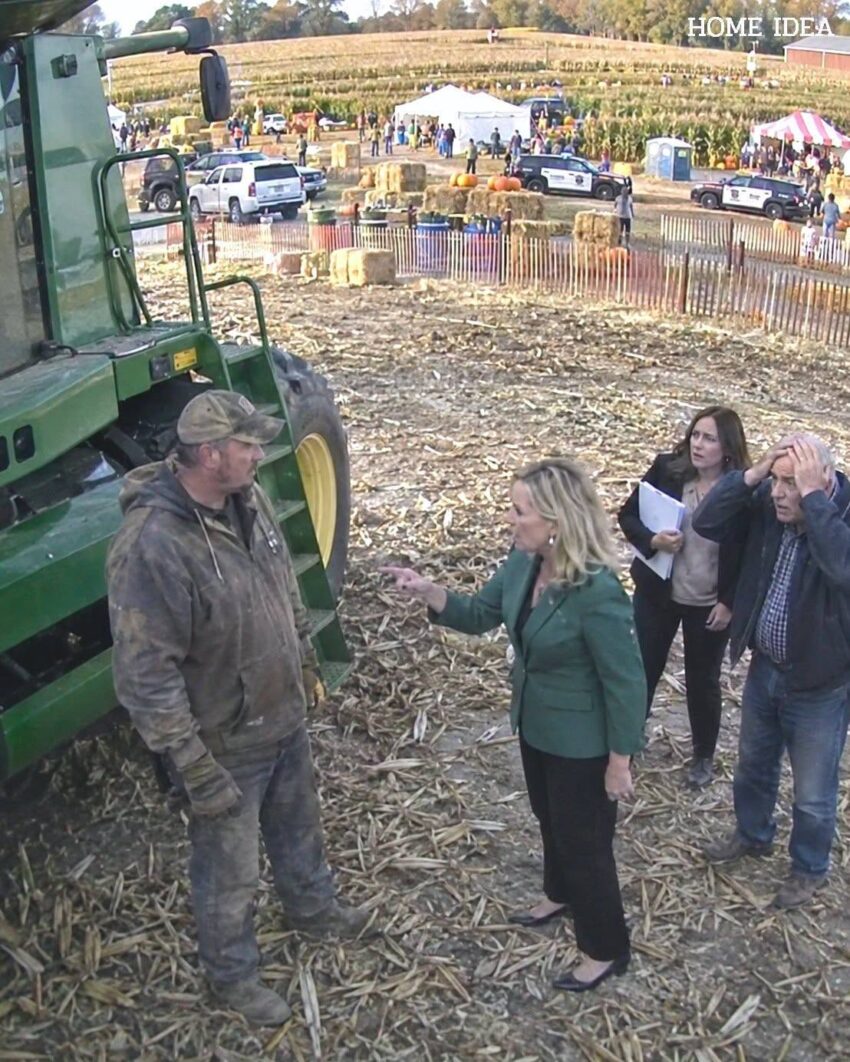
When a homeowners association sold 1,800 tickets to a corn maze on a farmer’s private property without permission, he decided to harvest every stalk before opening day. What happened next became the neighborhood’s most unforgettable lesson in property rights.
The first time I heard that my farm was going to host a public event, I was standing in my kitchen with a cup of coffee in my hand.
I wasn’t informed by the homeowners association. Nobody had asked for my permission. I hadn’t signed a contract, agreed to rent out my land, or even discussed the possibility of opening my fields to the public.
I learned about it from a bright orange flyer someone had slipped beneath my mailbox.
“GRAND OPENING! THE NEIGHBORHOOD’S BIGGEST CORN MAZE!”
Below the headline was a photograph of a cornfield that looked suspiciously familiar.
My cornfield.
The flyer advertised family activities, food trucks, children’s games, a pumpkin patch, and an elaborate maze designed for visitors of all ages. Tickets were available online, with advance reservations strongly encouraged.
At the bottom, in smaller letters, was the name of the homeowners association that had been making my life difficult for nearly two years.
I read the flyer twice.
Then I checked the address listed beneath the event details.
It was my address.
I went straight to my computer, opened the ticket website, and felt my stomach tighten.
They had already sold 1,800 tickets.
My land was being advertised as a family attraction, and the HOA had apparently decided that my permission was an unnecessary detail.
They had made one serious mistake, though.
They had forgotten that I owned the corn.
The Farm They Thought They Could Use
My name is Daniel Mercer, and my family has farmed the same stretch of land for three generations.
The property sits just outside a growing residential development. When my grandfather bought it, the nearest house was nearly a mile away. Over the years, developers built roads, shopping centers, and rows of identical houses along the edges of our fields.
I didn’t object to people moving into the area. Neighborhoods grow, and farms have always existed alongside changing communities.
What bothered me was the homeowners association’s growing belief that the farm was somehow part of its development.
The HOA had complained about my equipment, the noise of my tractor, and the occasional dust that drifted toward the road during harvest season. One board member even suggested that I should adjust my working hours to avoid disturbing residents who preferred quiet mornings.
I tried to remain reasonable.
I kept the property maintained, followed applicable regulations, and responded politely whenever someone raised a legitimate concern.
But the association’s president, a woman named Patricia Langford, seemed determined to turn every minor inconvenience into a formal dispute.
Patricia had a particular talent for speaking as if every decision she made carried the force of law.
She once told me that the neighborhood’s property values depended on maintaining a consistent appearance throughout the surrounding area.
I reminded her that my farm was not part of the neighborhood.
She smiled tightly and replied, “We all have to learn to coexist, Daniel.”
I had no problem with coexistence.
What I objected to was being treated like an employee of an organization I had never joined.
Then came the corn maze.
The HOA’s Grand Plan
According to the promotional website, the association had spent months organizing what it called the Harvest Festival Experience.
The event was supposed to raise money for neighborhood improvements and become an annual tradition. The proposed attractions included a giant corn maze, a hayride route, a children’s activity zone, and a row of food vendors.
The website even included a map showing where visitors would park.
The parking area was my equipment yard.
The entrance was the gate I used to move machinery between fields.
And the corn maze itself occupied the largest of my three cornfields.
They had apparently planned the entire event around land they didn’t own.
I immediately contacted the HOA office and asked for an explanation.
The receptionist transferred me to Patricia.
“Oh, Daniel,” she said when she answered, sounding almost amused. “I’m glad you called. We were meaning to speak with you.”
“Your association is selling tickets to an event on my property,” I replied. “Who gave you permission?”
There was a pause.
“We assumed you’d be supportive of a community event.”
“That wasn’t my question.”
Patricia sighed.
“The field is adjacent to our development, and the event will benefit the neighborhood. We thought it would be a wonderful opportunity for everyone.”
“You thought I wouldn’t mind?”
“We thought we could work something out.”
I looked through the kitchen window toward the cornfield. The stalks were tall and healthy, their green leaves moving in the autumn breeze.
“Then you should have spoken to me before selling tickets.”
“We’re already committed,” she said. “There are families who have purchased tickets. We can’t simply cancel everything now.”
“That’s a problem for the people who sold them.”
Her voice hardened.
“Daniel, don’t make this more difficult than it needs to be. The HOA has considerable support in this community.”
I nearly laughed.
“That’s nice, Patricia. But the field belongs to me.”
She ended the call without saying goodbye.
The Letter That Changed Everything
The next morning, I received an email from the HOA’s attorney.
It was written in the kind of formal language that makes ordinary people wonder whether they are about to be sued.
The letter claimed that the association had invested substantial time and money into preparing the festival. It suggested that canceling the event could cause financial losses and disappointment among residents.
It also requested that I refrain from taking any action that might interfere with the planned opening.
I read the letter carefully.
Not once did it identify a lease, written agreement, easement, or other document giving the HOA the right to use my land.
There was a reason for that.
No such document existed.
I called my own attorney, explained the situation, and sent him the letter along with screenshots of the ticket website.
His advice was straightforward: preserve the evidence, confirm the property boundaries, communicate in writing, and do not allow the association’s assumptions to become a substitute for actual permission.
He also warned me against doing anything that might create unnecessary legal trouble.
I thanked him and spent the afternoon documenting everything.
I saved the advertisements, downloaded the event map, took photographs of the field, and kept copies of every message.
Then I walked the property line.
The field was mine. The access gate was mine. The corn had been planted, fertilized, irrigated, and maintained at my expense.
The HOA had not purchased a single seed.
Yet it was acting as if my harvest belonged to the neighborhood.
That evening, I sat at the kitchen table and studied the calendar.
The grand opening was scheduled for Saturday.
It was Wednesday.
I had three days to decide what to do.
The Decision
My first instinct was to put a chain across the gate and post a large sign.
PRIVATE PROPERTY. NO PUBLIC ACCESS.
That would have made my position clear, but I knew Patricia would probably send another letter accusing me of ruining the festival.
I could have spent weeks arguing with the association while hundreds of disappointed visitors showed up at my gate.
Instead, I considered the simplest fact in the entire dispute.
The corn was my crop.
I had planted it for agricultural purposes, and the time had come to harvest it.
I wasn’t required to preserve a standing crop for an event I had never agreed to host.
I called my farm manager, Luis, and asked him to meet me at sunrise.
When I explained the situation, he stared at me for several seconds.
“You’re going to harvest the whole field?”
“That’s what we were planning to do eventually.”
“Before their festival?”
I nodded.
Luis scratched his chin.
“Well, the corn is ready.”
That was all the encouragement I needed.
We checked the crop conditions, reviewed the harvest schedule, and arranged for the necessary equipment and transport. We also confirmed that the work could be completed safely and within the normal agricultural operation.
I wasn’t going to damage anyone’s property, block a public road, or interfere with an event on land the HOA actually owned.
I was going to harvest my own crop.
And I was going to do it before the weekend.
Thursday Morning: The Harvest Begins
At 6:15 a.m., the first machine entered the field.
The morning air was cold enough to make my breath visible. Dew clung to the leaves, and the sky had barely begun to brighten over the distant rooftops.
The harvester moved steadily through the rows.
Stalks disappeared into the machine, ears of corn were collected, and the field behind us gradually opened into neat stretches of cut ground.
From the road, it probably looked like an ordinary harvest.
For me, it felt like watching a ridiculous problem become much simpler.
By midmorning, my phone was buzzing constantly.
The HOA had discovered what was happening.
Patricia called first.
“What are you doing?” she demanded.
“Harvesting my corn.”
“You can’t do this!”
“I can harvest my crop, Patricia.”
“But the maze!”
“There is no maze. There is a cornfield that I own.”
She was silent for a moment.
Then she lowered her voice.
“Daniel, 1,800 people have purchased tickets.”
“I understand that.”
“Families have arranged their weekends around this event. Some people are traveling from out of town. We’ve paid for advertising, vendors, equipment, and staff.”
“Then you should have secured permission before selling tickets.”
“You are deliberately sabotaging us!”
“No,” I replied. “I’m carrying out my farming schedule.”
She threatened to have her attorney contact mine again.
I told her that would be fine and ended the call.
Luis, who had overheard the conversation, shook his head.
“She really thought you were going to stop harvesting because she asked?”
“Apparently.”
He laughed, then returned to work.
By sunset, a substantial portion of the field had been harvested. Trucks carried the crop to storage, and our crew prepared to continue the following morning.
I went home tired, dusty, and more relieved than I had expected.
For the first time in months, I felt as if I had stopped reacting to the HOA’s demands and started making decisions for my own farm again.
Friday: The Neighborhood Finds Out
The following morning, the story had spread throughout the development.
Residents were sharing photographs of the harvested field in the neighborhood’s online group.
Some were furious.
Others were confused.
A few seemed to believe the entire situation was a misunderstanding.
One post read:
“Does anyone know why the corn maze is being removed the day before opening?”
Another resident replied:
“Because the farmer apparently never agreed to let the HOA use his land.”
That comment received dozens of responses.
Patricia posted a statement insisting that the association had organized the festival in good faith and was attempting to resolve the dispute.
She did not explain why tickets had been sold before permission was obtained.
She did not produce a lease.
She did not identify any agreement granting the HOA access to my field.
Instead, the statement emphasized how much money had already been invested and how disappointed families would be.
I felt sorry for the ticket holders. Many had probably purchased tickets believing the event was legitimate and properly organized.
But sympathy for the customers did not make me responsible for the association’s decisions.
I posted a short response through my attorney, who approved the wording.
It stated that the property was privately owned, that I had not authorized the event, and that visitors should not attempt to enter the farm. It also advised ticket holders to contact the HOA regarding refunds.
I avoided insults and personal attacks.
I wanted the facts to speak for themselves.
Meanwhile, our harvest continued.
By Friday afternoon, the corn maze existed only in photographs, advertisements, and the imaginations of the people who had planned to walk through it.
The field was open and quiet.
The grand opening was less than twenty-four hours away.
Saturday Morning: 1,800 Tickets and an Empty Field
I woke before sunrise on Saturday.
I expected a difficult morning, so I made coffee, checked the weather, and reviewed the messages my attorney had sent.
The final loads of corn had been moved from the field, and the agricultural work was complete.
I had no intention of confronting anyone. My plan was to stay on my property, keep the entrance clearly marked, and let the HOA deal with the event it had advertised.
At 8:10 a.m., the first cars began arriving.
Families pulled up expecting a festive entrance, colorful banners, and a maze stretching across the field.
Instead, they found a harvested field and a sign explaining that the advertised attraction was not authorized by the landowner.
Parents got out of their cars and stared across the rows of cut stalks.
Children asked where the maze had gone.
A couple approached the gate and asked whether they were at the right address.
I explained politely that they were, but that I had never given the HOA permission to hold an event on my land.
One father looked at the ticket confirmation on his phone.
“We drove almost two hours,” he said. “My kids have been talking about this all week.”
I understood his frustration.
“I’m sorry you were given the wrong impression,” I told him. “You’ll need to contact the organization that sold the tickets.”
He looked back toward the field.
“Did they really not ask you?”
“No.”
He shook his head, gathered his children, and returned to his car.
I felt no satisfaction in watching families leave disappointed.
The people who had purchased tickets were not my enemies. They had trusted the event organizers to arrange a legitimate attraction.
The responsibility belonged to those who had advertised the event without securing the necessary permission.
By 9:00 a.m., more vehicles were arriving.
Someone had parked near the entrance with a large sign advertising the festival. A volunteer in a bright orange vest walked toward my gate carrying a clipboard.
“Sir, we’re supposed to start admitting people,” he said.
“I understand, but this is private property. The event isn’t authorized.”
He looked toward the field, then down at his clipboard.
“They told us everything was arranged.”
“I’m sorry they told you that.”
He stood quietly for a moment before turning around.
Behind him, the line of cars continued to grow.
The grand opening had become a very public reminder that advertising an event did not grant anyone the right to use another person’s land.
Patricia Arrives
At approximately 9:30 a.m., Patricia arrived in a silver SUV.
She stepped out wearing a cream-colored jacket and sunglasses, carrying the expression of someone who had spent the morning preparing for a confrontation.
She marched toward the gate.
“Daniel, we need to talk immediately.”
“We’ve already discussed this.”
“You have humiliated this association in front of the entire community.”
“I didn’t sell the tickets.”
She glanced toward the gathering families.
“Look at these people! Do you have any idea what you’ve done to them?”
“I know they’re disappointed. That’s why I told them to contact the organization that sold the tickets.”
“You could have waited until Sunday!”
I stared at her.
“You could have asked me before announcing the event.”
She opened her mouth, but I continued.
“You had months to contact me. You had time to design advertisements, build a website, arrange vendors, hire staff, and sell 1,800 tickets. You had time to send your attorney a letter. Yet nobody found the time to ask whether you could use my field.”
Her face reddened.
“We assumed you would cooperate.”
“That was your mistake.”
For the first time since I’d met her, Patricia seemed unable to produce an immediate response.
Then she said something that made the entire situation even more revealing.
“The community has invested in this event. You can’t simply decide that your personal interests matter more than everyone else’s.”
I glanced across the field.
“My personal interests? Patricia, this is my livelihood. This land belongs to my family. I pay the bills, maintain the equipment, buy the seed, and take the risk when the weather turns bad. Your association doesn’t get to turn my crop into a public attraction because doing so would be convenient.”
A few residents standing nearby nodded.
Patricia noticed.
She lowered her voice.
“We can still work something out.”
I shook my head.
“You should have tried that before selling tickets.”
She turned away without another word.
The HOA’s Biggest Problem Wasn’t the Corn
By midday, the festival had effectively collapsed.
The food vendors wanted to know who would cover their expenses. Temporary workers asked whether they would be paid. Ticket holders demanded refunds, and residents began asking why the association had proceeded without written permission.
The HOA’s board held an emergency meeting that afternoon.
I wasn’t invited, and I didn’t need to be.
My attorney had already advised me to keep all communications documented and avoid making public accusations beyond the facts I could substantiate.
What happened inside that meeting became neighborhood gossip over the following days.
Several board members reportedly asked Patricia to explain the property’s legal status.
According to residents who attended, she admitted that there had been no signed lease.
Her defense was that she had expected me to agree once the event became too expensive to cancel.
If that account was accurate, it explained everything.
She hadn’t mistaken permission for a formality.
She had treated my refusal as something she could prevent by creating a financial problem large enough that I would feel pressured to cooperate.
The more tickets she sold, the harder she believed it would become for me to say no.
But the strategy had depended on one assumption: that the cost of disappointing the neighborhood would outweigh my right to control my own property.
It didn’t.
The association now had to address refund requests, vendor disputes, and questions about how its funds had been spent. Any legal or financial consequences would depend on its contracts, applicable law, and the specific facts of the situation.
I wasn’t interested in making those problems worse.
I simply wanted the association to stop treating my farm as an extension of its development.
The Apology Nobody Expected
Three days later, I received a message from one of the HOA board members.
His name was Robert, and he had always been polite whenever we crossed paths.
He asked whether I would be willing to meet with a small group of board members to discuss what had happened.
I agreed, provided the meeting was scheduled in writing and my attorney could attend if necessary.
When we met, Patricia was not present.
Robert spoke first.
“We owe you an apology,” he said.
I waited.
He explained that the board had focused so heavily on the festival’s potential success that it had failed to verify whether the land could legally be used.
He acknowledged that my permission should have been obtained before tickets were offered for sale.
Another board member admitted that she had assumed someone else had already handled the arrangements.
Nobody had checked.
Nobody had asked me.
And once the event began gathering momentum, the association had become more concerned about protecting its investment than correcting the original mistake.
“We can’t undo what happened,” Robert said. “But we can make sure it doesn’t happen again.”
I appreciated the apology, though I made it clear that words alone would not be enough.
Any future proposal involving my land would require a direct conversation, clear written terms, appropriate insurance, and compliance with all applicable requirements. I would decide whether to accept it, and the association would have to respect that decision.
They agreed.
The meeting ended without shouting, threats, or dramatic declarations.
It was the first productive conversation I’d had with the HOA in a long time.
What Happened to the 1,800 Ticket Holders?
The ticket holders’ situation took longer to resolve.
The association had to review its financial records and determine what it owed under its ticketing arrangements and vendor contracts. Some refunds were reportedly processed quickly, while other disputes required additional communication.
I didn’t handle those payments, and I couldn’t promise anyone how the association would resolve every claim.
What I did know was that the people who had bought tickets deserved honest answers.
They had paid for an experience that was never properly secured.
Many residents were angry, not because a farmer had harvested his own corn, but because the association had made commitments it could not fulfill.
That distinction mattered.
A few families later contacted me to apologize for the comments they had made online before learning the full story.
One mother told me that her son had been disappointed about missing the maze, but that she had used the incident to explain why asking permission matters.
“You can’t promise someone else’s things to other people,” she said. “That’s what I told him.”
I thought that was a pretty good lesson for adults, too.
The Farm Moves On
The following week, I returned to the ordinary business of farming.
There were deliveries to organize, machinery to clean, records to update, and plans to make for the next planting season.
The harvested field looked different without the tall corn. The wide rows of cut stalks made the land seem larger than it had during the summer.
I stood at the edge of the field one evening and thought about how much trouble had come from a remarkably simple mistake.
The HOA had wanted a corn maze.
It could have contacted me, proposed a rental agreement, discussed safety requirements, and offered reasonable compensation. I might have agreed. I might not have. Either outcome would have been legitimate.
Instead, it had sold 1,800 tickets first and expected permission to follow.
The problem was never that a neighborhood wanted to celebrate autumn.
The problem was that its leaders believed a good intention gave them the right to make decisions for someone else.
A community event can be wonderful. A successful fundraiser can benefit many people. And neighbors should absolutely look for opportunities to cooperate.
But cooperation requires consent.
Without it, a plan that looks generous on a promotional flyer can quickly become an expensive lesson in responsibility.
As for Patricia, she eventually stopped sending me letters about the farm’s appearance. The association also became much more careful about communicating with property owners before announcing projects that involved land outside its boundaries.
We weren’t suddenly friends, but the relationship became more civil.
Sometimes that is the best outcome available.
I never set out to ruin a festival. I set out to protect a farm that had supported my family for generations.
The HOA sold 1,800 tickets to a corn maze it had no permission to build.
I harvested the corn before opening day.
And the field reminded everyone of something that should never have needed explaining:
You can organize an event, print a thousand flyers, sell thousands of tickets, and convince an entire neighborhood that something is yours. But none of that makes it yours.
Editorial note: This is a fictionalized story written for entertainment. It is not a verified report of an actual HOA dispute, and its legal implications would depend on the facts and local law.