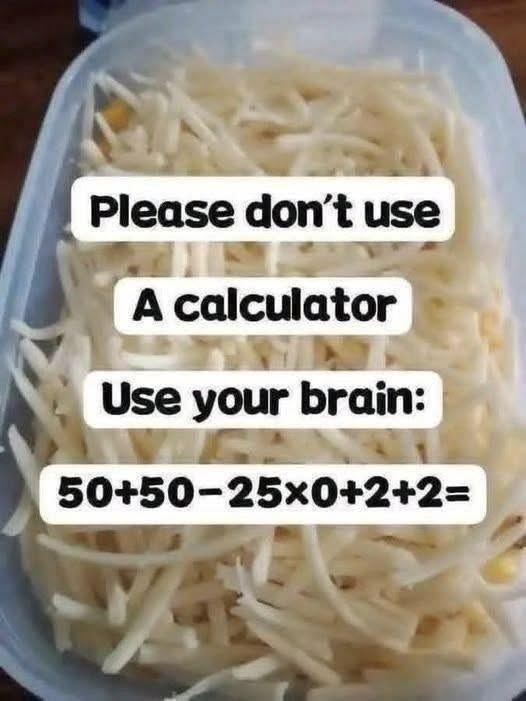
Can you solve this viral math puzzle without making a common mistake? Test your skills, learn the hidden trick, and discover why so many people get these puzzles wrong.
At first glance, a viral math puzzle can look almost ridiculously easy.
A few numbers. A couple of mathematical symbols. Maybe a question mark at the end.
You look at it for a few seconds and think, “I know the answer.”
But that confidence is exactly what makes these puzzles so entertaining.
Across social media, simple-looking math problems regularly spark hundreds or even thousands of comments, with people confidently defending completely different answers. Some solve them correctly, while others fall into a familiar trap: they rush instead of carefully following the mathematical rules.
One recent style of viral puzzle uses an expression such as:
50 + 50 − 25 × 0 + 2 + 2 = ?
Before reading any further, try solving it yourself.
What did you get?
The Answer May Not Be What You Expect
If you calculated the expression from left to right, you might have reached a completely different answer.
That’s where the trick comes in.
Mathematical expressions aren’t always solved simply by starting at the first number and moving across the line. Certain operations have priority over others.
This principle is known as the order of operations.
The Rule That Changes Everything
The order of operations tells us which calculations should be completed first.
Many people remember the rule using PEMDAS:
- P – Parentheses
- E – Exponents
- M – Multiplication
- D – Division
- A – Addition
- S – Subtraction
Another commonly used acronym is BODMAS:
- B – Brackets
- O – Orders
- D – Division
- M – Multiplication
- A – Addition
- S – Subtraction
The acronyms may differ, but the underlying mathematical rules are the same.
Multiplication and division are handled before addition and subtraction.
Let’s Solve the Puzzle
Take the expression:
50 + 50 − 25 × 0 + 2 + 2
There are no parentheses or exponents, so we move directly to multiplication.
Step 1: Multiply
The multiplication is:
25 × 0 = 0
Now replace that part of the equation:
50 + 50 − 0 + 2 + 2
Step 2: Work From Left to Right
Only addition and subtraction remain.
Start with:
50 + 50 = 100
Then:
100 − 0 = 100
Next:
100 + 2 = 102
And finally:
102 + 2 = 104
The Answer Is:
104
That’s the part that catches many people off guard.
Why Do People Answer 4?
The most common mistake is solving the equation strictly from left to right without considering the order of operations.
Someone might calculate:
50 + 50 = 100
100 − 25 = 75
75 × 0 = 0
0 + 2 + 2 = 4
That produces 4.
The arithmetic within each step isn’t the problem. The problem is that the multiplication was performed too late.
The expression requires 25 × 0 to be calculated before the subtraction.
That’s why the correct result is 104, not 4.
Why Simple Math Puzzles Go Viral
You might wonder why such an easy equation can generate so much attention.
The answer is psychology.
These puzzles are designed to look familiar.
When people see basic numbers such as 50, 25, 0, and 2, they immediately assume the problem will require basic mental arithmetic.
That creates a false sense of simplicity.
Instead of slowing down and checking the symbols, many people trust their first instinct.
That’s exactly what makes the puzzle effective.
The Confidence Trap
One of the funniest parts of viral math puzzles is how quickly people become confident about their answers.
Someone posts:
“The answer is 4.”
Another person replies:
“Definitely 104.”
A third person insists:
“You both got it wrong.”
Within minutes, the comments can turn into a debate.
The interesting thing is that these arguments are often caused by different approaches rather than difficult mathematics.
Once the order of operations is applied correctly, the expression becomes much easier to understand.
It’s Not an Intelligence Test
Getting a viral math puzzle wrong doesn’t mean you’re unintelligent.
People make mistakes because they:
- Solve too quickly
- Forget the order of operations
- Focus on the numbers instead of the symbols
- Assume everything should be calculated from left to right
- Trust their first answer without checking it
Even people who are very comfortable with mathematics can make careless mistakes when they’re distracted or rushing.
The goal of these puzzles is often less about measuring intelligence and more about testing attention to detail.
A Simple Strategy for Viral Math Puzzles
The next time you see a confusing equation online, don’t immediately calculate it.
Instead, use this checklist:
1. Look for Brackets or Parentheses
Anything inside brackets usually needs to be handled first.
2. Look for Exponents
Squares, cubes, and other powers come next.
3. Find Multiplication and Division
Handle these before addition and subtraction.
Remember that multiplication and division have the same priority, so when both appear together, work from left to right.
4. Finish With Addition and Subtraction
Once the higher-priority operations are completed, solve the remaining addition and subtraction from left to right.
5. Check Your Answer
Before posting your answer, go through the equation one more time.
Those extra few seconds can make all the difference.
Another Type of Viral Math Puzzle
Not every viral puzzle relies on PEMDAS or BODMAS.
Some use a hidden pattern instead.
For example:
10 + 5 = 35
20 + 4 = 36
30 + 3 = 39
40 + 2 = ?
At first, the equations don’t appear to follow ordinary addition.
But looking for a consistent pattern reveals:
10 + (5 × 5) = 35
20 + (4 × 4) = 36
30 + (3 × 3) = 39
So:
40 + (2 × 2) = 44
This demonstrates another important puzzle-solving skill: when normal arithmetic doesn’t explain the examples, look for a consistent hidden rule.
Why We Love These Challenges
Math puzzles are popular because they give people a quick mental challenge.
You don’t need special equipment.
You don’t need an advanced mathematics degree.
You simply need to slow down, observe carefully, and think logically.
They are also highly shareable.
A person can post a puzzle with one question:
“Can you solve this?”
Almost immediately, people begin commenting with their answers.
Some are correct.
Some are wildly wrong.
And some are convinced that everyone else is wrong.
That’s what keeps the conversation going.
Challenge Your Friends
Now that you know the trick, don’t give away the answer immediately.
Send the puzzle to a friend and ask them to solve it without using a calculator.
Give them a few seconds.
Then compare answers.
If they say 4, ask them to explain the order in which they performed the operations.
If they say 104, ask them to show their steps.
The explanation is often more interesting than the final number.
Final Answer
For the expression:
50 + 50 − 25 × 0 + 2 + 2
the correct answer is:
104
The key is not complicated mathematics.
It’s simply remembering that multiplication must be performed before addition and subtraction.
So the next time a viral math puzzle appears on your feed, don’t rush.
Look carefully.
Follow the order of operations.
And most importantly, don’t let an easy-looking equation trick you into giving an instant answer.