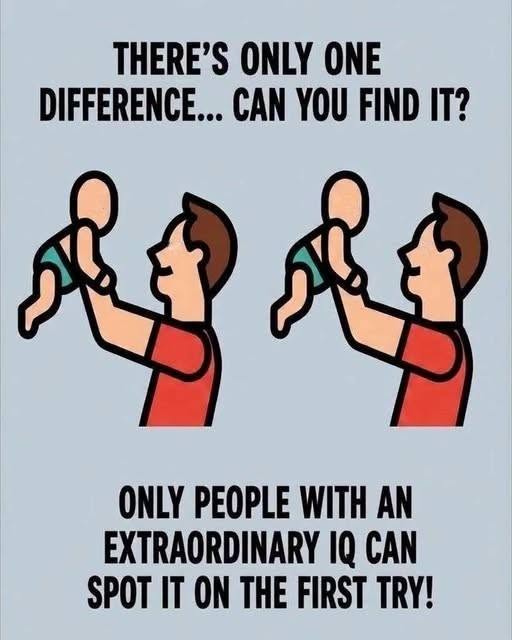
Can you find the one difference between these two nearly identical pictures? Take this visual puzzle challenge and see how quickly you can spot the hidden detail.
At first glance, these two pictures look almost exactly the same. The same man is holding a small child in the air, the child is wearing the same green outfit, and both figures appear to be standing in identical positions.
But there is one small difference hiding somewhere in the image.
The challenge is simple: Can you find it before looking at the answer?
Take a moment to carefully compare the two illustrations. Don’t rush. Look at the man’s face, hair, arms, hands, clothing, the child’s position, and especially the smaller details.
Look Carefully Before You Read the Answer
These types of visual puzzles are designed to test your observation skills, visual attention, and ability to notice small changes.
The difference isn’t immediately obvious because your brain tends to recognize the overall picture rather than examine every individual detail. When two images are almost identical, we often assume they are the same and overlook a tiny change.
Try this:
- Look at the left image for several seconds.
- Then look at the right image.
- Compare the man’s head and hair.
- Check his arms and hands.
- Examine the child’s body and clothing.
- Look closely at the shapes and outlines.
Have you found it yet?
Don’t Scroll Too Quickly!
If you want to challenge yourself, give yourself 15–30 seconds before checking the solution.
You can even ask a friend or family member to try it and see who notices the difference first.
The Answer
The difference is in the man’s hair.
Look closely at the top/front portion of the man’s hairstyle in the two pictures. The shape of the hair is slightly different between the left and right illustrations.
It is a very subtle change, which is why the puzzle can be surprisingly difficult even though the two images appear identical at first glance.
Why Are These Puzzles So Tricky?
Spot-the-difference puzzles take advantage of the way our brains process visual information.
When we see a familiar-looking scene, our brains don’t necessarily analyze every single line and shape independently. Instead, we quickly identify the overall structure and assume the smaller details are consistent.
That’s why you may look at both pictures several times and still miss the answer.
The trick is to slow down and deliberately compare individual areas rather than looking at the pictures as a whole.
How Quickly Did You Find It?
If you spotted the difference immediately, you have excellent visual attention.
If it took you longer, don’t worry. These puzzles aren’t a scientific measure of intelligence or IQ. Success can depend on concentration, familiarity with visual puzzles, screen size, and simply how carefully you’re looking.
The real fun is seeing whether you can train yourself to become faster at noticing tiny changes.
Did you find the difference before reading the answer? Share your result with someone and challenge them to beat your time!