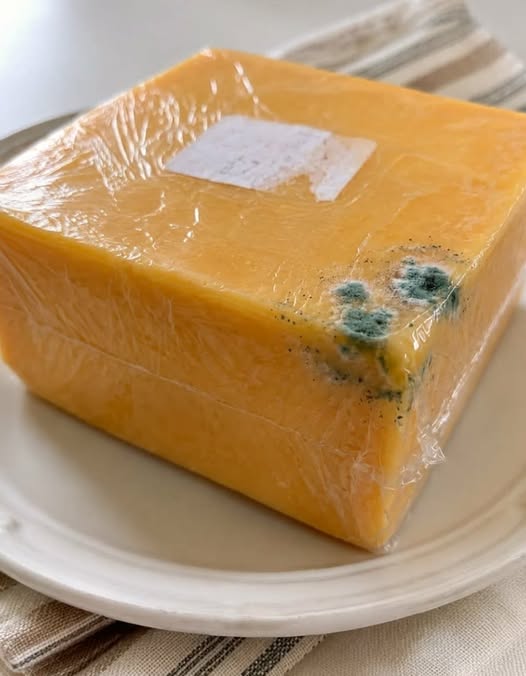
Found mold on your cheddar cheese? Don’t throw it away just yet. Learn when moldy cheddar can be safely trimmed, when the entire cheese should be discarded, and how to store cheddar properly.
Finding a small patch of mold on a block of cheddar can be frustrating. You open the refrigerator expecting a perfectly good piece of cheese, only to notice a fuzzy green, blue, white, or dark spot on the surface.
Your first thought may be: “Is the entire block contaminated?”
Not necessarily.
Because cheddar is a firm, relatively low-moisture cheese, a small amount of surface mold does not automatically mean the entire block has to go into the trash. However, the way you handle the mold matters.
Can You Eat Cheddar With Mold on It?
If you’re dealing with a firm or hard block of cheddar, a small isolated area of mold can sometimes be removed safely.
The important point is that you shouldn’t simply scrape the visible mold away and immediately eat the cheese. Instead, cut away the moldy area generously, including the surrounding cheese.
A commonly recommended approach for hard cheeses is to cut off at least 1 inch (about 2.5 cm) around and below the moldy area, keeping the knife away from the mold so it doesn’t drag spores into the clean portion.
After removing the affected section, wrap the remaining cheese in fresh packaging and refrigerate it.
Why Can Hard Cheese Sometimes Be Saved?
Cheddar has a much firmer and drier structure than foods such as cream cheese, cottage cheese, or soft fresh cheese.
That makes it more difficult for mold to penetrate deeply into the cheese compared with high-moisture foods.
However, you cannot determine safety simply by looking at the surface. That’s why generous trimming is important, and why different types of cheese should be treated differently.
When Should You Throw the Cheese Away?
Don’t try to rescue every piece of moldy cheese.
It’s safest to discard cheddar when:
- The mold covers a large portion of the cheese.
- There are multiple moldy areas throughout the block.
- The cheese has an unusual smell or appearance beyond the expected mold.
- The cheese is shredded, sliced, grated, or crumbled and has developed mold.
- The cheese has become unusually slimy or deteriorated.
- You’re unsure how the cheese was stored or whether it has been contaminated.
For shredded or sliced cheese, mold can spread between pieces much more easily, so simply removing the visible portion isn’t a reliable solution.
What About Soft Cheese?
This is where many people make a mistake.
Soft, high-moisture cheeses are generally not treated like a solid block of cheddar.
Examples include:
- Cream cheese
- Cottage cheese
- Ricotta
- Soft fresh cheese
- Brie and similar soft-ripened cheeses, depending on the type and situation
When unwanted mold develops on a soft, high-moisture cheese, the safer choice is generally to discard the entire product, because mold and potentially harmful microorganisms can spread below the surface where you can’t see them.
What If the Mold Is White or Blue?
Color alone isn’t enough to determine whether a mold is safe.
Some cheeses are intentionally produced with specific molds. For example, certain blue cheeses are supposed to contain blue-green mold, while some soft-ripened cheeses have characteristic white rinds.
But unexpected mold growing on a cheddar block is different.
Don’t assume that a white, blue, green, or black spot is harmless simply because another cheese normally contains that color of mold.
How to Remove Mold From Cheddar
If you have a firm block of cheddar with a small isolated patch of unwanted mold, handle it carefully.
Step 1: Don’t smell the mold closely
Avoid putting your face directly over the moldy area. Mold can release spores into the air.
Step 2: Use a clean knife
Use a clean, sharp knife to remove the affected portion.
Step 3: Cut generously
Don’t just shave off the fuzzy surface. Remove the mold and at least 1 inch of cheese around and below the affected area.
Try not to let the knife touch the mold and then pass through the clean portion.
Step 4: Rewrap the remaining cheese
Place the usable portion in fresh, clean packaging.
Step 5: Refrigerate promptly
Keep the cheese properly refrigerated and avoid leaving it sitting at room temperature for extended periods.
Preventing Mold From Appearing on Your Cheese
The best way to deal with mold is to prevent it from developing in the first place.
Keep cheddar properly refrigerated and protect it from excess moisture and exposure to air.
When storing a block of cheese, use clean food-safe wrapping or an appropriate airtight container. Avoid repeatedly handling the cheese with dirty utensils or hands.
It’s also helpful to check your refrigerator periodically for old food that may have developed mold, because mold spores can spread between foods.
The Bottom Line
A little mold on a firm block of cheddar doesn’t always mean the entire block is ruined.
If the mold is limited to a small area, the block is otherwise in good condition, and you’re dealing with a firm cheese, you may be able to salvage it by cutting away the mold plus a generous margin around and beneath it.
But moldy shredded, sliced, crumbled, or soft cheeses are a different story and are generally better discarded.
When in doubt, remember the simplest food-safety rule: if you’re uncertain about the condition of the cheese, throwing it away is safer than taking a chance.