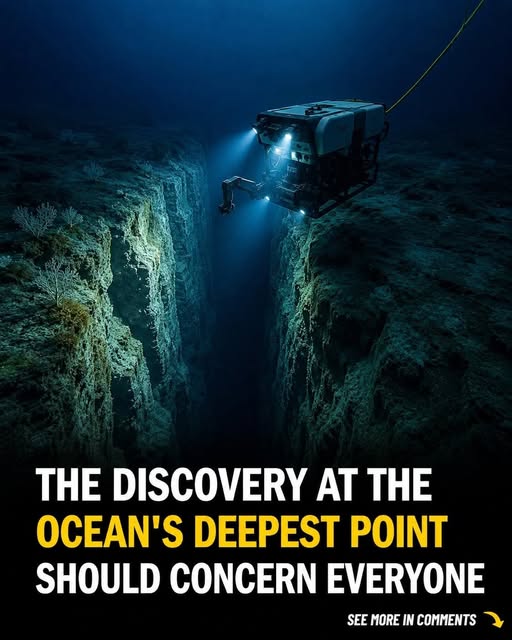
Imagine descending thousands of feet beneath the surface of the Pacific Ocean, into a world where sunlight disappears, temperatures drop, and the pressure becomes incredibly intense.
This is the Mariana Trench, one of the deepest places on Earth—and it continues to surprise scientists with the unusual organisms and environments found in its extreme depths.
A World Almost Completely Hidden From Us
The deepest parts of the ocean are dramatically different from the world we experience on land.
At depths approaching 35,000–36,000 feet, sunlight cannot penetrate. There is no ordinary day-and-night cycle like the one we experience at the surface, and the pressure is enormous.
Yet life exists there.
Scientists have documented a remarkable variety of organisms living in deep-sea environments, including microorganisms, amphipods, sea cucumbers, and other highly specialized animals.
How Can Anything Survive That Deep?
The enormous pressure is one of the biggest challenges.
As depth increases, the weight of the water above creates tremendous pressure. Deep-sea organisms have evolved specialized adaptations that allow them to survive conditions that would be extremely dangerous for humans.
Many deep-ocean animals have soft bodies and biological structures adapted to high pressure. Some also have specialized biochemical mechanisms that help their cells function under these extreme conditions.
Why the Mariana Trench Is So Fascinating
The Mariana Trench is located in the western Pacific Ocean and contains Challenger Deep, the deepest known part of the ocean.
Because reaching these depths requires specialized submersibles and remotely operated vehicles, scientists cannot simply visit the area whenever they want.
Every expedition can potentially reveal something new.
That makes reports of unusual creatures or mysterious objects from these depths particularly fascinating.
Not Everything Seen in the Deep Sea Is a Mystery Creature
Deep-sea images can sometimes be misleading.
Unusual lighting, limited visibility, suspended particles, camera distortion, and unfamiliar marine organisms can make ordinary animals appear strange.
A photograph or short video alone may therefore not be enough to identify something with certainty.
Scientists generally compare observations with known species, environmental conditions, depth, location, and other evidence before reaching a conclusion.
The Deep Ocean Still Holds Many Secrets
Despite decades of ocean research, a huge portion of the deep sea remains difficult to explore.
New observations continue to expand our understanding of how life can survive under extreme conditions.
The creatures found in these environments demonstrate just how adaptable life can be—and how much remains to be discovered beneath the surface of our planet.
So when something is reported as being spotted around 35,000 feet below the ocean surface, it is worth paying attention—but it is equally important to separate genuine scientific discoveries from exaggerated social-media claims.
The deep ocean is already fascinating enough without needing to turn every unusual image into a mystery.