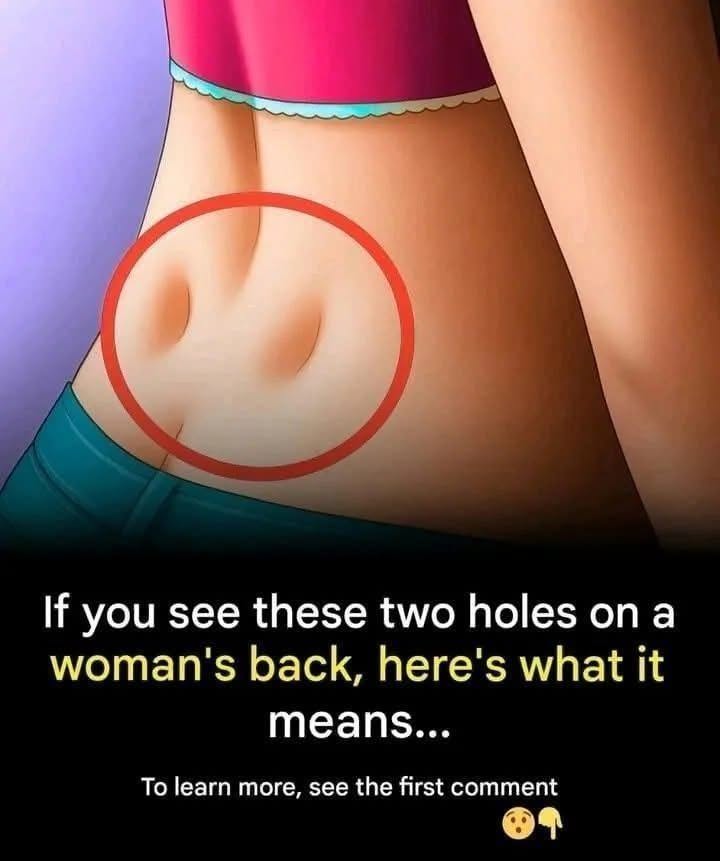
Wondering what the two small dimples on your lower back mean? Learn why these natural indentations appear, what they are called, and when they may need medical attention.
Have you ever noticed two small, symmetrical dimples near the bottom of your back?
They are often called “Venus dimples” and are usually located just above the buttocks, around the area of the pelvis. While they can look distinctive, these little indentations are generally nothing to worry about.
What Are Lower-Back Dimples?
The dimples are created by the way the skin and underlying connective tissues attach around certain parts of the pelvis.
They are particularly noticeable around the area of the posterior superior iliac spines, which are bony points near the back of the pelvis.
Because everyone’s bone structure and soft tissue distribution are different, some people have very visible dimples while others don’t have them at all.
Why Do Some People Have Them?
Genetics and individual anatomy play a major role.
Some people naturally have:
- More prominent pelvic landmarks
- Different patterns of connective-tissue attachment
- Less soft tissue covering the area
- Body proportions that make the indentations easier to see
Weight and body composition can also influence how noticeable the dimples appear.
Importantly, having these dimples does not mean someone is healthier, fitter, or more athletic than someone who doesn’t have them.
Are They a Sign of Good Health?
Not necessarily.
Social media sometimes describes lower-back dimples as a sign of exceptional fitness, good circulation, or a “perfect” body. These claims aren’t supported by good medical evidence.
They are primarily an anatomical feature.
Someone can be perfectly healthy without having them, and someone with prominent dimples isn’t automatically healthier because of them.
Are Venus Dimples the Same as a Sacral Dimple?
No.
This distinction is important.
Venus dimples are usually two symmetrical indentations located over the back of the pelvis.
A sacral dimple, on the other hand, is typically a single small indentation near the base of the spine and above the crease of the buttocks. Sacral dimples are common and are often harmless, particularly when they are small and isolated.
However, certain unusual features around a sacral dimple may warrant medical evaluation.
When Should a Back Dimple Be Checked?
Most ordinary symmetrical lower-back dimples don’t require medical attention.
A healthcare professional should evaluate an unusual indentation if it is accompanied by features such as:
- A deep or unusually large pit
- Hair growing from the area
- A skin tag
- A noticeable change in skin color
- Drainage or bleeding
- Swelling or redness
- Significant pain
- Neurological symptoms such as weakness or numbness
These features don’t automatically mean something is wrong, but they can help a clinician determine whether further assessment is appropriate.
Can Exercise Create These Dimples?
Exercise can make existing dimples more noticeable by changing muscle tone and body composition, but exercise doesn’t necessarily create the underlying anatomical structure.
Strengthening the glutes, hips, and core can improve overall posture and muscle definition, which may make natural pelvic contours easier to see.
However, there’s no special exercise that guarantees everyone will develop Venus dimples.
The Interesting Truth
The two little indentations may look mysterious, but their explanation is surprisingly simple: human bodies naturally have different shapes and anatomical structures.
For most people, lower-back dimples are simply a normal variation in how the pelvis, connective tissue, and skin are arranged.
So if you have them, there’s usually no special treatment or action required—and if you don’t, there’s absolutely nothing missing.
Final Thoughts
Those two small dimples in the lower back may have an intriguing nickname, but they aren’t a secret indicator of health or fitness.
Venus dimples are generally a normal anatomical feature.
The important thing is to distinguish them from an unusual single sacral dimple or an indentation accompanied by other skin or neurological changes. If something about a dimple looks unusual or has recently changed, getting it checked by a healthcare professional is the safest approach.