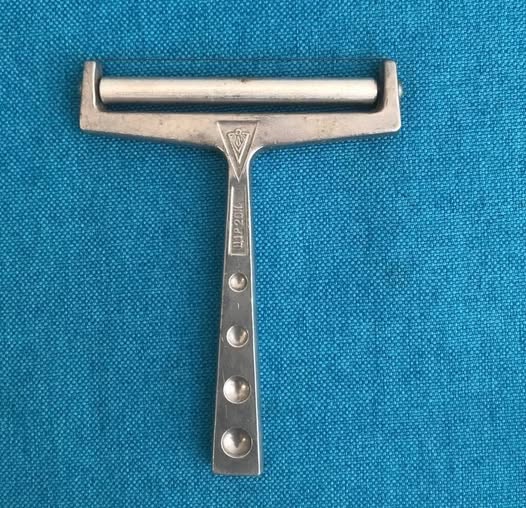
Every now and then, an ordinary-looking object from the past appears online and leaves thousands of people completely confused.
People stare at it from different angles. They compare it with old kitchen gadgets. They search photographs, ask collectors, post it in identification groups, and make guesses about what it could possibly be.
And then comes the big question:
“What on earth is this thing?”
One such mystery object has been circulating online, with many people unable to identify it at first glance. According to the widely shared identification, the unusual-looking item is a Vintage Presto Aluminum Cheese Slicer, associated with the kitchenware of the 1940s and 1950s.
At first, its shape can make it look like a strange mechanical device rather than something that belongs in a kitchen. But its purpose was actually remarkably simple: it was designed to slice cheese.
What Is a Vintage Presto Aluminum Cheese Slicer?
The Vintage Presto Aluminum Cheese Slicer was a practical kitchen utensil designed for cutting portions of cheese from a larger block.
Unlike many modern cheese slicers, which have familiar wire frames or contemporary plastic handles, older utensils often had distinctive shapes and were made almost entirely from metal.
The Presto-style slicer is described as being made from lightweight but sturdy aluminum, giving it the durability expected from many household tools of that period.
Its unusual appearance is probably one of the main reasons modern viewers have difficulty recognizing it.
Today, most people encounter cheese in pre-sliced packages. If they buy a block, they may use a knife or a modern wire cheese slicer.
Decades ago, however, kitchen tools were often designed specifically for individual food-preparation tasks.
How Did It Work?
The basic idea was straightforward.
The slicer was used against a block of cheese and moved through it to create a relatively even slice.
Instead of repeatedly cutting cheese with a kitchen knife, a dedicated slicer could make the process more convenient and consistent.
Depending on the particular design, the user would position the cutting portion against the cheese and draw the utensil through the block.
The result was a slice that could be used for:
- Sandwiches
- Crackers and snacks
- Breakfast plates
- Burgers
- Lunch boxes
- Cheese boards
- Cooking and baking
It was essentially a specialized tool for a job that many people today simply perform with a knife.
Why Does It Look So Strange to Modern Eyes?
This is where the mystery becomes interesting.
Kitchen technology has changed enormously.
A person born several decades after these tools were commonly used may never have encountered one. Modern supermarkets also changed the way people purchase cheese.
Pre-sliced cheese, individually packaged portions, food processors, multipurpose kitchen tools, and inexpensive modern utensils have reduced the need for many specialized gadgets.
As a result, an object that would once have been immediately recognizable can now look completely unfamiliar.
The same thing happens with old-fashioned egg slicers, butter molds, nutcrackers, meat grinders, jar openers, and other vintage kitchen implements.
What looks mysterious today may once have been an everyday household item.
The Charm of Aluminum Kitchenware
Aluminum became popular for household products because it offered a useful combination of light weight and durability.
For kitchen utensils, this made practical sense.
A tool could be strong enough for repeated use without being unnecessarily heavy.
The Vintage Presto cheese slicer reflects that philosophy of design: make the tool simple, functional, durable, and easy to handle.
There was no electronic component, complicated mechanism, or digital display.
It was simply a tool designed to perform one job.
And sometimes that is exactly what makes vintage kitchenware so fascinating.
From Everyday Utensil to Vintage Collectible
When these objects were new, their owners probably didn’t think of them as collectibles.
They were simply kitchen tools.
Someone could have used one to prepare lunch, slice cheese for children, or put together a quick snack for guests.
After decades passed, however, the same object became a piece of household history.
Vintage kitchenware has become increasingly interesting to collectors because it offers a physical connection to earlier generations.
A small aluminum utensil can tell us something about:
- How people prepared food
- What kitchens looked like
- What materials manufacturers preferred
- How household products were designed
- How food was served
- What everyday life was like decades ago
That makes an inexpensive old utensil surprisingly interesting.
Why People Couldn’t Identify It
There are several reasons an object like this can fool people.
1. Its original context is missing
If you see an unfamiliar object sitting by itself, you don’t necessarily know what it was designed to accompany.
A cheese slicer makes much more sense when you see it next to a block of cheese.
2. Kitchen technology has changed
Many specialized kitchen tools have disappeared from everyday use.
People simply don’t encounter them often enough to recognize them.
3. Vintage designs can be surprisingly different
Manufacturers didn’t always follow the shapes we associate with kitchen tools today.
An old utensil may have a metal construction and unusual proportions that make its purpose difficult to guess.
4. People naturally assume it must do something complicated
When an object looks mechanical, people often assume it has a complicated function.
In reality, some vintage tools were incredibly simple.
This cheese slicer is a perfect example.
Was It Really a “Mystery Object”?
There is an important distinction here.
The internet claim that “the entire internet” searched for the object and that “90% of people” couldn’t identify it is viral storytelling rather than a verified statistical finding.
The underlying identification is repeated by multiple websites: the mystery item is presented as a Vintage Presto Aluminum Cheese Slicer.
However, there does not appear to be reliable evidence showing that exactly 90% of people failed to identify it.
So the “90%” figure is best understood as part of the attention-grabbing story surrounding the image rather than a scientifically measured statistic.
A Simple Piece of Kitchen History
Perhaps the most interesting part isn’t even the object itself.
It’s the realization that everyday life changes.
A tool that was once obvious to someone’s grandmother can become completely mysterious to a younger generation.
Think about the objects in an older kitchen:
A hand-cranked grinder.
A mechanical egg beater.
A butter mold.
A manual can opener.
A cheese slicer.
A flour sifter.
A potato ricer.
At one time, these weren’t unusual objects at all.
They were simply part of the kitchen.
Today, many of them have disappeared behind modern appliances and pre-packaged foods.
Would You Still Use One Today?
Absolutely.
If the slicer is in good condition and appropriate for food use, a vintage cheese slicer can still be an interesting and practical kitchen tool.
There is also something satisfying about using a utensil that doesn’t require batteries, electricity, or complicated instructions.
You simply take a block of cheese, position the slicer, and make a slice.
That’s it.
Of course, anyone considering using vintage kitchenware should inspect it carefully first. Old utensils can have corrosion, sharp edges, damaged components, or finishes that are no longer suitable for food contact.
For valuable or particularly old pieces, collectors may prefer to preserve them rather than use them.
A Conversation Starter
Even if you never use the slicer, it can make an excellent conversation piece.
Imagine putting one on a kitchen shelf and asking visitors:
“Do you know what this is?”
Many people would probably start guessing.
Some might say it is an old can opener.
Others might think it is a woodworking tool.
Someone might even suggest that it belongs in a workshop rather than a kitchen.
Then comes the reveal:
It was a cheese slicer.
That’s part of the appeal of vintage objects. They allow us to rediscover ordinary pieces of technology that have nearly disappeared from everyday life.
The Bigger Lesson Behind the Mystery
The story of the Vintage Presto Aluminum Cheese Slicer is a reminder that ordinary objects can become historical artifacts.
We often think of history as famous people, major inventions, wars, buildings, and important dates.
But history also exists in our kitchens.
A small aluminum utensil can show us how people lived, cooked, ate, and solved everyday problems many decades ago.
What seems useless or mysterious today may once have been an essential household item.
And that’s why vintage kitchen tools continue to fascinate people.
Final Answer: What Is It?
The mystery object discussed in the viral post is identified as a Vintage Presto Aluminum Cheese Slicer, a mid-century kitchen utensil intended to make slicing cheese from a block easier and more consistent.
So if you ever discover one tucked away in an old kitchen drawer, don’t assume you’ve found some strange mechanical device.
You may simply be looking at a little piece of American kitchen history.
Sometimes the objects we no longer recognize are the ones that tell the most interesting stories.
Meta Description
What is that mysterious vintage kitchen tool everyone is struggling to identify? Discover the history and purpose of the Vintage Presto Aluminum Cheese Slicer and learn how this unusual-looking utensil was once used in everyday kitchens.