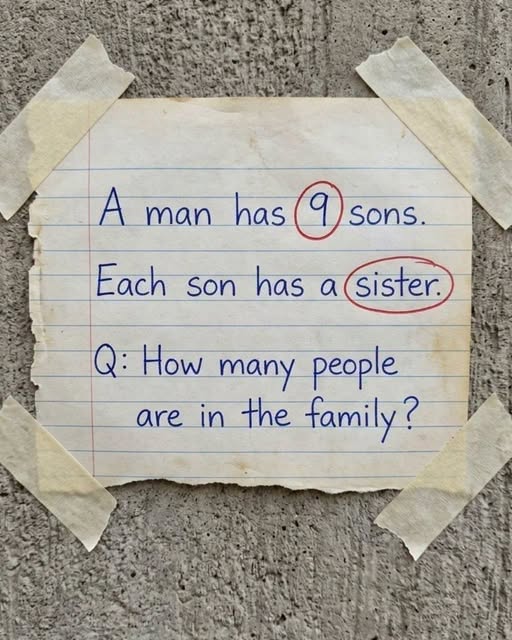
Can you figure out how many people are really in this family? This clever family riddle uses relationships and careful wording to challenge your thinking and reveal a surprisingly simple answer.
Some riddles look like simple counting questions, but the real challenge is understanding exactly what the words mean. Family riddles are especially tricky because one person can have several different relationships at the same time.
The question “How many people are in this family?” may seem easy at first, but don’t rush to add up every role mentioned. The secret is to determine whether those roles belong to different people or whether one person can fit more than one description.
Why This Riddle Is Tricky
Imagine a riddle that mentions fathers, mothers, sons, and daughters. Your first instinct might be to count every title separately.
For example, if a puzzle says there are:
- 2 fathers
- 2 mothers
- 2 sons
- 2 daughters
you might immediately calculate:
2 + 2 + 2 + 2 = 8 people.
But this is where the trick begins.
A person can belong to more than one category. A man can be someone’s father while also being the son of his own father. Similarly, a woman can be someone’s mother while also being the daughter of her parents.
So the number of relationships mentioned does not necessarily equal the number of people in the family.
Think in Generations
One of the easiest ways to solve these puzzles is to imagine the family as different generations.
The Older Generation
Start with the grandparents or oldest people mentioned in the riddle.
A grandfather can simultaneously be:
- A father
- A husband
- A son
depending on which family relationship is being described.
The Middle Generation
Now consider their children.
A person in the middle generation might be both:
- Someone’s son or daughter
- Someone else’s father or mother
This is why simply counting the words can produce the wrong answer.
The Younger Generation
Finally, look at the children.
They may be described as sons or daughters, but they can also have another family role depending on how the riddle is written.
The Important Question
Whenever you see a family-counting puzzle, ask yourself:
“Does every description represent a different person?”
If the answer is no, you should not simply add the numbers.
Instead, draw a small family tree or mentally connect the relationships. Once you do that, the apparent confusion usually becomes much easier to understand.
Why People Get the Answer Wrong
These riddles take advantage of a common habit: counting before understanding.
When we see several numbers, our brain naturally wants to add them together. But the puzzle may be testing your ability to recognize overlapping relationships rather than your arithmetic skills.
For instance, the same person could be:
a son + a father
at the same time.
Another person could be:
a daughter + a mother.
Therefore, several titles can describe the same individuals.
A Simple Strategy for Solving Family Riddles
The next time you see a puzzle like this, follow these steps:
1. Don’t add the numbers immediately.
First understand what each description means.
2. Identify the generations.
Separate grandparents, parents, and children.
3. Look for overlapping roles.
Ask whether someone can be both a parent and a child.
4. Draw the relationships.
Even a simple mental family tree can make the answer obvious.
5. Count actual people—not titles.
This is usually the key to the entire puzzle.
The Real Lesson Behind the Riddle
The fun of this puzzle isn’t really the final number. It’s the way it makes you slow down and question your first assumption.
A person can occupy several roles within a family, so relationships and people are not always the same thing.
That’s why these riddles are popular as brain teasers. They encourage careful reading, logical thinking, and attention to details that are easy to overlook.
Can You Solve It?
Before looking for an answer, read the original riddle one more time. Don’t count the family members based only on the numbers you see.
Instead, ask yourself:
Who is related to whom, and which descriptions could belong to the same person?
Once you understand that distinction, what initially looks like a complicated family puzzle can become surprisingly simple.