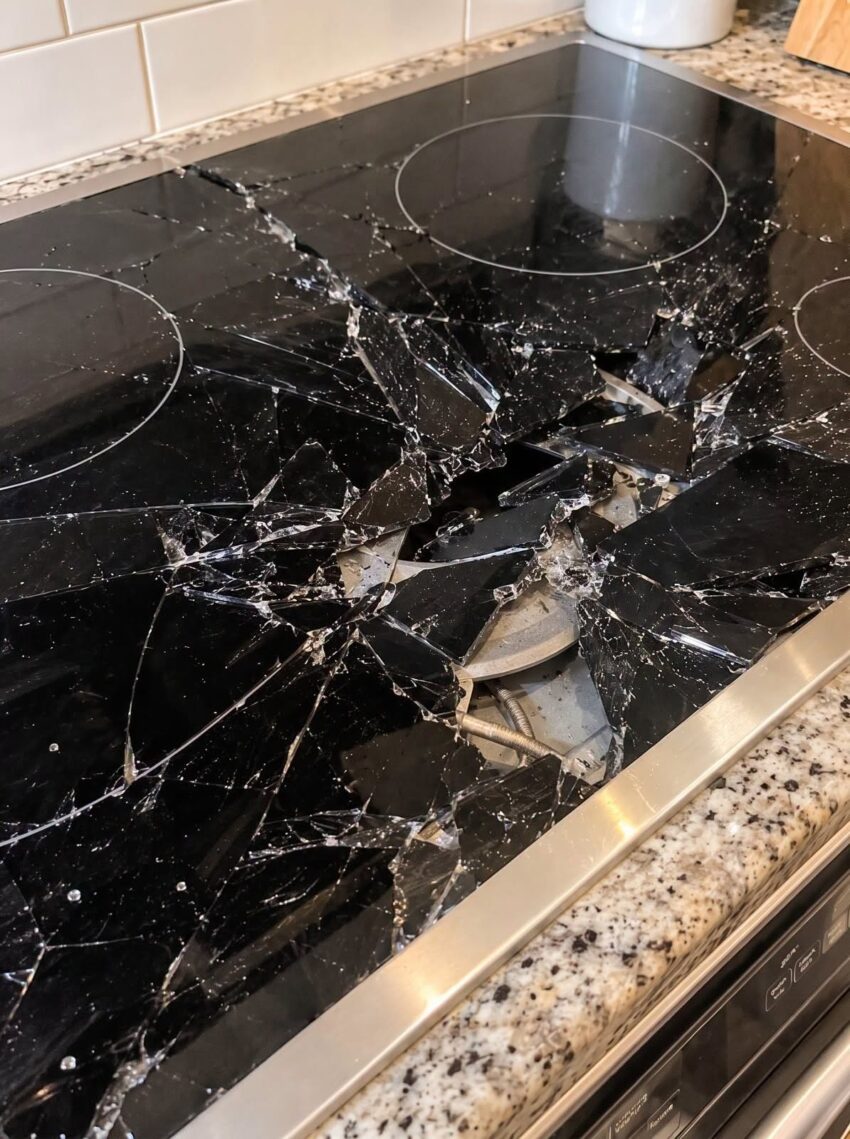
A glass-top stove can sometimes crack or shatter suddenly without an obvious cause. Learn the common reasons, warning signs, safety steps, and what to do after a cooktop breaks.
Waking up to the sound of a glass-top stove suddenly shattering would be frightening for anyone—especially when children are nearby. If your daughter was simply preparing dinner and the cooktop suddenly broke without anyone dropping anything on it, you may naturally wonder: How could this happen?
The good news is that a sudden break does not automatically mean someone was careless. Glass-ceramic cooktops are designed to withstand significant heat, but they can still fail when the surface has been weakened by impact, a tiny crack, installation stress, or other factors.
1. A Tiny Crack May Have Been Hidden
One possibility is that the cooktop already had a very small chip, scratch, or hairline crack that was difficult to notice.
Every time the stove heats up, the glass-ceramic surface expands and contracts. If there is an existing weakness, repeated heating and cooling can allow that damage to spread until the glass suddenly gives way.
This can make the failure appear completely spontaneous even though the weakness may have developed earlier.
2. A Heavy Pan May Have Caused Earlier Damage
Glass cooktops can be damaged by impact. A heavy pot, cast-iron pan, lid, or another object doesn’t necessarily have to visibly break the surface immediately.
For example, a pan may have been placed down harder than usual or something may have fallen onto the cooktop days earlier. The initial damage might have been almost invisible, with the final break occurring later while the stove was being heated.
Manufacturers identify impact from cookware or objects as one of the common causes of cracked ceramic-glass cooktops.
3. Sudden Temperature Changes Can Put Stress on the Surface
Another possible explanation is thermal stress.
Although quality glass-ceramic cooktops are specifically engineered to tolerate large temperature differences, sudden and unusual temperature changes can still contribute to failure when the surface has already been weakened.
For example, a very hot area could potentially be exposed to a cold spill or another sudden temperature change. SCHOTT, a major glass-ceramic manufacturer, explains that its CERAN material has high resistance to thermal shock, but manufacturers still warn that damaged cooktops should not be used.
4. Installation Stress Is Another Possibility
Sometimes the problem isn’t the person cooking at all.
If a cooktop was installed incorrectly or the opening was too tight, the glass may not have enough room to expand when it becomes hot. That can create mechanical stress in the panel.
Zanussi specifically notes that incorrect installation can cause stress damage, with cracking potentially occurring during the first use or after repeated use.
This is particularly worth considering if the stove was relatively new, recently installed, or recently removed and reinstalled.
5. Why Does It Sometimes Sound Like an Explosion?
When glass-ceramic breaks under stress, a large area can fracture almost simultaneously. Instead of producing one simple crack, the surface may suddenly break into many pieces or form a dramatic spiderweb-like pattern.
That’s why the noise can be extremely loud and frightening.
The suddenness of the event can make everyone in the room believe that something must have struck the stove—even when nobody actually saw an impact.
6. Look at the Pattern Before Cleaning Everything Up
If the family is trying to understand what happened, take photographs first.
Take several clear pictures showing:
- The entire cooktop
- The center of the broken area
- The edges and corners
- Any obvious point of impact
- Any chips or dents
- The surrounding countertop
- The cookware that was being used
- The model and serial-number label
A technician may be able to determine whether the damage is more consistent with impact or stress.
For example, damage concentrated around a particular point may suggest an impact, while a crack running across a larger portion of the panel without an obvious impact point may warrant investigation of stress or installation.
However, a photograph cannot always prove the exact cause.
7. Do NOT Continue Cooking on It
This is the most important part.
Do not turn the cooktop back on to see whether it still works.
A cracked or broken glass-ceramic cooktop should be taken out of service. Manufacturers and appliance guidance recommend disconnecting the appliance from power and arranging professional repair. A crack can also expose electrical components underneath the surface.
If it can be done safely, switch the appliance off at the appropriate electrical isolation point or breaker. If you’re unsure how it is wired, don’t attempt electrical work yourself.
8. Keep the Children Away From the Area
Since your grandchildren were already frightened, keep them away from the kitchen until the situation has been made safe.
Broken cooktop glass can have extremely sharp edges and tiny fragments may be difficult to see.
Don’t allow children to help with cleanup, and avoid touching large broken pieces with bare hands.
9. Don’t Pour Water Over the Broken Surface
If the surface is still hot, don’t try to cool it rapidly with water.
Also avoid attempting to wash the broken area while the appliance is still connected to electricity. Water and damaged electrical components are an unsafe combination.
10. Don’t Try to Repair or Replace the Glass Yourself
Even if the stove appears simple, the glass panel is part of an appliance containing heating elements and electrical components.
Professional manufacturers recommend having broken glass replaced by an authorized or qualified technician rather than attempting a DIY replacement.
Could It Really Have Happened “For No Reason”?
It can look that way.
Usually there is a physical reason—such as an unnoticed impact, an existing microscopic defect, accumulated stress, thermal stress, or installation pressure—but the final failure can occur suddenly and without anyone doing anything immediately beforehand.
So if your daughter says she didn’t drop anything or hit the stove, don’t automatically assume she caused it.
The safest approach is to document the damage, stop using the cooktop, and have a qualified technician inspect it.
Final Takeaway
A glass-top stove suddenly shattering is alarming, but it doesn’t necessarily mean someone made a mistake. The most common possibilities include previous impact damage, a hidden crack, thermal stress, or installation-related stress.
For now, the priority isn’t figuring out who is responsible—it’s keeping everyone safe. Keep the children away, disconnect the appliance safely, don’t use the damaged cooktop, and arrange an inspection or replacement.
If the cooktop is still under warranty, photograph the damage before cleaning anything up or disposing of any pieces. Those photographs may also help the manufacturer or technician determine what happened.