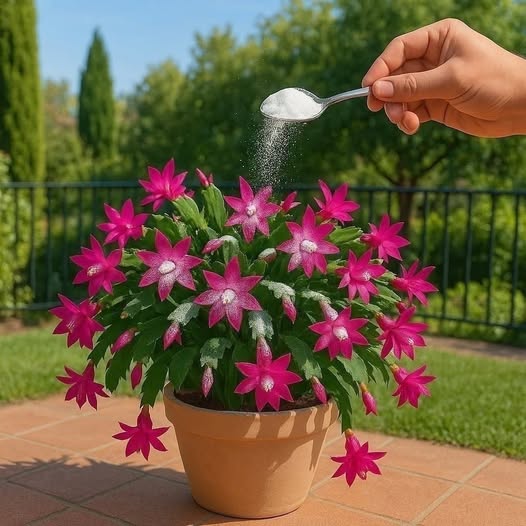
Want more flowers from your plants? Discover how a simple two-spoon homemade feeding method may support flowering plants when used correctly, plus important tips for healthy blooms.
Few things are more satisfying than seeing a plant covered with colorful, healthy flowers. But when a plant grows plenty of leaves and produces very few blooms, it can be frustrating.
The good news is that flowering is influenced by several factors, including sunlight, watering, soil quality, temperature, pruning, and nutrition. A simple homemade fertilizer or soil amendment may help provide nutrients, but there is no single ingredient that can magically make every plant bloom overnight.
One popular gardening approach involves using just two spoonfuls of a nutrient-rich material around the plant. The exact ingredient matters, however, because different plants have different nutritional needs.
Why Some Plants Produce Lots of Leaves but Few Flowers
If your plant looks green and healthy but refuses to bloom, excessive nitrogen can sometimes be part of the problem.
Nitrogen encourages leafy growth, while flowering also depends on adequate phosphorus, potassium, light, and overall plant health.
Other common reasons include:
- Not enough sunlight
- Too much nitrogen fertilizer
- Overwatering
- Poor drainage
- Incorrect pruning
- The plant being too young
- Extreme temperatures
- Nutrient-poor soil
- Seasonal changes
Before adding fertilizer, it is therefore worth checking the plant’s growing conditions.
The “Two-Spoon” Method
A common homemade gardening trick is to measure a small amount of an appropriate organic amendment and apply it to the soil around the plant rather than placing it directly against the stem.
For example, two tablespoons of mature compost or another suitable organic soil amendment can be incorporated gently into the top layer of soil for a small container plant.
The purpose isn’t to force flowers instantly. Instead, organic matter can gradually contribute nutrients and improve soil structure.
For larger plants or garden beds, the correct quantity will depend on the size of the plant, soil condition, and the specific product being used.
Don’t Assume More Fertilizer Means More Flowers
One of the biggest gardening mistakes is thinking that if a little fertilizer helps, a lot must work even better.
It doesn’t.
Excess fertilizer can damage roots, cause leaf-tip burn, disturb nutrient balance, and potentially make the plant less healthy.
That’s why a measured amount is safer than repeatedly adding large quantities.
Sunlight Is Often More Important Than Fertilizer
Before reaching for any fertilizer, check how much sunlight your flowering plant receives.
Many flowering plants require several hours of suitable light each day to produce abundant blooms. A plant kept in excessive shade may remain alive and produce leaves while flowering poorly.
Move container plants gradually if they need more light, because suddenly exposing a shade-adapted plant to intense sunlight can cause leaf damage.
Watering Matters Too
Overwatering can be just as problematic as underwatering.
If the soil remains constantly wet, roots may struggle to receive enough oxygen, increasing the risk of root problems. On the other hand, severe dryness can stress the plant and interfere with growth and flowering.
Water according to the plant’s needs rather than following a fixed schedule for every plant.
A Simple Routine for More Blooms
For healthier flowering, focus on the basics:
- Provide the right amount of sunlight.
- Use well-draining soil.
- Water according to the plant’s requirements.
- Avoid excessive nitrogen.
- Feed lightly when the plant actually needs nutrients.
- Remove spent flowers when appropriate for that species.
- Avoid disturbing the roots unnecessarily.
- Be patient—plants need time to respond.
Can Two Spoons Really Make Any Plant Covered in Flowers?
Not by themselves.
The exciting headline may suggest that two spoonfuls are a guaranteed flowering solution for every plant, but gardening doesn’t work that way. Different plants have different nutrient requirements, and flowering depends on much more than fertilizer.
A small amount of an appropriate soil amendment can be useful, but healthy soil, adequate light, proper watering, and species-specific care are the real foundation of abundant flowering.
Final Thoughts
If your flowering plants aren’t producing enough blooms, don’t immediately assume they need a powerful fertilizer.
Start by checking sunlight, watering, drainage, soil quality, and the plant’s natural flowering season. Then, if nutrition is genuinely needed, use a suitable fertilizer or organic amendment in the recommended amount.
Sometimes the simplest gardening routine—not the strongest fertilizer—is what helps a plant reach its full flowering potential.