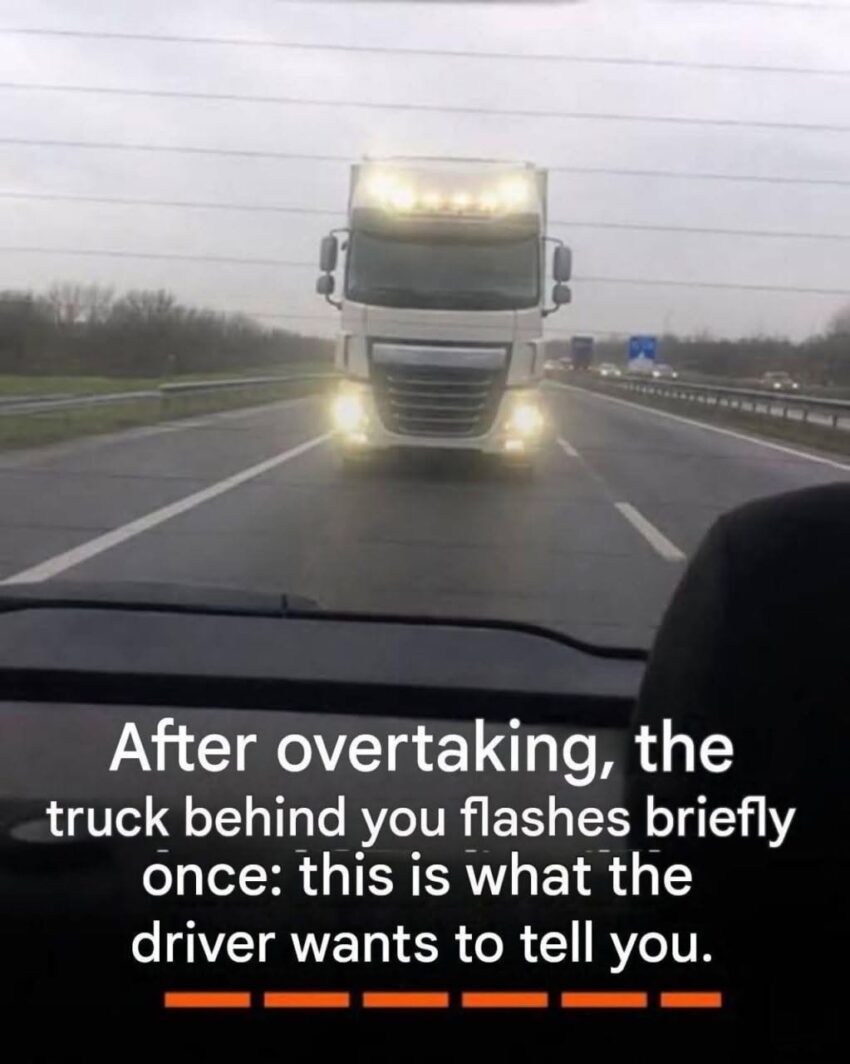
If a truck driver briefly flashes the headlights after you overtake, it can be a useful road-safety signal. Learn what this common driving gesture may mean and why understanding it matters.
If you’ve ever driven on a highway, especially around large trucks, you may have experienced this situation:
You overtake a truck and move back into your lane.
A few seconds later, the truck behind you briefly flashes its headlights once.
At first, you might wonder:
“Why did they flash me?”
Some drivers assume the truck driver is angry.
Others think they’re complaining about the overtaking maneuver.
But in many driving situations, a brief flash can actually be a courtesy or communication signal rather than a sign of aggression.
It Can Mean “You’re Clear—You Can Move Back”
One common interpretation is that the truck driver is communicating that you’ve safely completed the overtaking maneuver.
Large trucks have significant blind spots, and the driver may have a different view of surrounding traffic than the driver of a smaller car.
If you’ve passed the truck and are moving back into the lane, the truck driver may briefly flash the headlights to communicate something like:
“You’re clear.”
However, this isn’t a universal signal.
The meaning of a headlight flash can vary by country, road culture, and individual driver.
Why Trucks Require Extra Awareness
Driving alongside a large truck is different from driving alongside a passenger car.
Trucks are much larger and heavier, take longer to stop, and have areas around them where the driver may have limited visibility.
That’s why it’s important not to move immediately in front of a truck after overtaking.
A useful rule is to make sure you’ve created a reasonable amount of space before returning to the truck’s lane.
If you can see the truck clearly in your own rear-view mirror, you generally have a better indication that you’ve moved far enough ahead to merge back safely.
A Flash Doesn’t Always Mean “Thank You”
Headlight flashing has several possible meanings.
Depending on the situation, a driver may be communicating:
- You can move back into the lane.
- I’m letting you know I’m behind you.
- There’s something ahead you should notice.
- I’m warning you about a hazard.
- I’m asking you to proceed.
- Or, in some situations, I’m expressing frustration.
That’s why the surrounding circumstances matter.
Never assume that a flash has one universal meaning.
Watch the Road, Not Just the Lights
The most important thing is not to become distracted trying to interpret every flash.
If a truck flashes its headlights after you overtake, continue paying attention to your lane, mirrors, speed, traffic and road conditions.
Don’t suddenly brake.
Don’t deliberately slow down to confront the driver.
And don’t respond aggressively with your own lights.
A moment of uncertainty isn’t worth creating a dangerous situation.
Why Truck Drivers May Use Light Signals
Professional truck drivers spend long hours on highways and often develop communication habits with other drivers.
A short flash can sometimes be a simple way to communicate without using the horn.
Because trucks are large and their acceleration and braking characteristics differ from cars, clear communication can be particularly useful when traffic is moving quickly.
But these signals are informal rather than a substitute for proper road rules.
What Should You Do After Overtaking?
When passing a truck, focus on the actual safety of the maneuver:
1. Check your mirrors.
Make sure you know where the truck is and what’s happening behind you.
2. Signal before changing lanes.
Give other road users enough warning.
3. Maintain a safe speed.
Don’t race past the truck unnecessarily.
4. Don’t cut back in immediately.
Leave sufficient distance before returning to the lane.
5. Keep watching the road ahead.
Don’t let a headlight flash distract you.
6. Follow local traffic laws.
Headlight signaling customs differ between countries.
One Flash Can Be a Simple Message
So, if a truck briefly flashes its headlights after you’ve overtaken it, don’t automatically assume the driver is angry.
In some situations, the driver may simply be communicating that you’ve completed the maneuver or acknowledging your position on the road.
But there is no universal rule that one flash always means the same thing.
The safest approach is to consider the context and continue driving defensively.
After all, good communication on the road isn’t about knowing every secret signal.
It’s about making sure everyone gets home safely.