When a student claims his mother flies an F-22 fighter jet, his classmates laugh and his teacher accuses him of lying. But during Heroes Week, one unexpected arrival changes everything and teaches the entire school a lesson about courage, sacrifice, and never judging someone too quickly.
“My Mom Pilots an F-22 Fighter Jet,” I Said. The Entire Classroom Laughed—Until Heroes Week Changed Everything
The moment I said those words, the classroom erupted in laughter.
“My mom pilots an F-22 fighter jet.”
For a second, nobody said anything. Then someone in the back row snorted, another student burst out laughing, and within moments, the entire classroom was filled with whispers and mocking comments.
“Sure she does,” one boy said.
“Next, he’ll tell us his dad is an astronaut,” another added.
I stood beside my desk, gripping the edges of a photograph so tightly that my fingers began to hurt. In the picture, my mother stood beside a gray fighter jet, wearing a green flight suit, her helmet tucked beneath one arm. The sunlight reflected off the aircraft behind her.
It was the same photograph I had proudly brought from home that morning.
Now, I wished I had left it in my bedroom drawer.
My teacher, Mr. Collins, leaned back in his chair with a small, knowing smile.
“Ethan,” he said, “there’s nothing wrong with having an interesting story to tell. But when you make extraordinary claims, you should expect people to ask for proof.”
“I have proof,” I whispered, holding up the photograph.
He glanced at it briefly.
“Pictures can be misleading. Your assignment was to tell the class about someone you admire, not invent a superhero.”
The laughter grew louder.
I lowered the photograph.
My mother had warned me that some people might not understand her job. She had told me that military service came with responsibilities that were sometimes difficult to explain, especially to children. But she had never told me that people would look me directly in the eyes and call me a liar.
I was eleven years old.
I had never felt so small.
And I had no idea that, just a few hours later, the same people who were laughing at me would be standing in complete silence.
The Mother Nobody Knew
My mother’s name was Captain Sarah Bennett.
At home, she wasn’t a fighter pilot.
She was the woman who made pancakes shaped like dinosaurs on Saturday mornings. She was the person who tucked blankets around me when I fell asleep on the couch. She was the one who checked the weather before school, reminded me to wear a jacket, and left little notes inside my lunchbox whenever she had to travel.
Sometimes, she disappeared for weeks.
Sometimes, she came home exhausted and fell asleep before dinner.
Sometimes, she received phone calls that made her face serious, and afterward, she would tell me she couldn’t discuss the details.
I didn’t always understand.
But I knew she flew military aircraft. I knew she had trained for years, worked incredibly hard, and earned the position she held. And I knew that when she put on her flight suit, she was doing something she loved.
The F-22 Raptor was an advanced fighter aircraft, and my mother was proud of the demanding training and teamwork required for her role.
I was proud of her, too.
That was why I had chosen her for our school’s Heroes Week presentation.
Every student had been asked to talk about a personal hero. Some chose famous athletes. Others talked about firefighters, doctors, grandparents, or historical figures.
I chose my mother.
I wanted everyone to know that the woman who sometimes missed my birthday dinner because of her duties was extraordinary.
I wanted them to understand why I never complained when she had to leave early in the morning.
Most of all, I wanted them to see her the way I did.
Instead, they saw a boy telling an unbelievable story.
The Assignment That Turned Into a Nightmare
The trouble began when Mr. Collins asked each student to introduce their hero before the larger Heroes Week assembly.
When my turn came, I walked to the front of the room and unfolded my notes.
“My hero is my mom,” I began. “Her name is Captain Sarah Bennett, and she flies an F-22 fighter jet.”
A few students exchanged looks.
“She works with the United States Air Force,” I continued. “She trains for difficult missions, and she has to stay focused even when she’s tired or worried. She says flying is not just about being brave. It’s about preparation, discipline, and trusting the people around you.”
For a moment, I thought they might listen.
Then Jake Miller raised his hand.
“Does she fly faster than Superman, too?”
The classroom exploded.
My cheeks burned.
Another student asked whether my mother parked her fighter jet in our driveway.
I tried to smile, hoping they would understand that I wasn’t joking. But every explanation seemed to give them another reason to laugh.
Mr. Collins finally raised his hand for silence.
“Let’s be realistic,” he said. “Military pilots are highly trained professionals. You cannot simply claim that your mother flies one of the most advanced fighter aircraft in the world without credible evidence.”
I showed him the photograph again.
He studied it for a few seconds before handing it back.
“Bring something verifiable for the assembly,” he said. “Until then, I suggest you choose a more suitable subject.”
I returned to my seat.
My presentation notes trembled in my hands.
For the rest of the lesson, I stared at the photograph, trying not to cry.
I wasn’t embarrassed because my classmates had questioned my mother.
I was hurt because they had decided I was dishonest before giving me a chance to explain.
The Phone Call I Made at Lunch
At lunchtime, I sat alone near the far end of the playground.
My friends had gone to another table. I couldn’t blame them entirely; nobody wanted to become the next target of the jokes.
I took out my phone and called my mother.
She answered after several rings.
“Hey, buddy,” she said warmly. “How’s school?”
I tried to sound normal.
“Fine.”
There was a brief pause.
“That’s not your fine voice.”
I looked down at the photograph in my lap.
“Mom, can you come to school today?”
“Is everything okay?”
I hesitated.
“They laughed at me.”
Her voice became quieter.
“Who did?”
“Everybody. I told them what you do, and they said I made it up. Mr. Collins said I needed proof.”
For a moment, she didn’t speak.
I expected her to become angry. I expected her to tell me that people could be cruel and that I needed to ignore them.
Instead, she asked a question.
“What did you tell them about me?”
I explained the presentation, the photograph, and the jokes. By the time I finished, my voice was breaking.
“I just wanted them to know you’re my hero,” I said.
My mother took a slow breath.
“Ethan, listen to me. You never have to prove your worth by making other people believe something about your family. And you don’t have to be ashamed of telling the truth.”
“But they think I’m a liar.”
“I know that hurts.”
“Can you come?”
“I’ll see what I can arrange. I can’t promise anything, but I’ll try.”
Before ending the call, she added, “Whatever happens, I’m proud of you for standing up in front of your class and speaking about someone you love.”
I put my phone away.
For the first time that day, I felt a little better.
I still had no idea whether she could come.
Heroes Week Begins
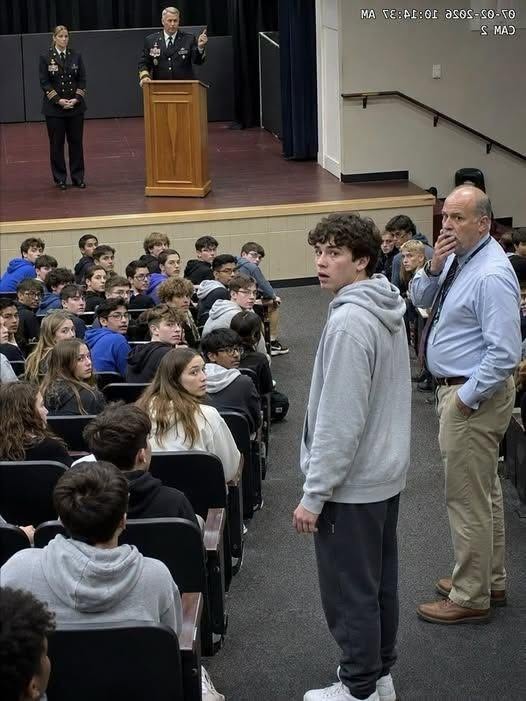
By early afternoon, the school auditorium was packed.
Parents sat beside teachers. Students filled the rows, whispering excitedly as staff members prepared the stage. A large banner reading HEROES WEEK: COURAGE, SERVICE, AND SACRIFICE hung above the curtains.
There were presentations about nurses, police officers, emergency responders, and military veterans.
I sat near the back with my photograph resting on my knees.
Mr. Collins approached me before the program began.
“Ethan,” he said, “I’ve adjusted the schedule. You’ll have a short opportunity to speak about your hero, but please keep your presentation factual.”
I nodded.
“Okay, sir.”
He seemed satisfied, perhaps assuming that I would choose another subject.
When the principal stepped onto the stage, the room grew quiet.
“Heroes Week gives us an opportunity to recognize people who serve others,” she began. “Some heroes are well known. Others work quietly, far from public attention. Today, we are especially grateful to the families who have joined us.”
She introduced several guests.
A firefighter received applause. A nurse spoke about helping patients during difficult moments. A retired service member described the importance of teamwork and responsibility.
Then the principal glanced at a card in her hand.
“Our final guest today is someone whose work requires exceptional training, discipline, and commitment. She has also agreed to share a few thoughts about service and the sacrifices military families make.”
She looked toward the auditorium doors.
“Please welcome Captain Sarah Bennett.”
The doors swung open.
And my mother walked in.
The Moment the Laughter Stopped
She wore her formal military uniform.
Her posture was straight, her expression calm, and her steps measured as she entered the auditorium. A school staff member escorted her toward the stage while the principal welcomed her.
At first, the audience responded with polite applause.
Then I heard someone behind me whisper, “Wait. That’s his mom?”
Jake, who had spent the morning mocking me, leaned forward in his seat.
Mr. Collins stood beside the stage, staring at the program in his hand before looking at my mother again.
She stepped up to the microphone.
“Good afternoon,” she said. “Thank you for inviting me.”
Her voice was steady and clear.
“My name is Captain Sarah Bennett. I serve in the United States Air Force, where my work involves demanding training, teamwork, and a constant commitment to safety and readiness.”
She spoke about the responsibility of military service. She explained that pilots depended on extensive preparation, experienced support crews, and people working together behind the scenes.
She did not boast.
She did not criticize anyone.
She simply spoke about her work with the same quiet confidence I had heard at our kitchen table.
Then she looked across the auditorium.
“I understand that some of you have already heard a little about my job today,” she said.
A few students shifted uncomfortably.
“My son is eleven years old. He’s proud of what I do, and he wanted to share that pride with his classmates. I think that’s a wonderful thing.”
My throat tightened.
She continued.
“But I want to make something clear. The purpose of service isn’t to make a person seem impressive. It’s to accept responsibility, work with others, and do your job with integrity.”
The auditorium was completely silent.
“Children learn how to treat people by watching the adults around them. They learn whether to listen before judging, whether to ask questions respectfully, and whether to admit when they have made a mistake.”
She paused.
“And sometimes, they learn those lessons in a classroom.”
I looked at Mr. Collins.
His face had changed.
The smug expression I had seen that morning was gone. He stood with his hands folded, listening carefully.
My mother wasn’t there to humiliate him.
She was there to teach us something more important.
An Unexpected Invitation
After her remarks, the principal invited students to ask questions.
Hands shot into the air.
One student asked how long it took to become a military pilot. Another wanted to know what kind of preparation pilots needed before flying. Someone else asked whether she ever felt nervous.
My mother answered each question thoughtfully.
“Yes,” she said when asked about fear. “Being brave doesn’t mean you never feel nervous. It means you take your responsibilities seriously, prepare carefully, and know when to ask for help.”
Then Jake raised his hand.
I almost couldn’t believe it.
“Captain Bennett,” he said, “is Ethan really your son?”
A few adults exchanged uncomfortable glances.
My mother smiled gently.
“He certainly is.”
Some students laughed, but this time it wasn’t at me. It was the nervous laughter of people realizing how foolish the morning’s jokes had been.
Jake lowered his hand.
My mother continued answering questions, never making anyone feel stupid for asking.
Finally, the principal invited me to join her onstage.
My legs felt strangely weak as I walked down the aisle.
When I reached my mother, she wrapped one arm around my shoulders.
“Ethan prepared a presentation about his hero,” the principal announced. “We would like him to share it now.”
I unfolded my notes.
For a moment, I couldn’t remember a single word.
Then I looked at my mother.
She gave me the small smile she always used when she wanted me to know that I was safe.
I began.
“My hero is my mom. Her job is important, but that’s not the main reason she’s my hero.”
The room was quiet.
“She’s my hero because she keeps going even when she’s tired. Because she tells me the truth. Because she does difficult things without expecting everyone to clap for her.”
I swallowed.
“Sometimes she has to leave home, and I miss her. Sometimes she can’t tell me everything about her work. But she always reminds me that doing the right thing matters, even when nobody is watching.”
I glanced at the photograph in my hand.
“This morning, people laughed when I said she flies an F-22. I know it sounds unbelievable to some people. But I wasn’t trying to impress anyone. I just wanted to tell them about my mom.”
My voice cracked.
“I wanted them to know how proud I am of her.”
For a moment, nobody moved.
Then someone began clapping.
Another person joined in, followed by the rest of the auditorium.
The applause grew until the entire room was on its feet.
I looked at my mother, who was smiling through tears.
And for the first time that day, I didn’t feel small.
The Apology I Never Expected
After the assembly, students crowded around my mother with questions. Teachers asked about her work, and parents thanked her for speaking.
I stood near the stage, waiting for the crowd to thin.
Mr. Collins approached me.
“Ethan, may I speak with you?”
My stomach tightened automatically.
“Yes, sir.”
He glanced toward my mother before returning his attention to me.
“I owe you an apology,” he said.
I stared at him.
He continued, choosing his words carefully.
“This morning, I assumed you were exaggerating. Instead of asking questions and listening to your explanation, I made you feel as though you had done something wrong by talking about your family.”
He paused.
“I should have handled that differently. I’m sorry.”
I wasn’t sure what to say.
Part of me wanted to tell him how embarrassed I had felt, how much I had wished to disappear, and how unfair it seemed that an adult had joined in making me feel ashamed.
But my mother had taught me that honesty didn’t require cruelty.
“Thank you for saying that,” I replied.
He nodded.
“I also want to make sure you have an opportunity to finish your presentation in class. You shouldn’t have to choose a different hero because people failed to listen.”
For the first time, I saw something different in his expression.
Not embarrassment alone.
Humility.
Later, Jake came over with two other students.
“Hey,” he said, looking at the floor. “Sorry we laughed at you.”
I studied him for a moment.
“Why didn’t you believe me?”
He shrugged uncomfortably.
“I don’t know. It sounded made up.”
I nodded slowly.
“Well, next time, you can ask me instead of calling me a liar.”
He looked up.
“Yeah. You’re right.”
It wasn’t a perfect apology, and it didn’t erase what had happened. But it was a beginning.
What My Mother Told Me on the Way Home
That evening, my mother and I sat in the car outside our house for a few minutes before going inside.
The day had been exhausting. My emotions seemed to arrive in waves: embarrassment, anger, relief, and finally, a strange sense of peace.
“Were you surprised when I walked into the auditorium?” she asked.
I laughed.
“I thought I was going to faint.”
She laughed, too.
“I wish I could have been there this morning.”
“It’s okay.”
“No,” she said gently. “It’s not okay that you were treated that way. But I’m glad we had a chance to talk about it.”
I looked at the photograph resting in my lap.
“Mom, why didn’t you tell everyone you were coming?”
“Because I didn’t want the day to become about proving somebody wrong. I wanted it to be about service, responsibility, and the people who do difficult work without needing attention.”
I considered that.
“Were you angry at Mr. Collins?”
“I was concerned about how he handled the situation. Teachers have an important responsibility. But people can make mistakes, and what matters is whether they are willing to recognize them and do better.”
She reached over and squeezed my hand.
“Ethan, you won’t always be able to convince everyone that you’re telling the truth. You can’t control every opinion someone forms about you.”
“Then what should I do?”
“Be honest. Be respectful. Stand up for yourself when you need to. And remember that someone else’s laughter doesn’t determine your worth.”
I leaned against the seat.
For the first time since morning, I felt completely calm.
The Lesson Our School Never Forgot
The following week, Mr. Collins invited me to deliver my presentation again.
This time, he asked the class to listen without interrupting.
I brought the same photograph.
I told them about my mother’s training, her responsibilities, and the sacrifices that military families sometimes make. I also talked about the ordinary parts of our lives: pancake breakfasts, bedtime stories, and the notes she left in my lunchbox.
When I finished, the classroom remained quiet for a moment.
Then my classmates applauded.
It wasn’t the applause that mattered most.
What mattered was that they had finally listened.
Over the next few weeks, the school began emphasizing a simple idea during class discussions: when something sounds unfamiliar or surprising, ask questions before deciding that someone is lying.
Mr. Collins later told us that he had learned something, too.
“Being a teacher doesn’t mean assuming you know everything,” he said. “It means helping students learn—and being willing to learn alongside them.”
I never forgot that.
Neither did Jake.
He eventually became one of my friends again, although our friendship took time to rebuild. Sometimes he still joked about my mother being able to fly faster than his bicycle, but now he did it with me rather than at me.
And whenever someone asked what my mother did for a living, I answered honestly.
“My mom is a military pilot.”
I no longer needed everyone to believe me immediately.
I knew the truth.
And I knew that the people who mattered would take the time to listen.
Because the greatest lesson of Heroes Week wasn’t that my mother flew an extraordinary aircraft. It was that the people we judge too quickly may have stories we haven’t bothered to understand—and that real courage sometimes means standing quietly in front of a laughing crowd and telling the truth anyway.