Meta Description: I was holding our newborn twins when my wife looked me in the eyes and said something that shattered my world. What happened next revealed a secret that changed everything I thought I knew about our marriage, our family, and the woman I loved.
I Had Both of My Newborn Twins in My Arms When My Wife Looked at Me and Said, “I Need to Tell You Something…”
I had both of my newborn twins in my arms when my wife looked at me and said seven words that changed my life forever.
“Daniel, there’s something you need to know.”
Her voice was so quiet that, at first, I thought I had misunderstood her.
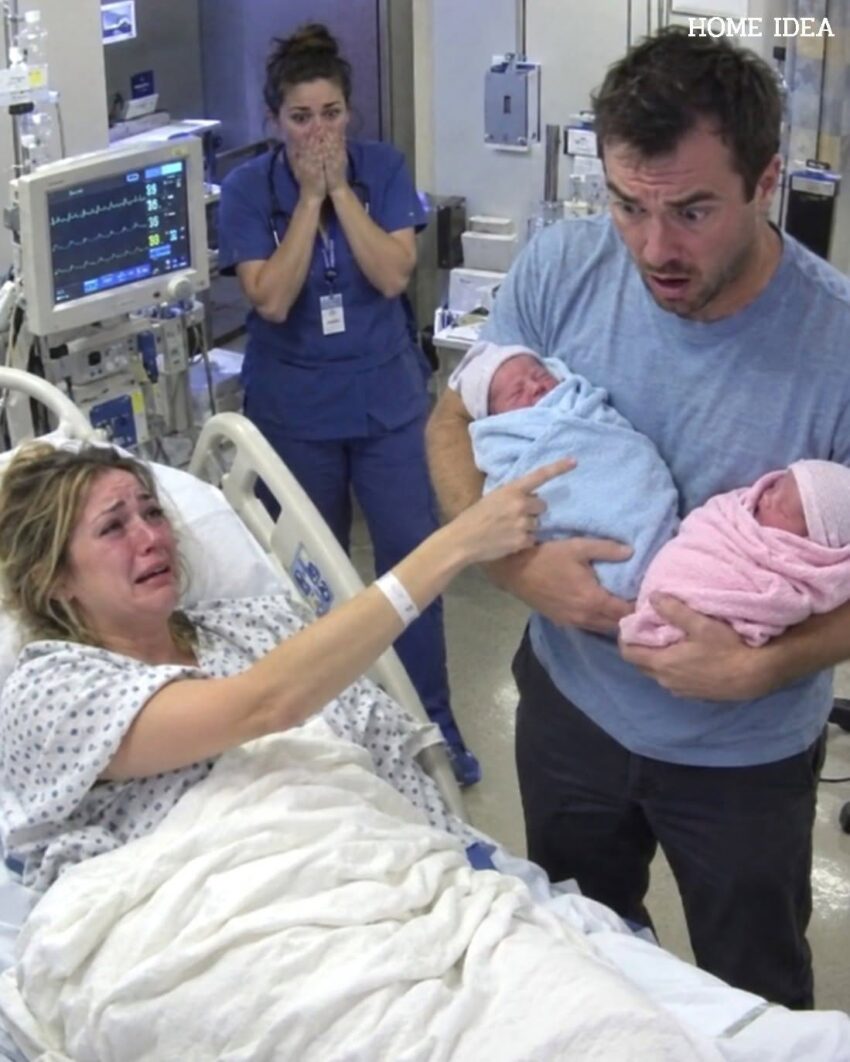
I was standing beside the hospital bed, holding our daughter in my left arm and our son in my right. They were only a few hours old, wrapped in matching white blankets, their tiny faces peaceful against my chest.
I had spent nine months imagining this moment.
I imagined my wife, Claire, smiling at me through happy tears. I imagined us choosing names, taking photographs, and arguing playfully about which twin looked more like whom.
I imagined bringing our babies home and beginning the happiest chapter of our lives.
I never imagined that my wife would look at me from that hospital bed as though she were about to confess a crime.
“What is it?” I asked.
Claire glanced toward the closed hospital door.
Then she looked at our babies.
“I didn’t tell you the whole truth about something that happened before we got married.”
My arms tightened around the twins.
“What truth?”
She began to cry.
And before she could answer, someone knocked on the door.
The Visitor Neither of Us Expected
I turned toward the entrance.
A nurse stepped inside, followed by an older man wearing a dark coat. He looked exhausted, as though he had driven through the night.
Claire immediately covered her mouth.
The man stopped when he saw me holding the babies.
For several seconds, nobody spoke.
Then he looked directly at Claire.
“You were going to tell him today?”
She closed her eyes.
I felt as if the room had suddenly become smaller.
“Who are you?” I asked.
The stranger didn’t answer immediately. Instead, he stared at the little girl in my arms, then at the boy resting against my other shoulder.
His expression changed.
Not with surprise.
With grief.
“I’m sorry,” he finally said. “I didn’t want to come here like this.”
I looked at Claire.
She was trembling.
“Daniel,” she whispered, “this is my father.”
I blinked.
Her father?
For five years, Claire had told me that her father had died when she was a teenager. She had spoken about him only a handful of times, always with a sadness that made me reluctant to ask questions.
I had never met him.
I had never received a letter from him.
And now he was standing in the hospital room where my children had been born.
“Your father is dead,” I said.
Claire began sobbing.
“That’s what I told you.”
The older man lowered his eyes.
“And that,” he said quietly, “is why we need to talk.”
The Secret Behind My Wife’s Past
Claire and I had met eight years earlier at a friend’s birthday party.
She was funny, thoughtful, and the sort of person who remembered small details about everyone she met. She knew when I was pretending to be fine and could make me laugh even after the worst day at work.
I fell in love with her gradually.
First, I loved the way she laughed.
Then I loved the way she treated people.
Eventually, I realized I wanted to spend the rest of my life beside her.
We married three years later.
During our engagement, Claire told me that her father had died after a long illness. She said she had barely spoken to him during his final years and that their relationship had been complicated.
I never pressed her for details.
Everyone has painful memories, I believed, and love doesn’t require someone to explain every wound before they are ready.
But there were things I had never understood.
Why did Claire become unusually quiet whenever someone mentioned family reunions?
Why did she keep an old photograph locked inside a desk drawer?
Why had she refused to invite any relatives to our wedding, insisting that she wanted a small ceremony?
I had accepted her explanations because I loved her.
Now, standing beside our newborn twins, I wondered how much of our life together I had misunderstood.
“Claire,” I said, struggling to keep my voice steady, “you told me your father died.”
“He was gone from my life,” she replied through tears. “But I shouldn’t have told you he was dead.”
Her father pulled a chair toward the bed.
“May I explain?”
I looked at the twins.
My daughter had begun moving her tiny hands inside her blanket. My son made a soft sound against my chest.
I wanted to be happy.
I wanted to focus on the two new lives I was holding.
But the woman I loved had just revealed that an important part of her history was not what she had told me.
I nodded.
“Please explain.”
Why Claire Had Cut Her Father Out of Her Life
Her father introduced himself as Robert Miller.
He explained that he and Claire’s mother had separated when Claire was sixteen. The separation had been bitter, and the family had spent years arguing over money, responsibilities, and where Claire would live.
Robert admitted that he had made mistakes.
He had worked too much. He had missed important moments in Claire’s life. During the divorce, he had allowed his anger toward his former wife to affect his relationship with his daughter.
Eventually, Claire stopped answering his calls.
Then her mother moved with her to another city.
For years, father and daughter barely communicated.
“I thought she would eventually call me,” Robert said. “I kept telling myself she needed time.”
Claire stared at the hospital blanket.
“I was a teenager,” she whispered. “I needed you then.”
Robert nodded slowly.
“I know.”
He didn’t try to defend himself.
He explained that he had sent letters and birthday cards, but Claire had returned several of them unopened. After a while, he stopped sending them because he believed she wanted nothing to do with him.
Then, several years later, he learned through a relative that Claire had married.
He wanted to contact her, but he was afraid of reopening old wounds.
“I should have tried harder,” he said. “I know that now.”
I listened, still trying to understand why Claire had told me that he was dead.
Finally, I asked the question that had been sitting in my chest.
“Why did you tell me you had lost your father forever?”
Claire looked at me.
“Because I didn’t want to explain what happened. Every time someone asked about him, I felt like I had to choose between defending him and explaining why I couldn’t forgive him.”
She wiped her cheeks.
“I thought if I told you he was dead, the questions would stop.”
I understood the fear behind her words.
But understanding did not make the lie disappear.
“You could have told me you weren’t ready to talk about it,” I said. “I would have respected that.”
“I know.”
“Why didn’t you trust me with the truth?”
She looked down at our children.
“Because I was afraid you would think I was a terrible daughter.”
For a long moment, I couldn’t find an answer.
Then Robert spoke.
“This isn’t just about me. Claire asked me to come because she wanted to tell you the truth herself. She didn’t know how to begin.”
I turned toward him.
“You knew about the twins?”
He nodded.
“She called me two weeks ago.”
Claire looked at me desperately.
“I wanted to tell you before the babies arrived. But every time I tried, I became frightened. Then the labor started, and everything happened so quickly.”
I glanced at the clock on the wall.
Our twins had been born less than six hours earlier.
I was exhausted, overwhelmed, and deeply hurt.
But I could also see that Claire was frightened—not only of losing me, but of finally facing a past she had spent years trying to bury.
The Question I Asked While Holding Our Children
I sat carefully in the chair beside her bed.
Our daughter slept in my arms, her tiny mouth slightly open. Our son had curled one hand around my finger.
I looked at Claire.
“Is there anything else I need to know?”
She hesitated.
That hesitation frightened me more than anything she had said so far.
“Claire?”
“No,” she whispered. “Not about our marriage. I haven’t been hiding another relationship or anything like that. I was hiding what happened with my family.”
I searched her face.
“Are you sure?”
“Yes.”
She reached toward our son but stopped before touching his blanket.
“I know I hurt you. I know this isn’t the way you should have found out. But I don’t want our children to grow up believing that secrets are the only way to protect ourselves.”
Her words stayed with me.
I thought about the twins’ future.
One day, they would ask about their grandparents. They would want photographs, family stories, and explanations for the complicated relationships that shaped their lives.
I didn’t want them to inherit a family history built on falsehoods.
But I also didn’t want to force Claire into a reconciliation she wasn’t ready for.
“I’m not going to decide what happens with your father today,” I said. “And I’m not going to make you forgive him because we have children now.”
Claire nodded, tears falling down her face.
“But I need honesty between us. Even when the truth is painful. Especially then.”
“I understand.”
“Can you promise me that?”
She looked directly into my eyes.
“I promise.”
It wasn’t a magical solution.
The hurt didn’t vanish, and trust wasn’t restored in a single conversation.
But it was the first honest promise she had made since the conversation began.
What Happened When the Nurse Returned
A few minutes later, the nurse came back to check on Claire and the babies.
She noticed the tension in the room but didn’t ask questions. She checked the twins, reminded us about feeding and rest, and explained the next steps before leaving us alone again.
Robert stood near the window.
“I should go,” he said. “You’ve had enough to deal with today.”
Claire looked at him.
For a moment, I thought she might ask him to stay.
Instead, she said, “I don’t know how to have a relationship with you again.”
He nodded.
“You don’t have to know today.”
“I don’t know if I can forgive you.”
“You don’t owe me forgiveness.”
His answer surprised me.
He continued, “I came because you asked me to. I wanted to see you and meet my grandchildren, but I know I can’t walk into your life after all these years and expect everything to be fine.”
Claire began to cry again.
Robert approached the bed, stopping a respectful distance away.
“May I see them?” he asked.
Claire looked at me.
I wasn’t sure what I felt. Part of me wanted to protect our little family from any further surprises. Another part recognized that the babies were not responsible for the mistakes the adults had made.
“They’re your grandchildren,” Claire said quietly. “You can meet them.”
I moved closer so he could see their faces.
Robert looked at the twins, and tears filled his eyes.
“They’re beautiful,” he whispered.
He didn’t ask to hold them. He didn’t demand a photograph. He simply stood there for a moment, taking in the fact that his daughter had become a mother.
Then he turned toward Claire.
“I hope I can do better this time.”
She didn’t answer.
But she didn’t look away, either.
When he left, the room became quiet again.
I looked at my wife, and she reached for my hand.
“I’m sorry,” she whispered.
I squeezed her fingers.
“We’ll work through this. But we have to do it honestly.”
The First Night as a Family of Four
That night, after Robert had gone and the hospital lights had dimmed, I sat beside the bassinets and watched our twins sleep.
Our daughter was named Grace.
Our son was named Noah.
We had chosen their names months earlier, long before I knew that their arrival would bring an unexpected reunion into our lives.
Claire lay in bed, exhausted.
“Do you regret marrying me?” she asked suddenly.
I looked at her.
“No.”
“Even after today?”
I thought carefully before answering.
“I love you. But loving you doesn’t mean every decision you make is okay. What happened today hurt me, and we’ll need to talk about it again when we’re home and rested.”
She nodded.
“I understand.”
“I don’t want us to pretend this didn’t happen. I also don’t want one difficult day to define our whole marriage.”
She reached for my hand.
For a while, we sat together in silence.
Then Noah began crying.
I lifted him from his bassinet, checked his blanket, and gently rocked him while Grace slept.
Claire watched me.
“Are you scared?” she asked.
I laughed quietly.
“Terrified.”
She smiled for the first time in hours.
“Me too.”
I looked down at our son.
“Then I guess we’ll learn together.”
For the first time that day, the future didn’t seem like something I had to solve immediately.
It was something we would build, one honest conversation at a time.
Six Months Later, I Finally Understood
The months that followed were not easy.
Sleep deprivation made every problem feel bigger. Caring for twins required patience we sometimes struggled to find. Claire and I had difficult conversations about trust, family, and the years she had spent avoiding her past.
We also began speaking with a couples counselor, who helped us discuss the difference between privacy and secrecy.
Claire learned that she could set boundaries with her father without inventing a story about his death.
I learned that supporting my wife did not mean ignoring the impact her choices had on me.
And Robert learned that becoming part of our family again would require consistency rather than grand gestures.
He began by sending occasional messages. Claire responded when she felt ready. Eventually, she agreed to meet him for lunch.
Their relationship remained complicated.
Some conversations went well. Others ended with Claire needing time to herself.
There was no dramatic moment when every old wound disappeared.
Instead, there were small changes.
An honest answer where there had once been an excuse.
A sincere apology without a demand for forgiveness.
A phone call answered after years of silence.
By the twins’ first birthday, Robert had become a familiar face in their lives, although Claire continued to decide what level of contact felt healthy for her.
One afternoon, I found her sitting on the floor beside Grace and Noah, helping them stack colorful blocks.
She looked up at me.
“I used to think that telling the truth would destroy everything,” she said.
I sat beside her.
“And now?”
“Now I think hiding it was making everything harder.”
I nodded.
“Sometimes the truth hurts because it changes what we thought we knew. But it also gives us something real to work with.”
She leaned against my shoulder.
I kissed the top of her head.
We still had work to do.
But we were no longer pretending the difficult parts of our lives didn’t exist.
The Lesson I Learned While Holding My Newborn Twins
I had imagined the day my children were born as a moment of pure happiness.
I expected photographs, tears of joy, and promises about the wonderful life we would give them.
Instead, I learned that even the happiest moments can contain complicated truths.
My wife had carried a painful family history for years. Her fear had led her to hide it from me, and that choice hurt our marriage.
But the discovery also forced us to confront something important: a family cannot build lasting trust by avoiding every uncomfortable conversation.
We cannot change the past.
We cannot force someone to forgive us.
And we cannot make every relationship work simply because we wish it would.
What we can do is tell the truth, accept responsibility, establish healthy boundaries, and choose our next steps with care.
As I watched Grace and Noah grow, I began to understand that the most important gift we could give them wasn’t a perfect family history.
It was a home where they would never have to pretend that difficult feelings didn’t exist.
A home where questions were welcome.
A home where mistakes could be acknowledged without pretending they didn’t matter.
And a home where love and honesty could exist together.
That was the promise I made to my children during their first night in the world.
Not that I would always know the right answer.
Not that our family would never face another painful surprise.
But that I would keep showing up, keep listening, and keep working to make our home a place where the truth could be spoken safely.
Because the day my wife looked at me while I held our newborn twins, I learned something I would never forget:
A family’s future is not determined by the secrets it has kept, but by what its members choose to do once the truth finally comes to light.