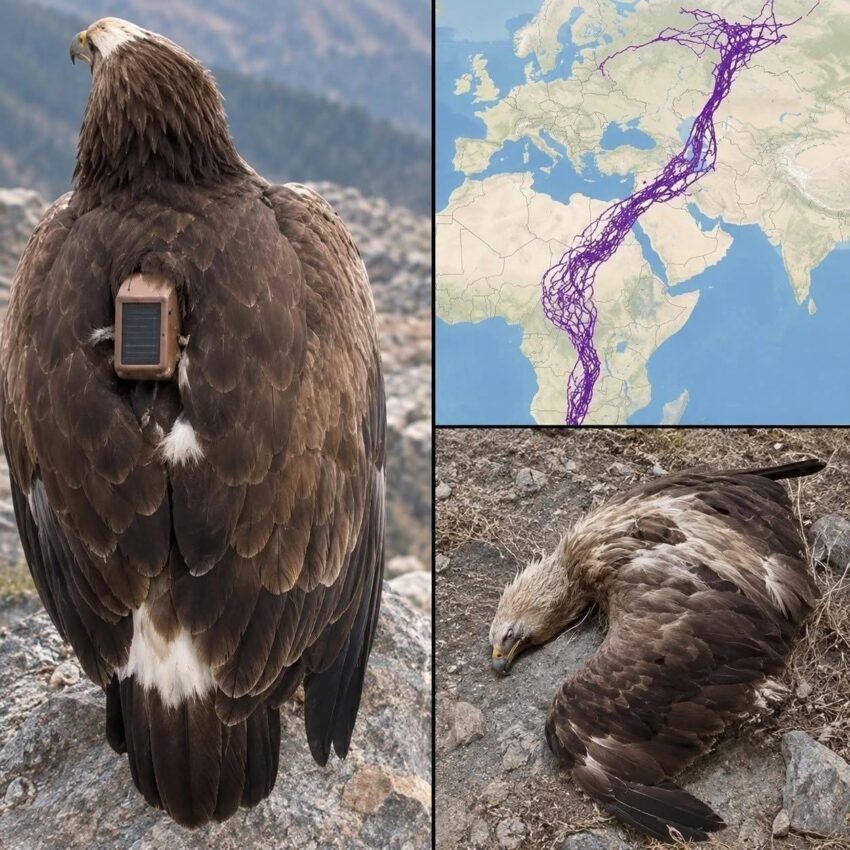
Scientists use satellite tracking to uncover the hidden lives of eagles, revealing remarkable migration routes, hunting habitats, survival strategies, and the importance of protecting their environment.
For centuries, eagles have fascinated people with their incredible eyesight, powerful wings, and ability to soar high above mountains and valleys. Yet even these famous birds have secrets that are difficult to uncover through ordinary observation.
Where do they go when they disappear from their nesting areas? How far can they travel in search of food? Do young eagles follow the same routes as adults? And how do they survive in landscapes that change throughout the year?
Modern wildlife tracking has helped scientists answer many of these questions. By fitting eagles with lightweight satellite transmitters, researchers can follow their movements over vast distances and discover patterns that would otherwise remain hidden.
Although the popular headline about tracking an eagle for 20 years does not identify a verifiable individual study, real eagle-tracking research has produced remarkable findings about migration, habitat use, and survival.
How Scientists Track Eagles Across Vast Landscapes
In the past, researchers depended heavily on field observations, bird banding, and occasional sightings. These methods provided valuable information, but they could not reveal every stage of a bird’s journey.
Satellite tracking changed that.
Scientists can attach a lightweight transmitter to an eagle using a specially designed harness. Depending on the device, it may record GPS coordinates and send information through satellite or cellular networks.
Researchers can then map where the bird travels, how often it returns to particular areas, and how its movements change with the seasons.
The U.S. Geological Survey has preserved satellite and radio-tracking records from golden eagles studied in western North America during the 1990s. That project included 21 satellite-tagged golden eagles, with some also fitted with radio transmitters for additional observations.
These records help scientists understand how eagles move between breeding and wintering areas.
1. Eagles Do Not Always Follow Simple Migration Routes
One of the most valuable discoveries from tracking studies is that eagle movements can be more complicated than a simple journey from one place to another.
Some eagles remain within a relatively familiar territory for much of the year. Others travel long distances between breeding and wintering grounds.
Their routes may depend on several factors, including age, weather, food availability, and the location of suitable habitats.
For example, research on eastern imperial eagles tracked in Central Asia found that birds tagged in Kazakhstan traveled to wintering areas across the Arabian Peninsula, Iran, and India.
The researchers also observed differences between adult and younger birds. The adult eagle tracked in the study migrated more efficiently than the four younger birds.
This demonstrates that age and experience may influence how eagles navigate their environment.
2. Weather Can Help Determine Where Eagles Fly
Eagles are powerful fliers, but soaring for long distances requires energy.
Fortunately, these birds can take advantage of rising air currents. Warm air rising from the ground creates thermals, while wind flowing upward over mountains and ridges creates orographic updrafts.
By circling within these rising currents, eagles can gain altitude without continuously flapping their wings.
Tracking research on eastern imperial eagles found that the birds used different types of rising air currents during seasonal migrations. Orographic updrafts helped during autumn migration, while thermal updrafts were important during spring migration.
These findings reveal how birds use the physical characteristics of the landscape to travel more efficiently.
Weather is therefore more than background scenery in an eagle’s life. It can influence when and where the bird travels.
3. Food Availability Influences an Eagle’s Movements
Eagles are predators, and their survival depends on finding enough suitable prey.
Depending on the species and habitat, their food may include small mammals, birds, reptiles, and other animals.
When prey is plentiful, an eagle may spend more time hunting within a familiar area. When food becomes scarce, it may explore a larger region or move to a different habitat.
Tracking data can help researchers identify these changes by showing where a bird repeatedly travels and which areas it uses during different seasons.
However, location data alone cannot explain every movement. Scientists often need to combine tracking records with field observations, prey surveys, and environmental information to understand why an eagle chooses a particular location.
4. Young Eagles May Behave Differently From Adults
A young eagle’s life can look very different from that of an established adult.
After leaving the nest, a juvenile must learn to hunt efficiently, recognize suitable habitats, and navigate its surroundings. It may explore areas that an experienced adult would not normally visit.
Research on golden eagles in Alaska has shown that young birds can use important summer areas far from their nesting locations before entering the breeding population.
These discoveries matter because protecting adult nesting territories alone may not be enough to support an entire population.
Young eagles also need safe places to feed, rest, and develop the skills necessary for survival.
Long-term observations allow scientists to distinguish temporary exploration from recurring patterns in how birds use the landscape.
5. Tracking Helps Scientists Identify Important Habitats
An eagle may cross a huge region during migration, but not every location is equally important.
Some places provide reliable food. Others offer suitable nesting sites, safe resting areas, or favorable conditions for soaring.
When researchers examine tracking records over time, they can identify locations that birds use repeatedly.
These areas can become important considerations in conservation planning.
For instance, researchers may discover that a particular mountain ridge provides valuable rising air currents or that a specific region serves as an important seasonal feeding ground.
Protecting these locations can help wildlife managers make more informed decisions about land use, development, and habitat preservation.
6. Tracking Can Reveal Hidden Threats to Eagles
Modern landscapes contain hazards that can be difficult to assess through occasional observations.
Roads, power infrastructure, habitat loss, and wind turbines can all affect large birds of prey.
Tracking data can help researchers understand how frequently eagles enter areas where these hazards exist.
The information can be especially valuable around wind farms, where the flight paths of large birds may overlap with turbine locations.
However, being recorded near a hazard does not automatically mean a bird has been injured or is certain to collide with it. Scientists must interpret movement data carefully and, where possible, combine it with direct observations.
The goal is to identify risks early and develop practical measures that reduce harm to wildlife.
7. Why Long-Term Tracking Matters
A few days of observations can provide a snapshot of an eagle’s behavior. Several years of tracking can reveal seasonal routines and recurring patterns.
Longer records may help researchers investigate questions such as:
- Do individual eagles return to the same breeding or wintering areas?
- How do migration routes change with environmental conditions?
- Do young birds use different habitats from adults?
- Which areas are essential for feeding and resting?
- How might habitat changes affect the birds over time?
Not every tracking project lasts 20 years, and transmitters do not necessarily operate for an entire bird’s lifetime. Batteries, equipment failure, and other limitations can interrupt data collection.
Nevertheless, combining multiple years of tracking with field observations can provide an increasingly detailed picture of an eagle’s life.
What These Discoveries Mean for Conservation
Eagles are important predators within their ecosystems. Their presence can provide valuable information about habitat quality and the availability of prey.
Yet many birds of prey face pressures from human activities and environmental change.
Satellite tracking helps conservationists identify important habitats, understand migration corridors, and investigate potential threats.
The findings can guide decisions about protected areas, infrastructure planning, and wildlife management.
Just as importantly, tracking reminds researchers that protecting a species requires more than preserving the place where it builds its nest. Birds may depend on several different regions throughout their lives, sometimes separated by enormous distances.
Effective conservation must consider this wider landscape.
Conclusion: An Eagle’s Journey Reveals More Than Its Flight Path
The real scientific story behind eagle tracking is fascinating because it reveals how closely animal behavior is connected to the environment.
Tracking research has shown that eagles can travel between distant regions, take advantage of rising air currents, change their movements with age, and depend on habitats that may be separated by hundreds or thousands of miles.
These findings help scientists understand the challenges eagles face and identify practical ways to protect them.
The claim that scientists tracked one particular eagle for exactly 20 years should be treated cautiously unless the original study can be identified. But the broader lesson is well supported: the more carefully researchers follow wildlife over time, the more they learn about the hidden journeys that shape an animal’s life.
Sometimes, the greatest discovery is not a single surprising moment. It is the understanding that emerges when scientists patiently observe nature over many years.