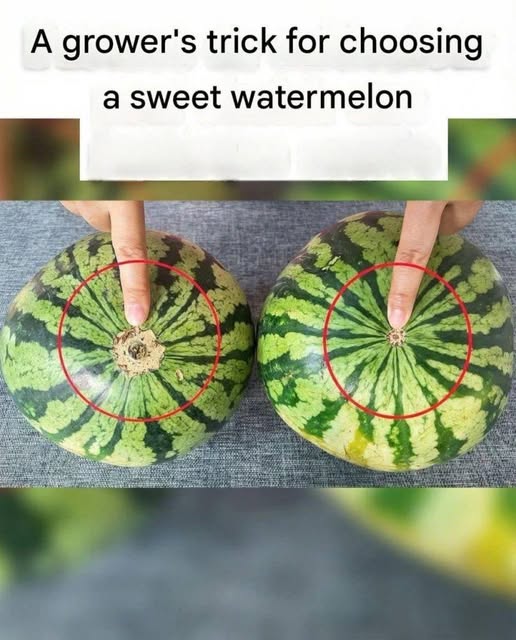
Stop choosing bland watermelons! Learn the simple visual clues that can help you spot a sweeter, riper watermelon at the market without cutting it open.
No More Bland Watermelons! Here’s How to Pick the Sweetest One
There’s nothing more disappointing than bringing home a beautiful watermelon, cutting it open, and discovering that it’s pale, watery, or almost tasteless.
The good news is that you can learn to judge a watermelon from the outside. While no visual trick can guarantee sweetness every time, several signs can help you choose a better melon.
🍉 1. Look for a Large Yellow Field Spot
This is one of the most useful clues.
Turn the watermelon over and look for the field spot—the area where it rested on the ground while growing.
A creamy yellow or deep yellow spot generally indicates that the melon spent enough time ripening on the vine.
A very pale white or greenish spot may suggest that it was harvested earlier.
Look for: a prominent, creamy-to-yellow patch rather than a tiny white mark.
🍉 2. Choose a Watermelon That Feels Heavy
Pick up a few melons that are roughly the same size.
Choose the one that feels heaviest for its size.
A heavier watermelon generally contains plenty of water, which is exactly what you want from a juicy melon.
This isn’t a direct guarantee of sweetness, but it’s a useful clue when comparing several melons.
🍉 3. Check the Webbing and Brown Marks
Those rough, brown, web-like lines on the rind aren’t necessarily something to avoid.
They can be associated with areas where the flower or fruit experienced stress during development.
Many shoppers prefer watermelons with more pronounced brown webbing or sugar spots, although these markings shouldn’t be treated as a foolproof sweetness test.
Think of them as one clue among several.
🍉 4. Look for a Dull, Not Shiny, Rind
A watermelon that’s ready to eat often has a duller, less glossy appearance.
A very shiny green rind can sometimes indicate that the fruit isn’t as mature.
Instead of looking for the brightest, prettiest watermelon, look for one with a more matte, well-developed rind.
🍉 5. Check the Shape
Look for a watermelon that is:
- Well rounded or evenly shaped
- Firm
- Free from major dents
- Free from soft, sunken areas
- Symmetrical rather than severely misshapen
An evenly developed melon is generally a better choice than one with obvious deformities or damaged areas.
🍉 6. Don’t Ignore the Stem
If the stem is still attached, take a look at it.
A dry, brownish stem can indicate that the watermelon had time to mature before being harvested.
A very green stem may indicate more recent harvesting, although the stem alone can’t tell you whether the fruit will be sweet.
🍉 7. Give It a Gentle Tap
You’ve probably seen people knocking on watermelons at the market.
The idea is that a ripe watermelon should produce a deep, resonant sound, rather than a dull thud.
However, tapping isn’t a scientifically reliable way to determine sweetness by itself. Use it as an additional clue rather than the deciding factor.
The Best Strategy: Combine Several Clues
Don’t rely on just one characteristic.
Instead, look for a watermelon that is:
Heavy for its size + has a large yellow field spot + looks mature and dull + feels firm + has no major soft spots.
That combination gives you a much better chance of taking home a juicy, flavorful watermelon.
One More Important Tip
Once you’ve selected your watermelon, don’t judge it solely by appearance. Different varieties naturally have different rind patterns, shapes, and colors.
And remember: the sweetest watermelon isn’t necessarily the biggest or most attractive one.
Next time you’re at the market, slow down, turn a few melons over, compare their weight, and check that yellow field spot. You might be surprised how much you can learn about a watermelon before ever reaching for a knife.