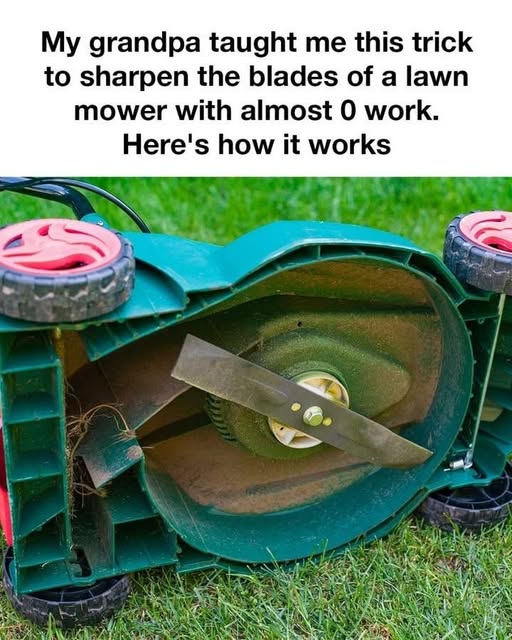
Learn how to safely sharpen a lawn mower blade at home with minimal effort. Discover the easiest sharpening methods, how to remove the blade safely, and how to know when it needs replacing.
My Grandpa Taught Me This Trick to Sharpen Lawn Mower Blades With Almost No Work—Here’s How It Works
A dull lawn mower blade can make mowing frustrating. Instead of producing clean cuts, it can tear and shred grass, leaving the lawn looking uneven and sometimes causing the grass tips to appear brown.
The good news is that sharpening a mower blade doesn’t necessarily require an expensive professional service. With the right tools and a few safety precautions, you can restore a reasonably sharp cutting edge at home.
The important part is to avoid shortcuts that involve running the mower or allowing the blade to spin while sharpening. The blade should always be removed or completely immobilized before you work on it.
Why Does a Mower Blade Become Dull?
Mower blades regularly encounter more than grass.
Over time, they can hit:
- Small stones
- Twigs
- Soil
- Roots
- Pine cones
- Hard debris
These impacts gradually wear down the cutting edge and can create small nicks.
A blade doesn’t need to be razor-sharp like a kitchen knife. In fact, an overly thin or razor-like edge can become damaged more easily. The goal is a clean, even cutting edge that is properly balanced.
The Easy Sharpening Method
For a typical rotary mower, one of the simplest approaches is using a metal file or purpose-made mower-blade sharpener.
1. Turn the Mower Completely Off
Before touching anything underneath the mower, disconnect its power source.
For a gasoline mower, remove the spark-plug wire and secure it away from the plug. For battery-powered models, remove the battery according to the manufacturer’s instructions.
Don’t rely solely on the mower’s ignition switch.
If you’re working with a model that has additional starting or safety systems, follow the manufacturer’s instructions before accessing the blade.
2. Remove the Blade
If possible, remove the blade rather than trying to sharpen it while it’s underneath the mower.
Wear sturdy gloves when handling the blade, but remember that gloves don’t make a sharp blade harmless.
Before removing the blade, take note of its orientation so you reinstall it correctly.
A block of wood can sometimes be used to prevent the blade from rotating while loosening the fastener, but use the procedure recommended in your mower’s manual.
3. Clean the Blade
Brush away accumulated grass and dirt so you can clearly see the cutting edge.
This is also a good opportunity to inspect the blade for:
- Large cracks
- Severe bends
- Deep corrosion
- Missing pieces
- Excessive wear
- Major dents
If the blade is cracked, badly bent, or significantly damaged, replace it rather than trying to sharpen it back into shape.
4. Sharpen the Cutting Edge
Secure the blade firmly.
Using a mill file or mower-blade sharpening tool, follow the existing bevel of the cutting edge. Work in one direction rather than aggressively sawing back and forth.
You don’t need to remove a huge amount of metal.
The objective is simply to restore a consistent edge and remove small nicks.
What about a power grinder?
A bench grinder or angle grinder can sharpen mower blades much faster, but it also removes metal quickly and can generate significant heat.
If you use a power tool, take light passes and avoid overheating the blade. Excessive heat can affect the metal’s properties.
For many homeowners, a hand file is slower but gives much better control.
5. Keep Both Sides Even
This is one of the most important parts.
Don’t aggressively sharpen one end of the blade while barely touching the other.
The cutting edges should remain approximately symmetrical.
An uneven blade can become unbalanced, which may cause vibration when the mower operates.
6. Check the Blade Balance
After sharpening, check whether the blade remains balanced.
A simple blade-balancing tool is inexpensive and specifically designed for this purpose.
If one side consistently drops lower than the other, that side is heavier.
Remove only a small amount of material from the heavier side and check again.
Never try to fix an unbalanced blade by randomly grinding large amounts of metal away.
7. Reinstall It Correctly
Once the blade is sharp, clean, and balanced, reinstall it according to the mower manufacturer’s instructions.
Make sure the blade is facing the correct direction and that the retaining hardware is installed and tightened to the manufacturer’s specified torque.
Don’t guess at the torque if the manual provides a specification.
Can You Really Sharpen a Blade With “Almost No Work”?
There are products marketed as quick mower-blade sharpeners that attach to drills or other power tools.
They can make the process faster, but they aren’t magic. You still need to:
- Secure the blade.
- Maintain the correct bevel.
- Avoid removing excessive metal.
- Keep both sides reasonably equal.
- Check the blade balance afterward.
The best sharpening method is the one that lets you maintain the correct shape and balance safely, rather than simply removing metal as quickly as possible.
How Do You Know Your Blade Needs Sharpening?
Look at the grass after mowing.
A blade may need attention if you notice:
- Ragged or torn grass tips
- Uneven cutting
- Strips of uncut grass
- Excessive vibration
- The mower struggling more than usual
- Visible nicks along the cutting edge
A healthy, properly sharpened blade should cut grass cleanly rather than repeatedly smashing or tearing it.
Don’t Forget the Blade’s Condition
Sharpening isn’t always the answer.
If the blade is cracked, severely bent, deeply damaged, or excessively worn, replacing it is safer than trying to restore it.
And if the mower vibrates heavily after you’ve sharpened and reinstalled the blade, stop using it and investigate the cause. Persistent vibration can indicate an unbalanced or damaged blade or another mechanical problem.
The Bottom Line
You don’t need to make mower-blade sharpening complicated. For many homeowners, a good file, a secure work surface, and a little patience are enough to restore a dull blade.
The real trick isn’t making the blade razor-sharp—it’s keeping the cutting edge even, correctly angled, and balanced.
And most importantly, never attempt to sharpen or handle a mower blade while the mower could accidentally start or the blade could move. A few extra minutes spent making the mower completely safe are worth far more than saving a few minutes on sharpening.