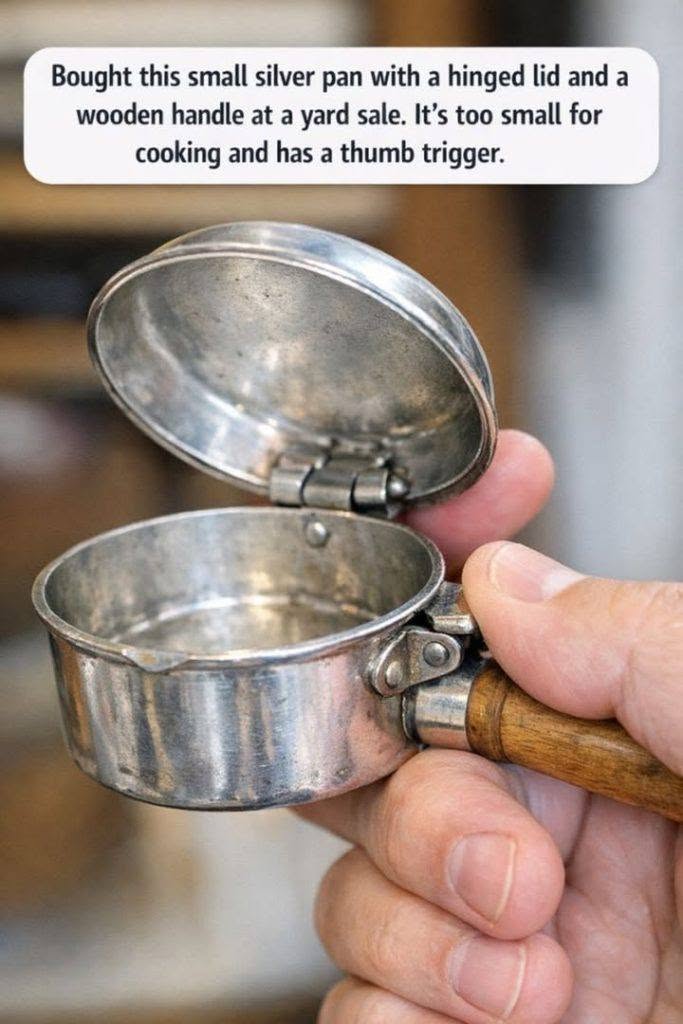
Found a tiny silver pan with a hinged lid, wooden handle, and thumb trigger? It may be a vintage silent butler, once used to collect table crumbs and household ash.
That Tiny Silver “Pan” Probably Wasn’t a Pan at All
Yard sales are full of objects that seem completely ordinary until you notice one strange detail.
That is exactly what makes this little silver-colored pan so fascinating.
It has a shallow metal body, a hinged lid, a wooden handle, and a small thumb-operated mechanism. At first glance, it looks like miniature cookware. But there is one obvious problem:
It is far too small for practical cooking.
So what was it?
The unusual combination of a lidded metal container, long wooden handle, and thumb trigger provides a major clue. Objects with this design were commonly made as silent butlers, also called crumb catchers or ash butlers.
Vintage examples with silver plating, wooden handles, hinged lids, and thumb-operated mechanisms are documented in antique and collectible listings.
What Is a Silent Butler?
A silent butler was a small household cleaning tool designed to collect unwanted debris discreetly.
Rather than being used to cook food, it was used to pick up things such as:
- Table crumbs
- Food particles
- Fireplace ash
- Cigarette or cigar ash
- Small bits of debris
- Other material that needed to be swept away
The name “silent butler” comes from the idea that the device allowed household cleaning to happen quietly and efficiently without the noise or inconvenience of a larger dustpan.
It was particularly associated with more formal households where keeping dining rooms, sitting rooms, and entertaining areas neat was important.
The Thumb Trigger Is the Big Clue
The feature that makes your description especially interesting is the thumb trigger.
That little mechanism wasn’t decorative.
On many silent butlers, the user could hold the wooden handle and operate the lid with a thumb tab or trigger. Pressing or pulling the mechanism releases the lid, allowing it to open without requiring the user to touch the dirty or dusty container.
Vintage examples specifically describe a hinged lid operated from the handle by a thumb tab.
It was a clever bit of household engineering for its time.
Imagine brushing crumbs from a formal dining table with a small hand brush. Instead of using your other hand to open a container, you simply operate the mechanism with your thumb and sweep the debris inside.
The lid could then be closed again.
Simple, clean, and discreet.
Why Does It Look Like a Tiny Frying Pan?
That’s probably the most confusing part.
The basic shape resembles a miniature pan because it consists of a shallow metal receptacle with a handle.
But the construction gives away its real purpose.
A cooking pan normally needs to tolerate significant heat. A silent butler, by contrast, was designed as a collection container.
The wooden handle is another clue. Although wood can certainly be used on some cooking utensils, combining a wooden handle with a hinged cover and thumb-operated lid makes much more sense for a cleaning implement than a tiny cooking vessel.
Some vintage examples are around six to seven inches across, making them roughly the size that might initially be mistaken for miniature cookware.
How Did People Use It?
The most recognizable use was cleaning crumbs from a dining table.
Picture a formal meal from decades ago.
After dinner, small crumbs would remain on the tablecloth or tabletop. Instead of immediately clearing everything away, someone could use a small brush to sweep those crumbs toward the edge of the table and into the silent butler.
The hinged lid helped contain the debris.
The same basic idea could be used in sitting rooms and other areas of the house.
Some examples were also used for collecting ash from fireplaces, ashtrays, or smoking areas. Antique examples are specifically described as being used for crumbs and ash.
Why Was It Called “Silent”?
The word “silent” is part of the charm.
Before modern vacuum cleaners and convenient disposable cleaning products became commonplace, household cleaning involved a variety of small specialized tools.
A silent butler made it possible to remove crumbs or ash without dragging a large dustpan around or disturbing people in the room.
In formal dining and entertaining environments, discreet cleaning was particularly useful.
The object therefore wasn’t simply a container.
It represented an entire approach to household management.
Silver-Colored Doesn’t Necessarily Mean Solid Silver
Another important point for anyone who finds one at a yard sale:
Don’t assume that a silver-colored object is made from solid silver.
Many vintage silent butlers were made from metal with a silver-plated finish.
For example, surviving examples are described as stainless steel with silver plate, while others are identified as silver plate over copper.
This distinction can make a huge difference when determining value.
A genuine sterling-silver piece could be substantially more valuable than an ordinary silver-plated household item.
That’s why markings are important.
Check the Bottom for Marks
Before polishing your yard-sale discovery, turn it over carefully.
Look for:
- Maker’s names
- Company logos
- “Sterling”
- “925”
- “Silver Plate”
- “EPNS”
- “EPC”
- Patent numbers
- Country-of-origin marks
- Engraved initials
- Model numbers
Even a tiny mark can help establish where and when the object was manufactured.
One vintage example, for instance, is identified as an F.B. Rogers silver-plated silent butler. Another is associated with Sheffield silver plate.
Could It Be Valuable?
Possibly — but identification alone doesn’t guarantee a high price.
Vintage silent butlers are collectible, but their value varies considerably.
The important factors include:
1. Material
Solid silver can be considerably more significant than silver plate.
2. Maker
A recognized manufacturer or prestigious silver company may increase collector interest.
3. Age
Older examples, particularly unusual or well-preserved pieces, can attract attention.
4. Condition
A working hinge, intact lid, clean interior, and good wooden handle are all positives.
5. Decoration
Engraving, unusual shapes, decorative borders, animal motifs, and elaborate handles can make individual examples more desirable.
6. Rarity
A common mid-century example may have modest value, while an unusual antique version can command considerably more.
As an illustration of how widely values can vary, current collectible listings range from relatively inexpensive examples to much more expensive decorative antiques.
A listing price, however, is not the same thing as a confirmed selling price, so don’t assume a particular asking price represents the item’s true market value.
Don’t Polish It Too Aggressively
If you think you’ve found an antique, resist the temptation to make it look brand new.
Heavy polishing can remove surface details and, in some circumstances, damage or diminish an original finish.
Instead, first photograph the object exactly as you found it.
Take pictures of:
- The top
- The bottom
- The handle
- The hinge
- The thumb mechanism
- Any engraving
- Any hallmarks or manufacturer’s marks
- The interior
These details can be extremely useful when researching the object.
The Wooden Handle May Tell You Something
The wooden handle is another interesting historical detail.
It made the tool comfortable to hold while also keeping the user’s hand away from the material being collected.
Some surviving silent butlers have long wooden handles, while others have more elaborate decorative designs.
The combination of metal body and wood handle was not simply practical. It could also make the object attractive enough to remain visible in a formal dining or sitting room.
In other words, even a humble cleaning tool could be designed with style.
What Makes This Object So Interesting Today?
Modern homes have largely replaced these specialized tools with vacuum cleaners, disposable wipes, dustpans, and other convenient cleaning equipment.
That’s why the object can look completely mysterious to someone who has never seen one before.
Today, most people would probably ask:
“Why would anyone make a tiny pan like this?”
The answer is that household routines were once very different.
People had specialized tools for specialized tasks.
There were objects for polishing silver, brushing clothes, cleaning crumbs, tending fireplaces, grooming furniture, and maintaining formal dining spaces.
The silent butler was one small piece of that forgotten world.
It Was a Household Gadget Before “Gadgets” Were Everywhere
There’s something surprisingly modern about the design.
The thumb mechanism is essentially a convenience feature.
Instead of forcing the user to stop and manipulate the lid manually, the designer created a mechanism that could be operated while holding the handle.
That means the user could:
- Hold the wooden handle.
- Sweep crumbs toward the container.
- Activate the thumb mechanism.
- Open the lid.
- Deposit the debris.
- Release the mechanism.
- Close the lid.
The entire process could be performed quickly and with minimal handling.
For its era, that’s clever design.
Could It Have Been a Toy?
That’s a reasonable first guess, especially if the object is unusually small.
But the functional details make the silent-butler explanation much stronger.
A decorative toy would not necessarily need a working hinged lid, a sturdy handle, and a thumb-operated mechanism.
Those features suggest that someone designed the object to perform a real household task.
Of course, without seeing the actual piece, its markings and construction, an absolute identification isn’t possible.
But based on the description alone, a vintage silent butler/crumb catcher is the strongest match.
What Should You Do Next?
If you still have the object, don’t throw it away or immediately sell it.
First, examine it closely.
Look underneath for markings and check whether the thumb mechanism actually operates the lid.
Then photograph the piece from several angles.
If you find a manufacturer’s mark, research that name together with terms such as:
“silent butler,” “crumb catcher,” “ash butler,” “silver plate,” or “table crumber.”
You may discover that what looked like a strange little pan is actually a recognizable piece of vintage household history.
A Tiny Object With a Big Story
The fascinating thing about old household objects is that their purpose often makes sense only after you understand how people once lived.
That tiny silver pan wasn’t necessarily designed to cook anything.
It may have been designed to make cleaning quieter, quicker, and more discreet.
The hinged lid kept its contents contained.
The wooden handle made it comfortable to hold.
And that mysterious thumb trigger gave the user control over the lid without having to touch it.
So the next time you see a strange little metal container at a yard sale, don’t dismiss it because you can’t figure out what it does.
Sometimes the strangest objects have the most interesting stories.
And in this case, that mysterious little “pan” may have been a silent butler all along.