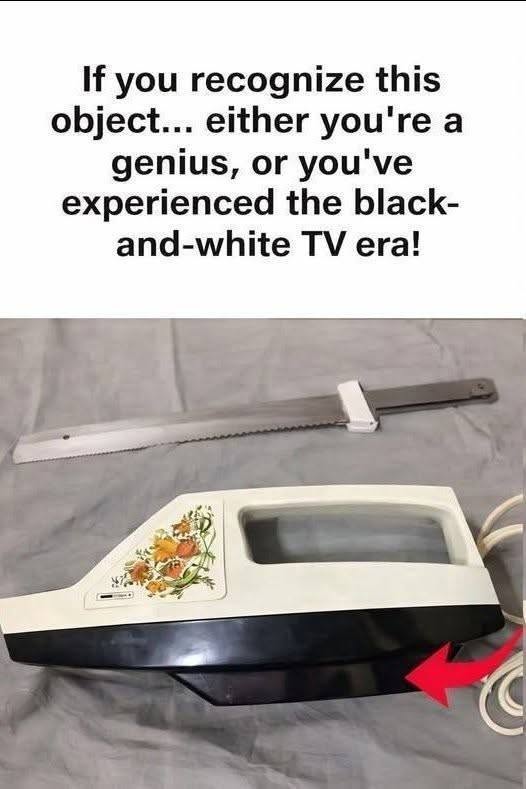
Can you identify this mysterious object? This simple visual challenge tests your observation and reasoning skills. See if you can recognize the object before revealing the answer—and learn why puzzles like this can be great mental exercise.
Can You Identify This Object? It Might Reveal How Sharp Your Mind Is
At first glance, the object may look completely ordinary—or surprisingly difficult to identify.
That’s what makes visual puzzles so entertaining.
Your brain doesn’t simply “see” an object. It interprets shapes, patterns, shadows, familiar features, and context to figure out what you’re looking at.
So, can you identify the mystery object?
🔍 Take a Closer Look
Before looking for the answer, examine the image carefully.
Ask yourself:
What shape does the object have?
Does it have a familiar texture?
Are there unusual openings or edges?
What material does it appear to be made from?
Could you be looking at an everyday object from an unusual angle?
Is part of the object hidden or cropped?
Don’t rush.
Sometimes the first answer that comes to mind is based on a familiar pattern rather than what is actually visible.
🧠 Why These Puzzles Feel Difficult
Your brain is constantly trying to recognize patterns.
When an object is photographed from an unusual angle, enlarged, partially hidden, or shown without its normal surroundings, your brain has less information to work with.
You may recognize individual features but struggle to combine them into the correct object.
This is sometimes called visual ambiguity.
The same principle explains why optical illusions can make ordinary shapes appear completely different.
🎯 Try the 10-Second Challenge
Give yourself 10 seconds before searching for clues.
If you identified it immediately:
You may have strong visual recognition skills and familiarity with everyday objects.
If you needed more time:
That doesn’t mean your brain is “less sharp.”
You may simply be approaching the puzzle analytically rather than intuitively.
If you guessed incorrectly:
That’s completely normal.
These puzzles are designed specifically to make identification difficult.
Does Getting It Right Prove You’re Smarter?
Not really.
A single visual puzzle can’t accurately measure intelligence, memory, creativity, or overall cognitive ability.
Your performance can be influenced by:
Familiarity with the object
Previous experience with similar puzzles
Image quality
Viewing angle
Attention
Expectations
Time pressure
Someone who misses one puzzle may solve another much faster.
So treat it as fun mental exercise—not a scientific intelligence test.
Why Brain Puzzles Can Be Fun
Puzzles encourage you to slow down and examine information carefully.
They can involve:
Observation
Pattern recognition
Logical reasoning
Attention to detail
Visual processing
Flexible thinking
They’re also a simple way to challenge your brain without turning it into a stressful task.
Don’t Give Up Too Quickly
If you can’t identify the object, try changing your strategy.
Instead of asking:
“What does this look like?”
ask:
“What ordinary object could have these particular features?”
Then mentally rotate it.
Imagine seeing it from another angle.
Sometimes the answer becomes obvious once your brain stops interpreting the image in its original orientation.
The Real Challenge
The goal isn’t necessarily to be the first person to guess correctly.
The real challenge is learning to question your first impression.
Look carefully.
Think about alternatives.
Then make your final guess.
And remember: getting the answer wrong doesn’t mean your mind isn’t sharp. Sometimes the most interesting puzzles are the ones that make you reconsider what you thought you were seeing.
Final Takeaway
A mystery-object puzzle can be a fun way to test observation, attention, and visual reasoning, but one puzzle can’t determine how intelligent or mentally sharp someone is.
So take your best guess, challenge your assumptions, and most importantly—
Have fun with it.