Discover the best sleeping positions for protecting your spine, reducing neck and back strain, and waking up with less stiffness. Learn how back, side, and fetal sleeping positions can affect spinal alignment.
Did You Know Your Sleeping Position Can Either Protect Your Spine—or Slowly Strain It?
Most people spend roughly one-third of their lives sleeping, yet few think about what their sleeping position is doing to their spine.
The position you maintain for several hours each night can influence how your neck, shoulders, hips, and lower back are positioned. If your body stays twisted or unsupported for long periods, you may wake up with stiffness, soreness, or tension.
The good news is that a few simple adjustments can make your sleeping posture much more comfortable.
1. Sleeping on Your Back
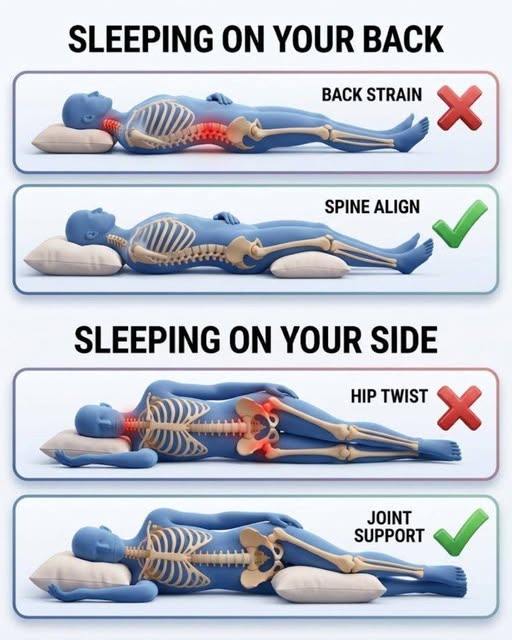
For many people, sleeping on the back is one of the most comfortable positions for maintaining a relatively neutral spinal position.
Your head should be supported without being pushed too far forward. A small pillow underneath your knees can also help reduce the natural arch in your lower back and allow your muscles to relax.
Try this setup:
- Use a supportive but not excessively thick pillow.
- Keep your head facing upward.
- Place a pillow beneath your knees.
- Keep your shoulders relaxed.
- Avoid forcing your lower back flat against the mattress.
2. Sleeping on Your Side
Side sleeping is another excellent option for many people.
However, your alignment matters. If your upper leg falls forward, your pelvis can rotate, potentially creating discomfort in the lower back.
Placing a pillow between your knees can help keep your hips and legs in a more comfortable position.
Your head pillow should also be high enough to keep your neck relatively straight rather than allowing it to bend toward the mattress.
3. The Gentle Fetal Position
The fetal position can be comfortable, especially for people who naturally prefer sleeping on their side.
The key is not to curl yourself too tightly.
Keep your knees slightly bent and allow your upper body to remain relaxed. A pillow between your knees can provide additional support.
If you wake up feeling stiff after sleeping tightly curled, try opening your posture slightly.
4. Support Your Neck With the Right Pillow
Your sleeping position and pillow work together.
A pillow that’s too high can push your neck upward. One that’s too thin may allow your head to drop toward the mattress.
For side sleepers, a somewhat thicker pillow may be needed to fill the space between the shoulder and head.
For back sleepers, a lower pillow is often more appropriate.
For stomach sleepers, a very thin pillow may reduce the amount of neck elevation, although changing to a side or back position may be more comfortable for some people.
5. Put a Pillow Under Your Knees
If you sleep on your back and experience lower-back discomfort, try placing a pillow underneath your knees.
This can reduce the amount of arching in your lower spine and may help your back muscles relax.
You don’t need a large or specially designed pillow. A regular comfortable pillow can work.
6. Put a Pillow Between Your Knees
For side sleepers, this simple trick can improve comfort.
Place a pillow between your knees and, if possible, your lower legs. This helps prevent your top leg from dropping forward and twisting your pelvis.
A body pillow can also provide support for your knees, hips, and upper body.
7. Be Careful With Stomach Sleeping
Stomach sleeping isn’t necessarily dangerous for everyone, but it can be harder to maintain comfortable spinal alignment.
Because your face needs to be turned to one side, your neck remains rotated for an extended period.
Some people who sleep on their stomach also experience increased lower-back discomfort.
If you’re a lifelong stomach sleeper and feel comfortable, you don’t necessarily have to force an immediate change. However, experimenting with side or back sleeping may be worthwhile if you regularly wake with neck or back stiffness.
Your Mattress Makes a Difference
Your mattress also affects how your spine is supported.
A mattress that’s too soft may allow your body to sink excessively, while one that’s too firm can create uncomfortable pressure points.
There isn’t one mattress firmness that’s ideal for everyone. Your body size, sleeping position, personal comfort, and any existing musculoskeletal problems all matter.
Signs Your Sleeping Position May Need Adjustment
Pay attention if you regularly wake up with:
- Neck stiffness
- Lower-back soreness
- Shoulder discomfort
- Hip pain
- Muscle tightness
- Numbness or tingling
- Pain that improves after you get moving
These symptoms don’t automatically mean your sleeping position is responsible, but they may be a reason to experiment with your pillow and posture.
A Simple Sleep Posture Check
Before going to sleep, ask yourself:
Is my neck comfortable and relatively straight?
Are my hips positioned naturally?
Is my lower back relaxed?
Am I twisting my torso?
Would a pillow under or between my knees provide better support?
Small adjustments can sometimes make a surprisingly big difference in how you feel the next morning.
So, What’s the Best Sleeping Position?
There isn’t one perfect position for everyone.
However, these are generally good positions to try:
🥇 Back sleeping + pillow under the knees
🥈 Side sleeping + pillow between the knees
🥉 Gentle fetal position + proper neck support
The goal isn’t to stay rigidly still throughout the night. It’s to create a comfortable position that supports your body and minimizes unnecessary twisting or strain.
Final Takeaway
Your sleeping position may influence how your spine, neck, hips, and muscles feel when you wake up. If you’re experiencing regular morning stiffness, try changing one thing at a time—such as your pillow height or adding support beneath or between your knees.
And remember, persistent or severe pain shouldn’t simply be blamed on sleeping posture. Pain accompanied by weakness, significant numbness, or bladder or bowel problems requires prompt medical evaluation.