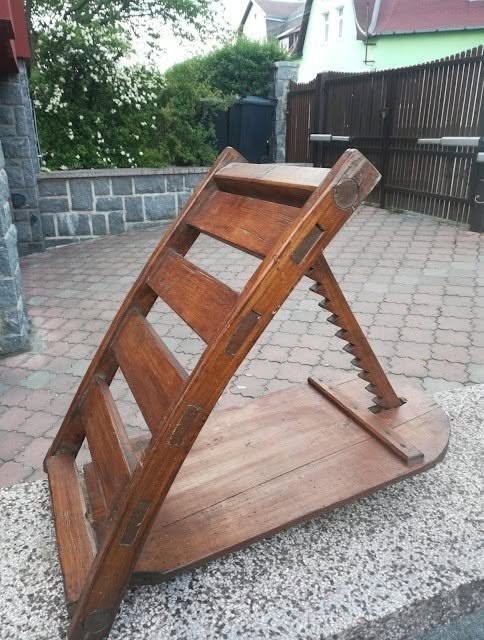
Discover what this unusual wooden adjustable chair may be, how it compares with the Berlebach CHARON astronomy chair, what its mechanisms reveal about its original purpose, and how to determine whether it is vintage, handmade, or a genuine astronomical observing chair.
What Is This Unusual Wooden Adjustable Chair?
At first glance, this unusual wooden object may look like a primitive stool or an old piece of workshop furniture. However, its construction and adjustable design strongly suggest that it may have been intended as an observer’s chair, particularly one used for astronomy or telescope viewing.
One modern design that provides a useful comparison is the Berlebach CHARON observer’s chair. Berlebach describes the CHARON as a folding astronomical chair with 12 height positions ranging from 10 to 93 centimeters. It is specifically designed to allow an observer to sit at a comfortable height while looking through a telescope. (Berlebach)
Why Would an Astronomy Chair Need to Be Adjustable?
Telescope eyepieces can be positioned at very different heights depending on the telescope, tripod, viewing angle, and the object being observed.
For example, when looking toward a low point near the horizon, an observer may need to sit relatively low. When the telescope is pointed higher into the sky, the eyepiece can become considerably higher.
An adjustable chair solves this problem without requiring the observer to stand for long periods.
The CHARON therefore uses a series of preset positions that allow the seat to be moved to an appropriate height. Its current specification provides 12 adjustment positions between 10 and 93 cm. (Berlebach)
Construction of the Berlebach CHARON
The comparison is particularly interesting because the CHARON isn’t an ordinary household chair.
According to Berlebach’s technical documentation, the chair uses 18-mm multiplex wood, stainless-steel fittings, and a padded genuine-leather seating surface. The broad supporting section is designed to provide back support while the wooden construction has a small amount of flexibility. (Berlebach)
The chair is also designed to fold for transportation and storage.
Its published specifications include:
- Height adjustment: 10–93 cm
- Number of positions: 12
- Seat: approximately 25 × 21 cm
- Weight: approximately 5.8 kg
- Maximum load: 120 kg
- Folded/transport dimensions: approximately 35 × 101 cm (Berlebach)
Does That Mean the Object Is a Berlebach CHARON?
Not necessarily.
This is the most important distinction.
A wooden object with an adjustable seat can resemble the design philosophy of the CHARON without actually being manufactured by Berlebach.
The genuine CHARON has identifiable construction details, including its particular folding mechanism, seat attachment system, hardware, and proportions. Berlebach identifies the current model as item number 500682. (Berlebach)
If the object you’re referring to has no Berlebach branding, label, serial information, or recognizable hardware, it would be more accurate to describe it as:
A vintage or handmade adjustable observer’s chair resembling an astronomical observing chair such as the Berlebach CHARON.
That wording avoids claiming authenticity without sufficient evidence.
It Could Also Be a Homemade Telescope Chair
This possibility is worth considering.
Amateur astronomers have historically built their own observing equipment, particularly chairs and stools. A telescope chair doesn’t necessarily require complicated technology. A strong wooden frame with multiple seat positions can accomplish the basic purpose very effectively.
A homemade version might use:
- wooden side rails,
- drilled adjustment holes,
- pegs or bolts,
- a removable seat,
- folding legs,
- a simple wooden back support,
- or a notched/slotted height mechanism.
If the craftsmanship looks inconsistent with factory production, the object may have been made by a carpenter or telescope enthusiast rather than commercially manufactured.
Another Possibility: A General-Purpose Adjustable Stool
There is also a possibility that the object has nothing to do with astronomy.
Adjustable wooden seating has historically been useful for many activities where the user needs to work at different heights. Similar constructions can appear as:
- workshop stools,
- artist’s stools,
- photographic equipment seats,
- garden or field stools,
- inspection seats,
- laboratory/workshop furniture,
- or specialized handmade furniture.
The adjustment mechanism is therefore more important than the fact that it is made of wood.
What Details Would Identify Its Original Purpose?
Several features can provide strong clues.
1. Seat adjustment mechanism
Look closely at how the seat moves.
A series of evenly spaced holes or notches strongly suggests that the object was intentionally designed for multiple height positions.
The Berlebach CHARON uses a specific snap-in adjustment arrangement, allowing the seat to be placed at predetermined heights. (Berlebach)
2. Back support
A relatively wide wooden back section would support the theory that this was intended for prolonged sitting rather than simply being a temporary stool.
Berlebach specifically emphasizes the broad supporting surface of the CHARON because it is intended to stabilize and support the user’s back during extended observing sessions. (Berlebach)
3. Folding construction
If the object folds relatively flat, that is another important clue.
Astronomical observing equipment often needs to be transported outside, so compact folding furniture makes practical sense. The CHARON is specifically designed to fold for transportation and storage. (Berlebach)
4. Wear patterns
The wood can tell a story.
Areas around the seat, adjustment holes, hinges, and feet may show considerably more wear than other sections.
For an old object, polished or darkened wood around the seating area could indicate years of use.
5. Hardware
The screws, bolts, hinges, and brackets can help determine whether it was commercially manufactured or made by hand.
Modern Berlebach CHARON chairs use stainless-steel fittings. (Berlebach)
An older homemade object might instead contain ordinary steel screws, hand-cut brackets, older bolts, or hardware that doesn’t match modern production standards.
Could It Have Significant Value?
Possibly, but the value would depend heavily on identification.
A genuine branded astronomical chair may have collector or resale value, while a handmade wooden chair could have more modest value unless it has particularly unusual craftsmanship, historical provenance, or association with an old telescope.
The current CHARON is still sold by Berlebach, with the manufacturer’s listed price currently shown as €221. (Berlebach)
That price, however, does not mean an unidentified vintage object is worth the same amount. Age, condition, authenticity, rarity, and provenance would all matter.
The Most Accurate Description
Based on the description alone, I would identify it conservatively as:
“A wooden adjustable observer’s chair, possibly designed for telescope or astronomical observation, with similarities to the Berlebach CHARON style.”
I would not call it a genuine Berlebach CHARON until its physical details can be compared with the manufacturer’s design.
If you have the original photograph of the object, you can upload it here. The photo would allow a much more reliable assessment of the shape, adjustment mechanism, joinery, hardware, possible manufacturer markings, approximate age, and whether it actually matches the CHARON design.