What happens when bananas are vacuum-sealed and left at room temperature? Discover why they may ripen more slowly, what happens inside the peel, and an important food-safety warning.
It started as a completely random kitchen experiment.
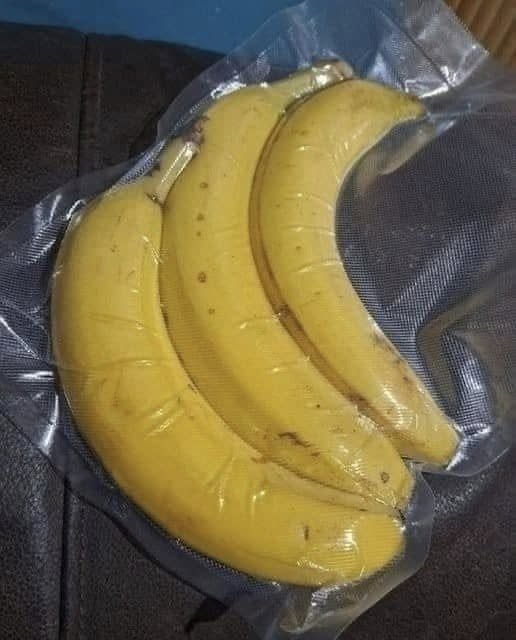
I had just bought a few bananas and wanted to test my vacuum-sealing machine. So, for no particular reason, I vacuum-sealed three bananas, placed them on the kitchen counter, and forgot about them.
Several days passed.
When I looked at them again, something seemed strange.
They hadn’t changed nearly as much as I expected.
The bananas appeared remarkably well preserved compared with ordinary bananas sitting on the counter. That naturally raised one question:
What was actually happening inside the sealed bags?
So I finally cut one open—and the answer is much more interesting than simply saying that vacuum sealing “keeps bananas fresh.”
Why Didn’t the Bananas Ripen Normally?
Bananas are living fruits. Even after they’re harvested, they continue to respire, producing carbon dioxide and undergoing chemical changes associated with ripening.
Temperature and the surrounding atmosphere can influence that process.
When air is removed from a package, the oxygen level around the fruit becomes much lower. Research on bananas has found that reduced-oxygen conditions can slow several processes involved in ripening, including color changes and softening.
That’s why a vacuum-sealed banana may appear to “pause” compared with one sitting in normal air.
The Peel May Look Surprisingly Normal
One of the first things you might notice is that the peel doesn’t necessarily develop the same brown spots as quickly.
That doesn’t mean the banana has stopped changing completely.
The fruit is still undergoing biological processes inside the package. Reduced oxygen changes the way the fruit respires, and prolonged oxygen deprivation can eventually affect texture, flavor, and aroma.
In other words, the banana isn’t frozen in time—its ripening environment has simply been changed.
What Happens When You Finally Open the Bag?
When the package is opened, fresh oxygen suddenly returns to the environment around the banana.
Depending on how ripe the fruit was when it was sealed, you may notice differences in:
- Texture
- Aroma
- Peel color
- Firmness
- Moisture
- Sweetness
A mature-green banana may remain firm for longer under reduced-oxygen conditions, while a ripe banana may behave differently.
Research has specifically found that vacuum packaging can delay banana ripening, although temperature and the condition of the fruit also make a major difference.
The Really Interesting Part: The Banana Was Still “Alive”
This is what makes the experiment fascinating.
Vacuum sealing doesn’t magically preserve a banana by killing everything inside it.
The fruit’s cells are still metabolically active.
With less oxygen available, the fruit’s normal respiration changes. Under sufficiently low-oxygen conditions, fruit can shift toward anaerobic metabolism, which can produce compounds such as ethanol and acetaldehyde. If the oxygen level becomes too low for too long, undesirable flavors and texture changes can occur.
So the banana may look surprisingly good on the outside while undergoing very different chemical processes inside.
Does Vacuum-Sealing Bananas Make Them Last Forever?
Absolutely not.
This is where viral kitchen experiments can become misleading.
Vacuum packaging can slow ripening under certain conditions, but it doesn’t make fresh fruit permanently shelf-stable.
Temperature remains extremely important. Commercial banana storage uses carefully controlled temperatures and atmospheres to delay ripening.
A home vacuum-sealer doesn’t provide the same controlled conditions as commercial produce storage.
One Important Safety Warning
There’s another reason to be careful with experiments involving vacuum-sealed food.
Vacuum packaging removes oxygen and creates a low-oxygen environment. Some harmful microorganisms can grow under those conditions, and dangerous bacteria may not always produce an obvious smell, appearance, or other warning sign.
USDA guidance specifically warns that vacuum-packed perishable foods should be refrigerated or frozen rather than stored at room temperature.
For that reason, don’t assume that a vacuum-sealed food is safe simply because it looks and smells normal.
Vacuum sealing is a packaging method—not a replacement for refrigeration, freezing, canning, or other approved preservation methods.
So What Was Inside the Banana?
Probably nothing mysterious or dangerous simply because it had been vacuum-sealed.
The most interesting explanation is that the reduced-oxygen environment altered the banana’s normal ripening process.
Instead of rapidly progressing through the usual changes associated with ripening, the fruit experienced a different atmosphere that could slow some of those processes.
That’s why opening the bag after several days can feel like opening a time capsule.
The banana may look far less changed than you expected—but that doesn’t mean nothing happened inside.
The Takeaway
The experiment reveals something surprisingly simple about fruit:
Ripening isn’t controlled by time alone.
Temperature, oxygen, carbon dioxide, ethylene, humidity, and the fruit’s stage of maturity all influence what happens after harvest.
Vacuum packaging changes one of those major factors—the atmosphere surrounding the fruit—and that can significantly alter the way a banana ripens.
So if you ever see a vacuum-sealed banana sitting on a counter looking almost unchanged, there may be a perfectly scientific explanation.
It isn’t magic.
The banana was simply ripening under very different conditions.
And that’s what makes the experiment so interesting.