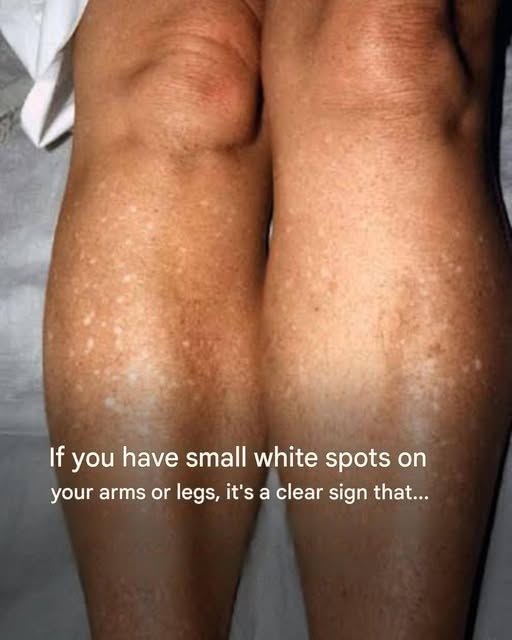
Small white spots on your arms or legs can have several causes, from sun-related changes and dry skin to fungal infections or vitiligo. Learn what they may mean and when to see a doctor.
Have you noticed tiny white spots appearing on your arms, legs, or other areas of your skin?
You may immediately wonder whether they’re caused by a vitamin deficiency, a skin disease, or something more serious. The truth is that white spots on the skin can have many different causes, and their appearance, texture, location, and how quickly they develop can provide important clues.
In many cases, small white spots are harmless. However, persistent, spreading, itchy, scaly, or rapidly changing patches deserve attention.
Let’s look at some of the most common possibilities.
1. Idiopathic Guttate Hypomelanosis
One common explanation for numerous tiny white spots on the arms and legs is idiopathic guttate hypomelanosis (IGH).
These spots are usually:
- Small and round or oval
- Flat rather than raised
- Lighter than the surrounding skin
- Often found on the forearms and shins
- Usually not painful or itchy
IGH becomes more common with age and is associated with long-term sun exposure.
The spots occur because areas of skin produce less pigment than the surrounding skin. Despite their appearance, they are generally considered harmless.
2. Dry Skin
Sometimes what appears to be white spotting is related to very dry or rough skin.
Dry skin can make the surface look uneven, particularly when the skin is exposed to cold weather, frequent bathing, harsh soaps, or low humidity.
You may notice:
- Fine scaling
- Rough texture
- Mild itching
- Pale or whitish areas
Regular moisturizing can improve the appearance when dryness is responsible.
3. Tinea Versicolor
A fungal skin condition called tinea versicolor can also cause lighter patches.
Although it is more commonly seen on the chest, back, shoulders, and upper arms, it can sometimes affect other areas.
The patches may be:
- Lighter or darker than surrounding skin
- Slightly scaly
- More noticeable after tanning
- Sometimes mildly itchy
Unlike ordinary pigmentation changes, tinea versicolor can gradually spread.
Because several skin conditions can look similar, it’s better to have a clinician confirm the diagnosis before treating it.
4. Vitiligo
Another possibility is vitiligo, an autoimmune condition in which pigment-producing cells are damaged.
Vitiligo can cause clearly lighter or completely white patches.
Unlike some other causes, the patches may become quite noticeable and can enlarge over time.
Common areas include:
- Hands
- Face
- Around the mouth and eyes
- Fingers
- Elbows
- Knees
- Genital areas
Vitiligo can affect people of any skin tone and isn’t contagious.
Having a white patch does not, by itself, mean that you have vitiligo. A healthcare professional can distinguish it from other pigment disorders.
5. Post-Inflammatory Hypopigmentation
Sometimes a lighter patch appears after the skin has been irritated or injured.
For example, it can follow:
- A rash
- Eczema
- Insect bites
- Scratches
- Burns
- Inflammation
- Certain skin treatments
The original skin problem may disappear while the lighter pigmentation remains temporarily.
In many cases, the color gradually becomes more even as the skin recovers.
Does It Mean You Have a Vitamin Deficiency?
This is a common question.
Not necessarily.
Small white spots on the arms or legs should not automatically be blamed on a vitamin or mineral deficiency. While nutritional problems can affect skin, the appearance of isolated white spots isn’t enough to diagnose a deficiency.
Taking supplements without knowing whether you need them isn’t a good way to treat unexplained skin changes.
If you have other symptoms or your diet is limited, a healthcare professional can determine whether testing is appropriate.
When Should You Be Concerned?
Most small, stable white spots aren’t an emergency.
However, it’s worth arranging a medical evaluation if the spots:
- Are rapidly increasing
- Are spreading to new areas
- Become completely white
- Develop significant scaling
- Are painful or intensely itchy
- Bleed or develop sores
- Appear after a new medication
- Are accompanied by other unusual symptoms
- Persist despite basic skin care
A dermatologist can often narrow down the cause by examining the pattern and pigment changes.
What Should You Do at Home?
Until you know what’s causing the spots, avoid aggressive home remedies.
Don’t scrub the areas with baking soda, lemon juice, vinegar, or harsh exfoliants. These can irritate the skin and potentially make pigmentation changes more noticeable.
Instead:
Keep the Skin Moisturized
Use a gentle, fragrance-free moisturizer if your skin is dry or rough.
Protect Your Skin From the Sun
Sun exposure can make differences between pigmented and unpigmented areas more noticeable.
Using broad-spectrum sunscreen and wearing protective clothing can help reduce additional sun damage.
Don’t Scratch
If the spots itch, scratching can cause inflammation and potentially leave additional pigmentation changes.
Take Photos
If you’re unsure whether the spots are spreading, taking occasional photographs in similar lighting can help you notice changes over time.
What Does the Pattern Tell You?
The pattern matters.
Tiny, scattered, flat white spots on sun-exposed arms and legs in an otherwise healthy adult may fit conditions such as idiopathic guttate hypomelanosis.
A patch that is expanding, very sharply defined, and becoming completely depigmented may require evaluation for vitiligo.
Light patches with fine scaling may point toward a fungal condition such as tinea versicolor.
And lighter areas that appeared after a rash, injury, or irritation may represent post-inflammatory hypopigmentation.
These are clues—not diagnoses.
Don’t Panic Over White Spots
Seeing new white spots on your skin can understandably be worrying, but they’re not automatically a sign of something dangerous.
Several common skin conditions can produce similar-looking changes, and many are manageable once the cause is identified.
The most useful things to consider are when the spots appeared, where they are located, whether they’re spreading, whether they have any scaling or itching, and whether the skin texture has changed.
If the spots are new, persistent, spreading, or changing noticeably, a dermatologist or other qualified healthcare professional can examine them and determine what is actually causing the change.
The Bottom Line
Small white spots on the arms or legs do not have one universal meaning.
They may be related to sun-associated pigment changes, dry skin, fungal infection, previous inflammation, vitiligo, or other causes.
So rather than assuming that the spots are a “clear sign” of a particular deficiency or disease, focus on the characteristics of the spots and seek professional evaluation when they are persistent or changing.
Your skin is giving you information—but sometimes it takes a proper examination to understand exactly what it is saying.