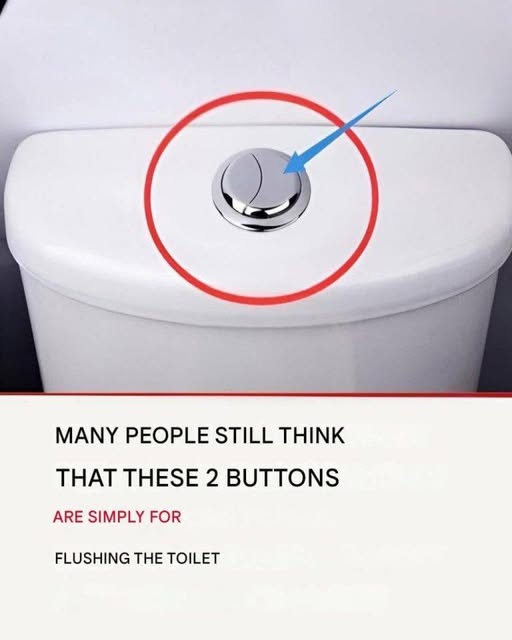
Why do some toilets have two flush buttons? Learn what the two buttons actually do, how dual-flush toilets save water, and when to use each button.
If you’ve ever wondered why some modern toilets have two buttons instead of one, the answer is simpler—and more useful—than many people realize.
The two buttons are part of a dual-flush system. They are both used to flush the toilet, but they release different amounts of water depending on what needs to be flushed.
What Do the Two Buttons Mean?
Although the exact design varies between toilets, the general rule is:
The Smaller Button = Less Water
The smaller button is normally intended for liquid waste.
It activates a smaller flush and uses less water. On many dual-flush toilets, this is roughly 2–3 liters, although the exact amount depends on the toilet model.
The Larger Button = More Water
The larger button is normally intended for solid waste.
It activates a stronger, higher-volume flush. Depending on the toilet, this may use around 4–6 liters or more.
The buttons may also be represented by different symbols rather than different sizes.
Why Were Two Buttons Introduced?
Traditional toilets generally use the same amount of water whether you’re flushing liquid or solid waste.
That means a large amount of water can be used even when only a small flush is necessary.
A dual-flush toilet gives you a choice:
Small job → smaller flush → less water
Large job → larger flush → more water
This simple design can reduce unnecessary water consumption over time.
How to Use the Buttons Correctly
The easiest way to remember is:
💧 Small button: Use for urine/liquid waste.
🚽 Large button: Use for solid waste.
Some toilets allow you to press both buttons simultaneously, which can activate the full flush or a specific manufacturer’s programmed function.
Because designs vary, check the symbols printed on your toilet or the manufacturer’s instructions if you’re unsure.
Does Pressing the Smaller Button Save a Lot of Water?
It can.
Imagine a household that uses the smaller flush whenever appropriate instead of using the full flush every time. Over hundreds or thousands of flushes, the difference can add up.
This is one reason dual-flush toilets are popular in homes, offices, hotels, and other buildings where reducing water consumption matters.
Don’t Force the Buttons
If one button becomes difficult to press, sticks, or doesn’t return properly, don’t repeatedly push it with excessive force.
The problem could involve the internal flushing mechanism, cables, rods, or the flush valve.
A malfunctioning dual-flush mechanism can cause the toilet to continue running and waste water.
A Common Misunderstanding
Some social-media posts suggest that the two buttons have completely different “secret” purposes.
The basic truth is much less mysterious:
They are both flush controls. The difference is the amount of water released.
The smaller flush is designed to use less water, while the larger flush provides more water when a stronger flush is needed.
Final Takeaway
Those two buttons aren’t decorative—and they aren’t two unrelated functions.
They’re a clever water-saving feature:
Small button = smaller flush.
Large button = larger flush.
Using the appropriate button for each type of waste can help avoid wasting water while still giving the toilet enough flushing power when needed.