Can the cup you choose really reveal whether you’re a narcissist? Explore the psychology behind this viral personality test, why people make different choices, and why one answer cannot diagnose narcissism.
The Cup You Think Will Fill First Reveals If You’re a Narcissist?
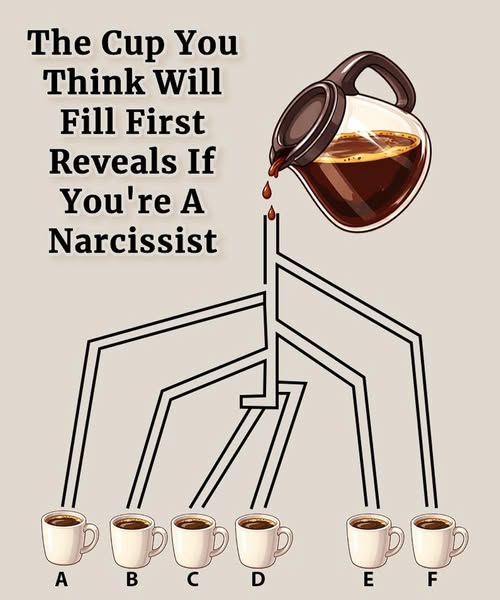
You’ve probably seen those viral puzzles showing several cups connected by pipes and asking:
“Which cup will fill first?”
Some posts claim that your answer reveals whether you’re a narcissist, manipulative, selfish, or emotionally intelligent.
But there’s an important catch:
A cup puzzle cannot diagnose narcissism.
Your answer may reveal something about how you approach a visual problem, but it cannot determine whether you have a personality disorder.
What Is the Cup Test?
The puzzle typically shows several cups connected by tubes or pipes.
You’re asked to look carefully at the pathways and decide:
Which cup will fill first?
The challenge is usually not about personality at all. It’s a visual reasoning puzzle.
You need to inspect which pipes are open, which are blocked, and which containers can actually receive water.
That’s where the fun begins.
Why Do People Think It Reveals Narcissism?
Social-media personality tests often attach psychological labels to simple choices.
For example, a post might claim:
- Cup 1: You’re confident.
- Cup 2: You’re analytical.
- Cup 3: You’re selfish.
- Cup 4: You’re a narcissist.
These interpretations can be entertaining, but they aren’t scientifically validated methods of diagnosing narcissism.
Personality psychology is much more complicated than choosing one picture or answer.
What Actually Is Narcissism?
Narcissism exists on a spectrum.
Many people occasionally want recognition, feel proud of themselves, or enjoy being admired. Those behaviors alone don’t make someone a narcissist.
Narcissistic personality disorder (NPD) is a diagnosable mental-health condition involving a persistent pattern of characteristics such as grandiosity, an excessive need for admiration, and impaired empathy, along with significant difficulties in functioning or relationships.
Diagnosis requires a proper clinical assessment.
A puzzle can’t provide that.
So What Can Your Cup Choice Reveal?
While it can’t reveal narcissism, your approach to the puzzle can be interesting.
You might:
Look for the obvious answer
You may quickly choose the cup that appears closest to the source.
Inspect every connection
You may carefully trace each pipe before making your decision.
Question the puzzle itself
You might notice that one of the pipes is blocked and realize that the obvious answer isn’t possible.
Guess based on intuition
Some people prefer to make a quick judgment rather than analyze every detail.
None of these approaches means you’re narcissistic.
They simply demonstrate different ways people approach a visual problem.
The Real Trick Is Often the Pipes
Many versions of the puzzle contain blocked pathways.
The cup that appears likely to fill first may actually be disconnected because water cannot pass through a closed or obstructed pipe.
That’s why the puzzle tests observation and logical reasoning, not personality.
Before choosing an answer, trace the entire route from the water source to each cup.
Why These Tests Feel So Convincing
These viral tests are designed to make you curious about yourself.
They’re short.
They’re visual.
They give you an immediate result.
And personality labels such as “narcissist,” “genius,” or “highly intelligent” make people want to share their answers.
But a catchy result isn’t the same thing as psychological evidence.
Don’t Label Yourself—or Someone Else—From a Puzzle
Calling someone a narcissist because they selected a particular cup can be misleading.
Real personality assessment considers patterns of behavior across time and different situations, not one isolated choice.
Someone who chooses the same cup as a supposed “narcissist” result may simply have interpreted the puzzle differently.
Likewise, choosing the supposed “empathetic” answer doesn’t prove that someone has exceptional empathy.
The Fun Way to Use the Puzzle
Instead of asking:
“Does my answer prove I’m a narcissist?”
Try asking:
“What made me choose this cup?”
Did you notice the blocked pipe?
Did you assume the shortest route would win?
Did you carefully inspect every connection?
Did you make a quick intuitive choice?
Those questions can make the puzzle much more interesting without turning it into a fake psychological diagnosis.
Final Takeaway
The cup you think will fill first cannot tell you whether you’re a narcissist.
It’s a fun visual puzzle that may test your attention, reasoning, and ability to notice details—but diagnosing narcissism requires much more than a single choice.
So go ahead and pick your cup.
Just don’t let a viral personality test convince you that one answer defines who you are.