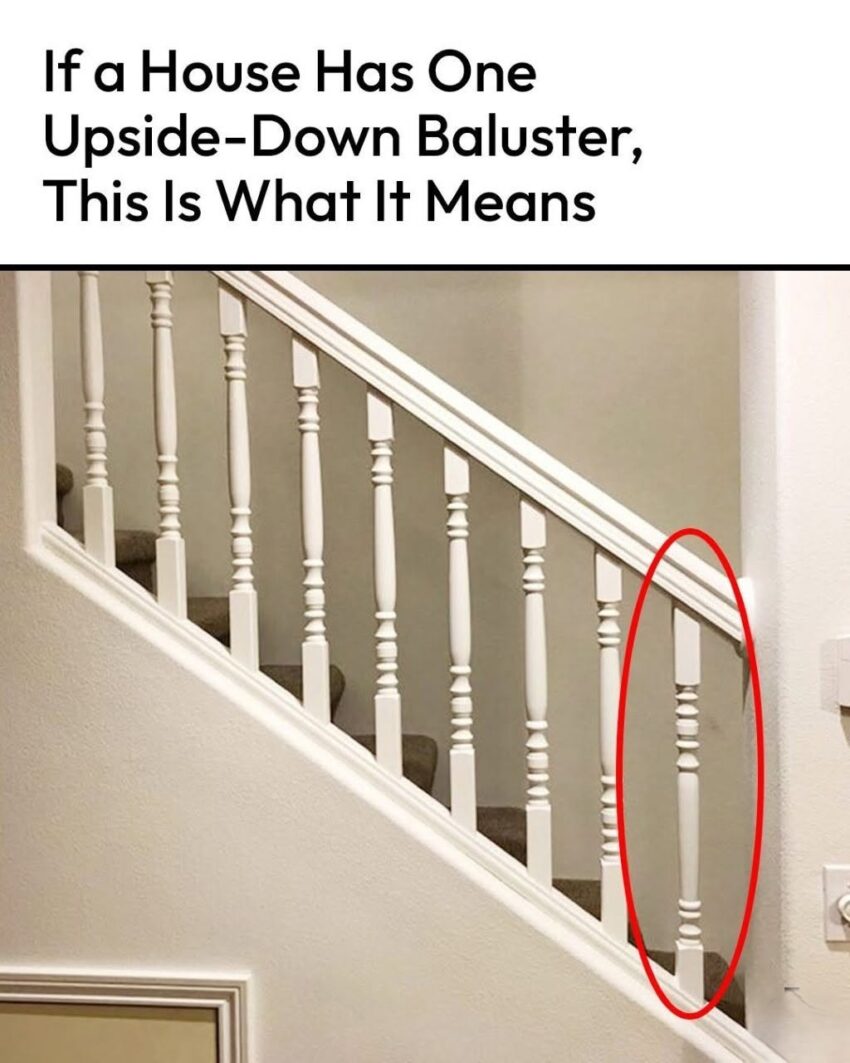
Have you ever noticed that one baluster on a staircase appears to be installed upside down? At first glance, it can look like a mistake made by the carpenter—but that’s not necessarily the case.
The unusual baluster in the photo is often referred to as a “turning point” or “upside-down baluster”, and there are several explanations for why you may see this detail in older or traditionally styled staircases.
Is It Really a Hidden Message?
A popular internet story claims that an upside-down baluster was deliberately installed by a carpenter as a personal signature or a way of saying that the work was done by a human rather than a machine.
It’s a fascinating story, but there isn’t good evidence that an upside-down baluster has one universal historical meaning.
In many cases, the explanation is much simpler: the baluster may have been intentionally reversed as part of the staircase’s design or installed that way during construction.
Why Does It Look So Strange?
Traditional turned balusters are designed with decorative sections that create a visual rhythm along the staircase. Reversing one can make the pattern appear slightly different from its neighbors.
That’s exactly what makes the detail so noticeable.
In some staircases, a different orientation may have been used near an end, transition, or structural component. In other cases, it could simply be an installation error.
Could It Actually Be a Mistake?
Absolutely.
Not every upside-down baluster has a secret meaning. Woodworkers and builders can make mistakes, and older homes have often been repaired or remodeled over the years.
So if you find one in your house, it doesn’t automatically mean your staircase contains a hidden historical message.
The Interesting Part
What makes this detail fun is that it encourages us to look more closely at ordinary features of older homes. Something that appears to be a mistake may have a practical explanation—or it may simply reflect the craftsmanship and construction methods of its time.
So the next time you see an upside-down baluster, don’t immediately assume it’s a secret symbol. It may be intentional, accidental, or simply part of the home’s unique history.
And that’s probably why so many people say, “We never noticed this before!”