Discover how soursop leaf tea is traditionally prepared, why people include it in wellness routines, its possible benefits, and important safety considerations before drinking it.
Soursop, also known as graviola or Annona muricata, is a tropical fruit known for its distinctive flavor and spiky green skin. While the fruit is commonly enjoyed as food, the leaves have also been used traditionally in various herbal preparations.
One preparation that continues to attract attention is soursop leaf tea—often made by gently boiling several fresh leaves in water and drinking the resulting herbal infusion.
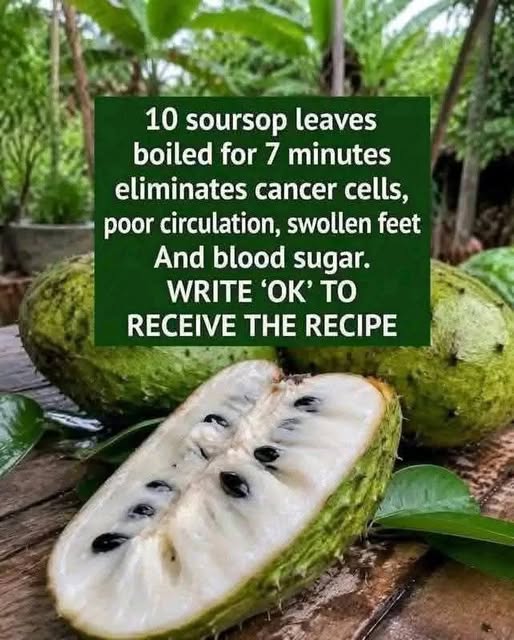
A popular traditional recipe calls for approximately 10 soursop leaves boiled in water for about 7 minutes.
But before adding this drink to your daily routine, it’s important to understand what is actually known about soursop leaves, what remains uncertain, and why more is not necessarily better when it comes to herbal remedies.
What Is Soursop Leaf Tea?
Soursop leaf tea is a simple herbal drink prepared from the leaves of the soursop tree.
Traditionally, people have prepared soursop leaves by washing them, simmering or boiling them in water, and then straining the liquid before drinking it.
The resulting tea has a mild herbal flavor that some people enjoy either warm or cooled.
Soursop leaves contain naturally occurring plant compounds, including acetogenins and other phytochemicals. These compounds have been studied in laboratory research, but laboratory findings should not automatically be interpreted as proof that drinking soursop tea produces the same effects in humans.
How Is It Traditionally Prepared?
A commonly shared preparation uses:
- 10 fresh soursop leaves
- About 4–5 cups of water
Step 1: Wash the Leaves
Rinse the leaves thoroughly under clean running water to remove dirt and other contaminants.
Step 2: Add Them to Water
Place the leaves in a saucepan with the water.
Step 3: Simmer
Bring the water to a gentle boil and allow the leaves to simmer for approximately 7 minutes.
Step 4: Strain
Remove the leaves and strain the liquid.
Step 5: Serve
The tea can be consumed warm or allowed to cool.
Important: The “10 leaves for 7 minutes” method is a traditional preparation, not a medically established dosage. There is no well-established clinical evidence showing that this exact quantity and boiling time is a safe or effective therapeutic dose.
Why Do People Drink Soursop Leaf Tea?
Soursop leaf preparations have a long history of traditional use in some tropical regions.
People have traditionally used the leaves in herbal drinks for general wellness and for purposes including relaxation and digestive comfort.
However, traditional use and scientific evidence are not the same thing.
Some compounds found in soursop have demonstrated biological activity in laboratory studies, but this does not establish that soursop leaf tea can prevent, treat, or cure a particular disease.
Antioxidant Potential
Soursop leaves contain plant compounds with antioxidant activity.
Antioxidants are substances that can help protect cells from oxidative stress.
This is one reason soursop and its leaves have attracted scientific interest.
However, drinking a herbal tea should not be considered a replacement for a balanced diet rich in vegetables, fruits, whole grains, legumes, nuts, and other nutrient-dense foods.
What About Blood Sugar?
You may encounter claims online that soursop leaf tea dramatically lowers blood sugar.
Some laboratory and animal research has investigated this possibility, but that does not establish soursop tea as a safe treatment for diabetes in humans.
People taking diabetes medication should be particularly cautious with concentrated herbal preparations because combining substances that affect blood sugar could potentially cause glucose levels to become too low.
If you have diabetes, speak with your healthcare professional before regularly consuming soursop leaf preparations.
What About Blood Pressure?
Soursop leaves have also been traditionally associated with blood-pressure-related benefits.
But again, evidence from laboratory or animal studies cannot be treated as proof that a homemade tea will safely lower blood pressure in people.
If you already take blood-pressure medication, regularly drinking concentrated herbal tea without discussing it with your healthcare provider may not be appropriate.
A Relaxing Evening Drink?
Some people choose herbal teas simply because they enjoy having a warm drink as part of their evening routine.
If soursop leaf tea is used in this way, it should be viewed as a traditional beverage rather than a guaranteed sleep remedy or treatment for anxiety or insomnia.
A calming nighttime routine can also include:
- Limiting caffeine late in the day
- Keeping a regular sleep schedule
- Reducing screen exposure before bed
- Keeping the bedroom comfortable and quiet
- Practicing relaxation techniques
The Important Safety Question
Natural products aren’t automatically harmless.
This is particularly important with soursop leaves because some compounds found in the plant have raised safety concerns when consumed in concentrated or prolonged amounts.
One concern involves annonacin, an acetogenin that has been investigated for potential effects on nerve cells.
Research into the long-term effects of consuming soursop products is still incomplete, and concerns have led researchers and health authorities to urge caution with repeated or high-dose consumption.
For that reason, drinking large quantities or using concentrated soursop leaf extracts as a long-term treatment is not something to approach casually.
Who Should Be Especially Careful?
Talk with a healthcare professional before using soursop leaf preparations regularly if you:
- Take medication for blood pressure
- Take medication for diabetes
- Have liver or kidney problems
- Have a neurological disorder
- Are pregnant or breastfeeding
- Are preparing the tea for a child
- Take multiple prescription medications
Pregnant and breastfeeding individuals should be especially cautious with medicinal amounts of herbal products because safety data are often limited.
Don’t Confuse Traditional Use With a Cure
Social media frequently turns traditional herbal recipes into claims that a plant can “clean the blood,” “kill cancer cells,” “reverse diabetes,” or “cure hypertension.”
These statements can be misleading.
Soursop has been investigated in laboratory research, including research involving cancer-related mechanisms. But laboratory activity is not the same as demonstrating that soursop leaf tea treats cancer in people.
Someone with cancer should never replace chemotherapy, radiation, surgery, immunotherapy, or another prescribed treatment with soursop tea.
The same principle applies to diabetes, high blood pressure, kidney disease, and other medical conditions.
Is 10 Leaves the Right Amount?
This is one of the most important points to understand.
There is no universally established medical dosage stating that 10 soursop leaves boiled for exactly 7 minutes is the correct or safe amount for everyone.
Leaf size, plant maturity, preparation method, concentration, frequency of use, and individual health factors can all influence exposure to plant compounds.
Therefore, the popular recipe should be considered a traditional preparation—not a medically validated prescription.
More leaves do not necessarily mean more benefits.
A Sensible Approach
If you’re interested in traditional herbal drinks, moderation and caution are sensible principles.
Instead of treating soursop tea as a cure-all, think of it as a traditional botanical beverage whose health effects in humans require more research.
Avoid highly concentrated extracts or supplements unless you’ve discussed them with a qualified healthcare professional.
And if you’re taking prescription medication, don’t assume an herbal tea cannot interact with it simply because it is natural.
Final Thoughts
Soursop leaf tea has a long history of traditional use, and the plant contains interesting natural compounds that scientists continue to study.
The popular preparation of 10 leaves boiled for 7 minutes is easy to make, but there is not enough clinical evidence to call this exact recipe a proven therapeutic treatment.
The safest approach is to appreciate soursop leaf tea for what it is: a traditional herbal preparation, not a replacement for medical care.
If you choose to consume it, be especially cautious about frequent or concentrated use and consult a healthcare professional if you have a medical condition or take prescription medication.
Traditional remedies can be interesting additions to wellness routines—but “natural” should never be confused with “risk-free.”