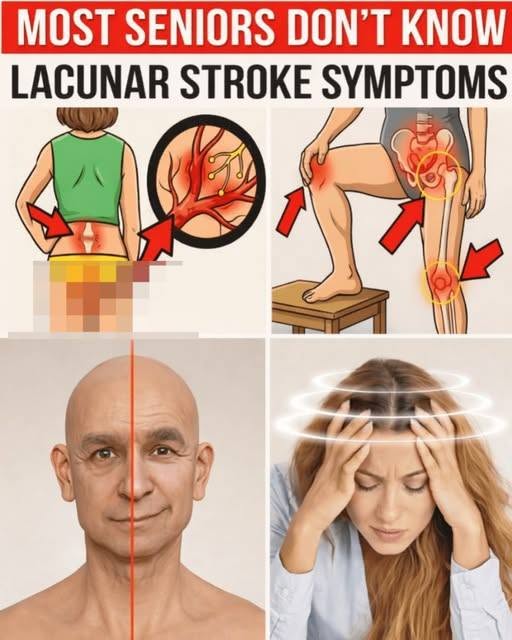
Learn 7 possible warning signs of a lacunar stroke in adults over 60, including sudden weakness, numbness, speech changes, balance problems, and subtle symptoms that require emergency attention.
A stroke doesn’t always look dramatic.
Some strokes affect relatively small areas deep inside the brain and are known as lacunar strokes. Because the affected area may be small, the symptoms can sometimes appear surprisingly subtle.
That doesn’t make them harmless.
A lacunar stroke is still a medical emergency, and sudden neurological symptoms should never be ignored—especially in an older adult.
What Is a Lacunar Stroke?
A lacunar stroke is a type of ischemic stroke that occurs when a small blood vessel supplying deep areas of the brain becomes blocked.
These small-vessel strokes can affect areas involved in movement, sensation, speech, coordination, and other functions.
High blood pressure, diabetes, smoking, and other vascular risk factors can increase the risk of small-vessel disease.
1. Sudden Weakness on One Side
One of the classic warning signs is sudden weakness affecting one side of the body.
It may involve:
- The face
- One arm
- One leg
- Several areas on the same side
Someone might suddenly struggle to lift an arm, stand normally, or walk.
Even if the weakness seems mild, sudden one-sided weakness requires emergency evaluation.
2. Sudden Numbness or Loss of Sensation
A person may suddenly notice that one side of their face, arm, leg, or body feels numb or different.
They might describe it as:
“My hand feels asleep.”
or
“I can’t feel one side properly.”
Don’t assume that an unusual sensation is simply a pinched nerve when it appears suddenly, particularly when it affects one side.
3. New Difficulty Speaking
Some lacunar strokes can affect speech.
A person may suddenly:
- Slur their words
- Have trouble articulating clearly
- Sound unusually slow or unclear
- Struggle to communicate normally
Importantly, the person may still understand everything being said to them.
A sudden change in speech should be treated as a potential stroke warning sign.
4. Sudden Clumsiness or Trouble Walking
This is one of the symptoms people can easily dismiss.
Someone may suddenly become unusually unsteady or have difficulty coordinating an arm or leg.
They may say:
“I’m just feeling a little off today.”
But sudden difficulty walking or coordinating movements can signal a neurological problem.
Don’t simply let the person sleep it off.
5. Facial Weakness
Ask the person to smile.
Does one side of the face appear to droop?
Does the smile look uneven?
Facial weakness can accompany a stroke and is particularly concerning when it appears suddenly together with arm weakness, numbness, or speech changes.
6. A Sudden Change in Fine Motor Skills
A person may suddenly have difficulty performing tasks that normally feel effortless.
For example, they might struggle to:
- Button a shirt
- Hold a cup
- Write
- Use utensils
- Pick up small objects
- Use a phone
These changes can be easy to blame on arthritis or aging.
But a sudden change is different from gradual age-related difficulty.
If someone’s hand suddenly becomes clumsy or weak, seek emergency medical evaluation.
7. Symptoms That Seem Mild or Brief
Perhaps the most dangerous mistake is assuming that a mild symptom isn’t serious.
A person may have a small amount of weakness, numbness, or speech difficulty and decide to wait.
Some stroke symptoms can also improve temporarily. A transient ischemic attack (TIA) can cause stroke-like symptoms without permanent brain injury, but it is still an emergency warning that requires medical assessment.
Never wait for symptoms to become severe before seeking help.
Remember B.E. F.A.S.T.
A useful way to remember common stroke warning signs is:
B — Balance: sudden loss of balance or coordination
E — Eyes: sudden vision changes
F — Face: facial drooping
A — Arms: sudden weakness or numbness
S — Speech: sudden speech difficulty
T — Time: call emergency medical services immediately
If symptoms suddenly appear, note the time the person was last known to be well.
That information can help doctors determine which treatments may be appropriate.
Why Fast Treatment Matters
Some ischemic strokes can be treated with clot-dissolving medication when a person reaches medical care within an appropriate treatment window. Some patients with certain large-vessel blockages may also qualify for mechanical clot removal.
The important point is that treatment decisions depend on the type of stroke, brain imaging, timing, and the person’s medical circumstances.
Never assume a stroke is “too small” to require urgent care.
What Should You Do If You Suspect a Stroke?
If an older adult suddenly develops weakness, numbness, facial drooping, speech problems, or difficulty walking:
- Call your local emergency medical service immediately.
- Note when symptoms began—or the last time the person was known to be normal.
- Don’t give food or drink if they have difficulty swallowing.
- Don’t give aspirin unless emergency medical professionals advise it, because some strokes are caused by bleeding rather than a clot.
- Don’t drive the person yourself if emergency medical transport is available.
- Don’t wait to see whether the symptoms disappear.
The Bottom Line
Lacunar strokes can produce symptoms that appear relatively subtle, particularly when a small area of the brain is affected.
Sudden weakness, numbness, facial changes, speech problems, walking difficulties, or unexpected loss of coordination are not simply signs of getting older.
When these symptoms appear suddenly, every minute matters.
If you suspect a stroke, seek emergency medical care immediately—even if the symptoms seem mild or begin to improve.
This article is for general educational purposes and does not diagnose stroke. Suspected stroke symptoms require immediate emergency medical evaluation.