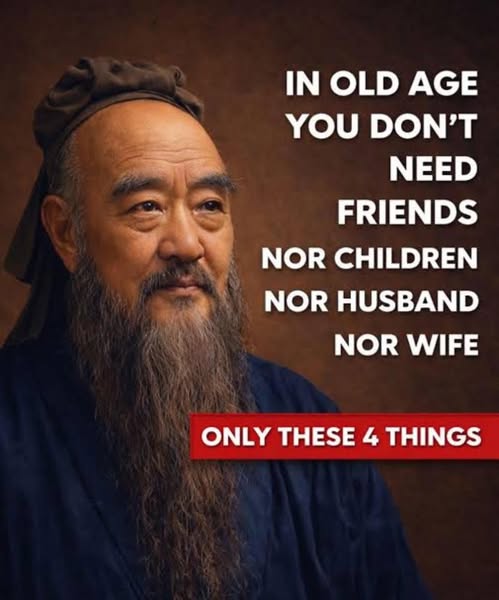
Growing older is not simply about adding years to your life. It is also about learning how to live those years with greater calm, purpose, wisdom, and balance.
Teachings associated with Confucius have influenced East Asian ideas about character, relationships, self-discipline, learning, and living responsibly within a community. Although many sayings circulating online are modern paraphrases rather than verified quotations from Confucius, several broad principles are consistent with Confucian thought.
Here are four timeless principles that can help create a fuller and more balanced old age.
1. Keep Learning, No Matter Your Age
One of the most valuable habits in later life is remaining curious.
Getting older does not mean that personal growth has to stop. Reading, learning a new skill, asking questions, talking with others, or exploring an unfamiliar subject can keep the mind engaged.
A person does not have to return to school to keep learning. Even small activities can provide intellectual stimulation:
- Reading books or newspapers
- Learning a new recipe
- Studying a language
- Exploring history or culture
- Learning to use new technology
- Teaching something you already know to another person
The goal isn’t to become an expert. It is to maintain an attitude of curiosity.
2. Cultivate Good Relationships
Confucian philosophy places considerable importance on relationships and responsibilities toward other people.
In old age, meaningful relationships can become especially important. Family members, friends, neighbors, former colleagues, and community members can provide companionship and a sense of belonging.
Strong relationships don’t require constant agreement. They require respect, patience, honesty, and consideration.
Simple habits can make a difference:
- Listen before responding.
- Express appreciation.
- Make time for people you care about.
- Avoid unnecessary arguments.
- Apologize when you are wrong.
- Offer help when you genuinely can.
A balanced life is rarely built entirely alone.
3. Practice Self-Discipline and Moderation
A fulfilling later life doesn’t necessarily require dramatic changes. Often, consistency matters more than intensity.
Moderation can apply to many parts of daily life—food, spending, entertainment, work, and even arguments.
Having reasonable routines can make everyday life feel more stable. Regular meals, adequate sleep, physical activity appropriate for your abilities, and time for rest can all support a healthier lifestyle.
Self-discipline also means recognizing what you can and cannot control.
Instead of constantly chasing what you don’t have, learning to appreciate what is already meaningful can bring a greater sense of contentment.
4. Live With Purpose and Good Character
Perhaps the most important principle is to make your actions reflect the person you want to be.
Growing older can provide an opportunity to look beyond achievements and possessions and ask deeper questions:
Have I treated people fairly? Have I helped others? What values do I want to pass on? What kind of example do I want to leave behind?
Purpose doesn’t have to mean starting a business or accomplishing something extraordinary.
It might mean:
- Supporting your family
- Mentoring younger people
- Helping in your community
- Caring for someone you love
- Practicing a meaningful hobby
- Sharing knowledge and life experience
- Becoming a calmer and kinder person
A meaningful life can be built through ordinary actions repeated over many years.
The Wisdom of Growing Older
Aging inevitably brings changes. Some things become more difficult, while other things can become clearer with experience.
The aim isn’t to pretend that aging has no challenges. Instead, it is to develop habits and attitudes that help you respond to those challenges with dignity and resilience.
The four principles can be summarized simply:
Keep learning.
Value relationships.
Practice moderation.
Live with purpose and integrity.
These ideas are not a guaranteed formula for happiness, but they can provide a useful framework for thinking about what makes later life richer and more balanced.
Final Thought
A fuller old age isn’t necessarily measured by how much money someone has, how many possessions they own, or how young they look.
It can be measured by something much quieter: wisdom gained, relationships maintained, kindness given, and purpose preserved.
That may be one of the most enduring lessons associated with Confucian thought—our character is shaped not by one grand decision, but by the way we live our everyday lives.