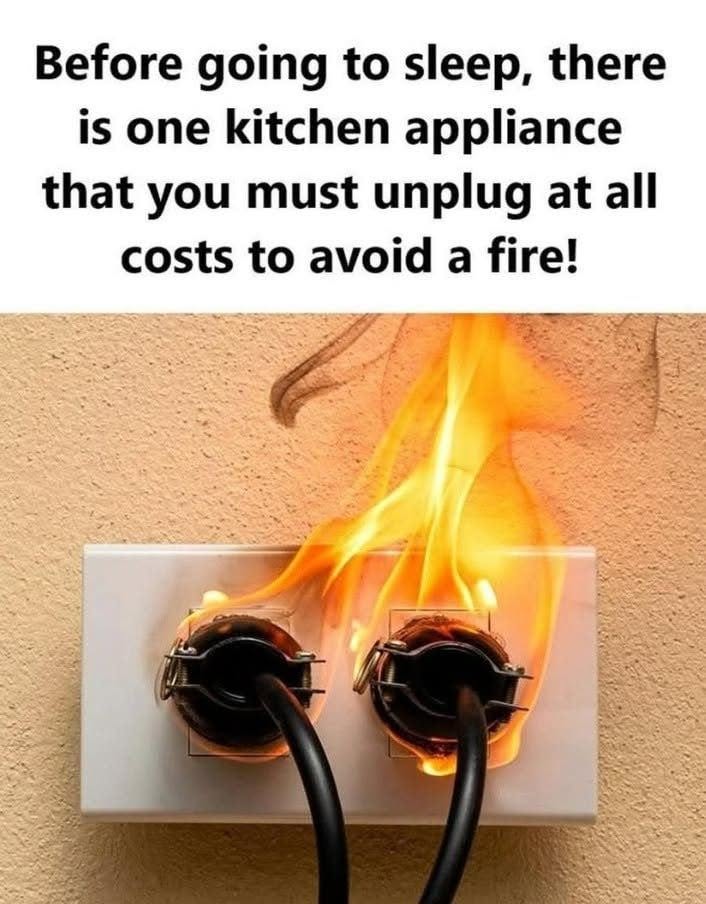
Discover why unplugging certain kitchen appliances before bed can reduce fire risks, which appliances deserve extra attention, and simple nighttime safety habits for your home.
Most people switch off the kitchen lights before going to bed and assume the kitchen is completely safe for the night.
But there is another small habit worth considering: unplugging certain countertop appliances when they are not being used.
While modern appliances are designed with safety features, electrical faults, damaged cords, overheating, or accidental activation can still create hazards. Unplugging an appliance removes its connection to the electrical supply, which can provide an additional layer of protection when the appliance is not needed.
The Appliance to Pay Special Attention To: Toasters
If you want one simple kitchen appliance to add to your nighttime safety checklist, the toaster is a sensible choice.
Toasters generate substantial heat while operating, and crumbs can accumulate inside them over time. A toaster that is damaged, malfunctioning, or accidentally activated can potentially create a fire hazard.
This does not mean that every plugged-in toaster will start a fire. It simply means that there is little benefit to leaving an appliance like this connected when you are asleep and not using it.
Before going to bed, make sure the toaster is switched off and, if practical, unplug it.
Why Unplugging Matters
Turning an appliance off and unplugging it are not always the same thing.
Some appliances can continue to draw a small amount of electricity while plugged in, even when their main function appears to be switched off. More importantly for certain devices, unplugging completely disconnects the appliance from the household electrical supply.
This can eliminate some risks associated with:
- Electrical faults
- Damaged cords or plugs
- Internal component failures
- Accidental activation
- Power surges
- Overheating caused by malfunction
Unplugging is not a substitute for maintaining electrical equipment, but it is a simple precaution.
Don’t Forget the Crumbs
Toasters deserve particular attention because food particles can collect inside them.
Small crumbs may appear harmless, but they can become problematic when exposed to heating elements.
That is why regularly cleaning your toaster according to the manufacturer’s instructions is important.
Always unplug the toaster and allow it to cool before cleaning it.
Never insert metal objects into a toaster to remove stuck food.
Other Kitchen Appliances Worth Checking
The toaster is not the only appliance that deserves attention.
You should also think about other countertop appliances that produce significant heat or have heating elements, particularly if they are old, damaged, or used frequently.
Examples can include:
- Toaster ovens
- Electric grills
- Portable hot plates
- Air fryers
- Slow cookers
- Coffee makers
- Electric kettles
Whether an appliance should remain plugged in depends on its design, manufacturer’s instructions, condition, and how it is being used.
Some appliances are specifically designed to remain connected to power, while others are better unplugged when not in use.
Check the Cord Before Going to Bed
An appliance can be perfectly functional while its power cord is becoming dangerous.
Before continuing to use a kitchen appliance, look for:
- Frayed insulation
- Exposed wires
- Burn marks
- Melted plastic
- Loose plugs
- Discoloration around the outlet
- A cord that becomes unusually hot
If you notice any of these problems, stop using the appliance and have it appropriately repaired or replaced.
Never cover damaged wiring with a temporary solution and continue using the appliance normally.
Be Careful With Extension Cords
Another common mistake is using extension cords or power strips for appliances that require substantial power.
High-power kitchen appliances can place significant loads on electrical circuits. Using inappropriate extension cords, overloaded power strips, or poor-quality electrical accessories can increase the risk of overheating.
Whenever possible, follow the appliance manufacturer’s electrical requirements and use an appropriate wall outlet.
If an outlet repeatedly becomes hot, sparks, smells burnt, or trips the circuit breaker, stop using it and have the electrical problem investigated.
What About Your Refrigerator?
Your refrigerator is different.
It is designed to operate continuously, so unplugging it every night is not appropriate. The same applies to many appliances that are specifically designed for continuous operation.
The goal is not to unplug everything in your kitchen.
Instead, identify appliances that do not need to remain connected while you are sleeping and follow the manufacturer’s instructions.
A Simple Nighttime Kitchen Checklist
Before heading to bed, take less than a minute to look around the kitchen.
1. Check countertop appliances
Make sure appliances that have finished their job are switched off.
2. Unplug appropriate heat-producing appliances
If the manufacturer’s instructions permit it and the appliance does not need continuous power, unplug it.
3. Check the stove
Make sure all burners and the oven are completely switched off.
4. Keep appliances away from flammable materials
Do not leave paper towels, curtains, packaging, dishcloths, or other combustible materials close to heat-producing appliances.
5. Look for damaged cords
Do not ignore frayed, melted, or burned electrical cords.
6. Keep the area around appliances clear
Good ventilation is particularly important for appliances that generate heat.
Don’t Panic About Every Plug
There is no need to walk around the house unplugging every device before sleeping.
Some appliances are designed to remain connected to power, and repeatedly unplugging certain devices may be inconvenient or inappropriate.
Instead, focus on appliances that:
- Produce significant heat
- Have heating elements
- Are damaged or unusually hot
- Are not needed overnight
- Have manufacturer instructions recommending disconnection
The Bigger Fire-Safety Habit
Unplugging an appliance is only one part of preventing kitchen fires.
Good kitchen safety also means never leaving cooking unattended, keeping flammable materials away from heat sources, maintaining appliances properly, and replacing damaged electrical equipment.
Smoke alarms should also be installed and maintained according to local safety recommendations.
And everyone in the household should know what to do if a kitchen fire occurs.
Final Takeaway
There is no single kitchen appliance that can be blamed for every household fire, and leaving a particular appliance plugged in does not automatically mean your home is in danger.
However, unplugging countertop heat-producing appliances such as toasters when they are not needed can be a simple precaution, especially if the appliance is old, damaged, or rarely used.
Before bed, take a few seconds to switch off what you used, unplug appropriate appliances, check for damaged cords, and make sure nothing heat-producing has been left running.
That small habit can add another layer of safety to your nighttime routine.