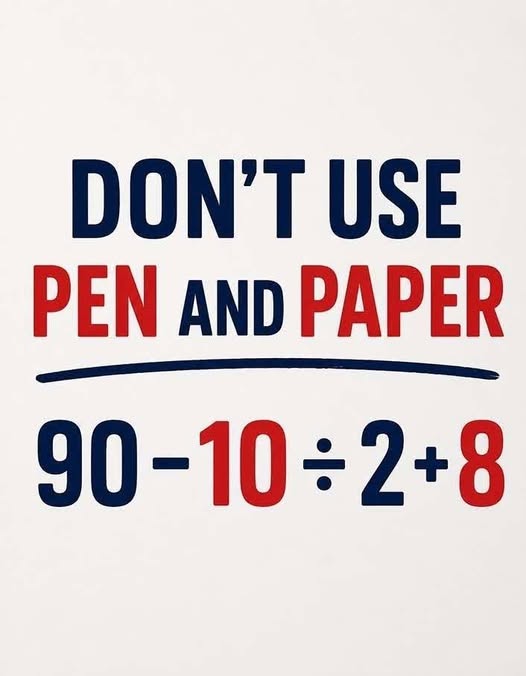
Think you’re good at mental math? Try this clever math riddle without using a calculator, pen, or paper. Take a moment, trust your reasoning, and see if you can find the answer.
Math doesn’t always have to involve complicated formulas, long calculations, or a calculator.
Sometimes, the most entertaining math problems are incredibly simple—but they’re designed to make your brain pause.
That’s exactly what makes a good math riddle so much fun.
Here’s a quick challenge for you:
The Challenge
A number is multiplied by 2. Then 8 is added to the result. The final answer is 20. What is the original number?
Don’t reach for your phone.
Don’t write anything down.
Take a few seconds and solve it in your head.
What do you think the answer is?
If you immediately thought of a number, hold onto your answer before reading further.
Think Backward
The easiest way to solve this kind of puzzle is to work backward.
We’re told that the final answer is 20.
Before 8 was added, the number must therefore have been:
20 − 8 = 12
But 12 was the result of multiplying the original number by 2.
So now we divide:
12 ÷ 2 = 6
That means the original number is:
6
Pretty simple, right?
But the interesting part of the puzzle isn’t necessarily the arithmetic.
It’s the way the question makes you approach the calculation.
Why Working Backward Helps
When a problem gives you a final result and asks you to find the starting number, working backward can be much easier than following the original steps forward.
The original process was:
Number → multiply by 2 → add 8 → 20
To reverse it, simply undo each operation in reverse order:
20 → subtract 8 → 12 → divide by 2 → 6
This is a basic mathematical principle that becomes extremely useful when solving more complicated equations.
Did You Get It Right?
If you answered 6, congratulations—you solved it correctly.
If you got a different answer, don’t worry.
Mental-math riddles are often designed to encourage people to rush. The wording can make a simple problem feel more complicated than it really is.
That’s why slowing down and identifying exactly what the question is asking can make such a big difference.
Try Another One
Ready for a second challenge?
Think of a number. Add 10 to it, then divide the result by 2. The answer is 15. What was the original number?
Again, try solving it without writing anything down.
Start with the final answer:
Undo the division first:
15 × 2 = 30
Then undo the addition:
30 − 10 = 20
So the answer is:
20
Why These Puzzles Are So Addictive
Simple math riddles have a way of turning an ordinary calculation into a mini competition.
You want to solve the problem before someone else does.
You want to prove that you can do it without a calculator.
And when the answer turns out to be much simpler than expected, there’s a satisfying moment of discovery.
These puzzles can also encourage people to practice mental arithmetic without realizing they’re learning.
Don’t Let the Wording Fool You
Many popular math riddles aren’t difficult because of the mathematics.
They’re difficult because of the wording.
A puzzle might present several operations in a way that encourages you to calculate too quickly.
The best approach is to pause and identify:
- What information do you already know?
- What is the question asking you to find?
- Which mathematical operation happened last?
- Can you reverse that operation?
Once you develop that habit, many seemingly tricky puzzles become much easier.
A Quick Mental-Math Trick
When you’re given a final number and need to discover the starting number, imagine reversing the process.
If the original problem says:
Add → multiply → subtract
Then solve backward:
Add back → divide → subtract
In other words, reverse both the order and the operation.
Addition becomes subtraction.
Subtraction becomes addition.
Multiplication becomes division.
Division becomes multiplication.
This simple idea can make a surprising number of puzzles easier.
Challenge Your Friends
Now that you’ve solved the puzzle, don’t keep the fun to yourself.
Send it to a friend, family member, or coworker and ask them to solve it without a calculator.
Don’t give them the answer immediately.
Give them a few seconds to think.
You may be surprised by how different people’s approaches can be to the same simple problem.
Final Answer
Let’s check the original puzzle one more time.
The unknown number is 6.
Multiply it by 2:
6 × 2 = 12
Add 8:
12 + 8 = 20
Everything checks out.
So if you got 6 without using pen and paper, you passed the challenge.
And if you didn’t, there’s always another puzzle waiting to test your brain.
Did you solve it in your head?