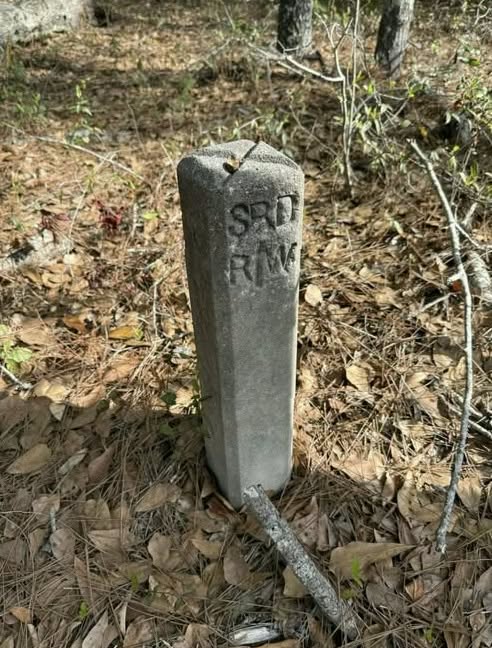
Found This Knee-High Cement Structure in the Woods—What Could It Have Been?
Finding a knee-high concrete structure standing beside an old roadbed in the middle of the woods can be a fascinating clue to the area’s history. At first glance, it may look like nothing more than an abandoned piece of concrete, but its shape, position, and relationship to the old road could reveal what once stood there.
1. It Could Be an Old Road Marker
One possibility is that the structure was used as a road marker or boundary post.
Older roads sometimes had concrete markers to identify:
- Property boundaries
- Road rights-of-way
- Township or land boundaries
- Survey points
- Road maintenance limits
If the concrete post is relatively narrow and stands upright by itself, this becomes a stronger possibility.
Look carefully for numbers, letters, carved markings, metal caps, bolts, or a metal rod sticking out of the top.
2. It May Be Part of an Old Drainage System
The old road itself is one of the biggest clues.
Roads need drainage to prevent water from washing them away. A concrete structure near a ditch or low section of the road could have been associated with an old culvert or drainage system.
The original road may have disappeared because of vegetation, erosion, or years of disuse, while the concrete drainage components remained.
Check whether there is:
- A ditch running alongside the road
- A small stream nearby
- A depression in the ground
- A concrete or stone channel
- Another concrete structure on the opposite side
If two matching structures appear on opposite sides of the old road, a culvert or crossing becomes much more likely.
3. It Could Be a Remnant of an Old Bridge
If the old roadbed crosses a creek, stream, ravine, or wet area, the concrete could be part of an old bridge foundation or abutment.
This is especially interesting if you can find another concrete piece nearby.
An old bridge may have been removed or collapsed while portions of its foundation remained buried in the vegetation.
4. It Might Have Supported an Old Utility
Another possibility is that it was connected to an old telephone, electrical, water, or other utility line.
Look for unusual features such as:
- A hole through the concrete
- Metal brackets
- Rusted bolts
- A metal pipe
- Ceramic pieces
- Insulator fragments
- Wires or cables nearby
Even if the utility line has disappeared, its supporting structures can sometimes remain for many decades.
5. It Could Be a Survey Monument
A carefully constructed, solid concrete post may have been placed there as a permanent surveying reference point.
Survey markers are particularly interesting because they can remain in forests long after roads, houses, farms, and property boundaries have changed.
If there is a small metal disk, metal pin, engraved number, or unusual marking on the top, don’t remove or damage it. It may still have legal or historical significance.
6. The “Old Road” May Not Actually Be a Road
This is an important possibility.
Some abandoned railroad grades look remarkably similar to old roads after many decades. A former railway line can leave behind a long, straight, raised and relatively level path through the woods.
If the path is unusually straight and elevated, look for:
- Old railroad ties
- Large crushed stone/ballast
- Rusted pieces of rail
- A wider, very level embankment
- Concrete structures at regular intervals
If those clues are present, the concrete structure could potentially be related to the former railway rather than a road.
What the Structure’s Shape Can Tell You
The top of the concrete is particularly important.
A flat top could indicate a marker, post, or support.
A hole in the top could suggest that something was mounted there.
A metal rod could indicate a survey marker.
A pipe coming out of it could point toward an old water or drainage installation.
A wide, heavy base could indicate that it once supported a larger structure.
And if the concrete appears broken rather than deliberately shaped, it might simply be the remaining portion of something that originally extended much farther underground or above ground.
The Best Clue Is What Is Around It
Don’t look at the concrete by itself. Walk your eyes along the old roadbed and look for patterns.
If you find several similar concrete objects at regular intervals, they were probably part of the same installation.
If there is only one, it could be a boundary or survey marker.
If there are two matching structures across a ditch or stream, think culvert or bridge.
If there are remnants of metal, wires, pipes, or ceramic insulators, think utility infrastructure.
If the roadbed is exceptionally straight and raised, investigate the possibility of an old railway grade.
One Thing I Wouldn’t Do
I wouldn’t immediately dig it up, move it, or chip away at the concrete. If it’s a survey marker, property marker, historic feature, or part of an old utility installation, disturbing it could destroy the very clues needed to identify it.
A clear photo would make this much easier to narrow down. Ideally, photograph the structure from all four sides, the top, its base, and one wider shot showing exactly how it sits beside the old roadbed. The surrounding landscape can sometimes be just as informative as the concrete itself.