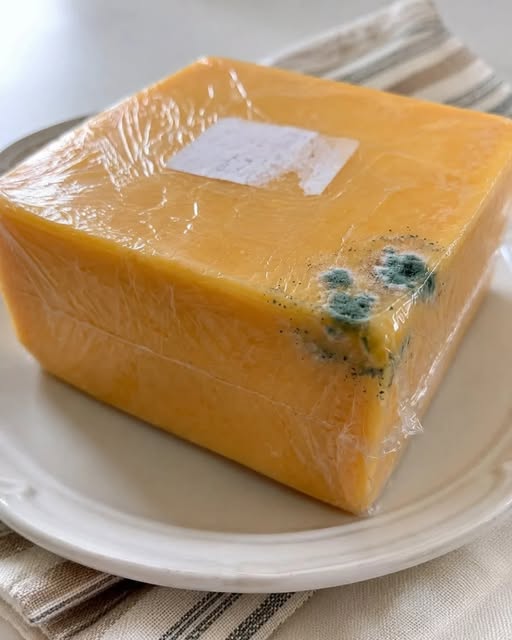
Found a green or blue spot on cheddar cheese? Learn when you can safely cut away mold, when the entire cheese should be discarded, and how to store cheddar properly.
Seeing a green, blue, or fuzzy spot on a block of cheddar can make you wonder whether the entire piece has gone bad. The answer depends largely on what type of cheddar you have and how extensive the mold is.
🧀 Can you just cut off the mold?
For a firm or hard cheese such as cheddar, a small isolated patch of surface mold does not necessarily mean the entire block must be thrown away.
Because hard cheeses are relatively dense, mold generally doesn’t penetrate them as easily as it can softer foods.
If there is only a small area of visible mold, food-safety guidance commonly recommends cutting away the mold plus at least 1 inch (about 2.5 cm) around and below the affected area.
Use a clean knife and try not to drag the knife directly through the mold and then into the uncontaminated cheese.
🚨 When should you throw the cheddar away?
Don’t rely on simply cutting off the spot if:
- Mold covers a large portion of the cheese.
- There are multiple areas of mold.
- The cheese has an unusual or unpleasant odor.
- The cheddar has become unusually slimy or wet.
- You aren’t sure whether the cheese is actually a hard cheese.
- It is shredded, sliced, crumbled, or otherwise cut into small pieces and mold is present.
For softer cheeses, the safest choice is generally to discard the entire product because mold can penetrate beneath the visible surface.
What about different-colored mold?
Green or blue patches are often visible mold growth, but color alone can’t tell you whether a particular mold is safe or unsafe.
Don’t taste the moldy portion to determine whether the cheese is still good.
How to prevent mold on cheddar
Proper storage can help considerably:
- Keep cheddar refrigerated.
- Store it in suitable cheese wrapping or an airtight container.
- Avoid repeatedly leaving it at room temperature.
- Use clean utensils when handling it.
- Check the cheese periodically for changes in appearance, smell, and texture.
The bottom line
If it’s a solid block of cheddar with one small spot of surface mold, you may be able to salvage it by cutting away the mold and a generous margin around it.
But if the cheddar is soft, shredded, sliced, heavily contaminated, or showing significant spoilage, it’s safer to throw the whole thing away.
When in doubt, don’t risk it—discard it.