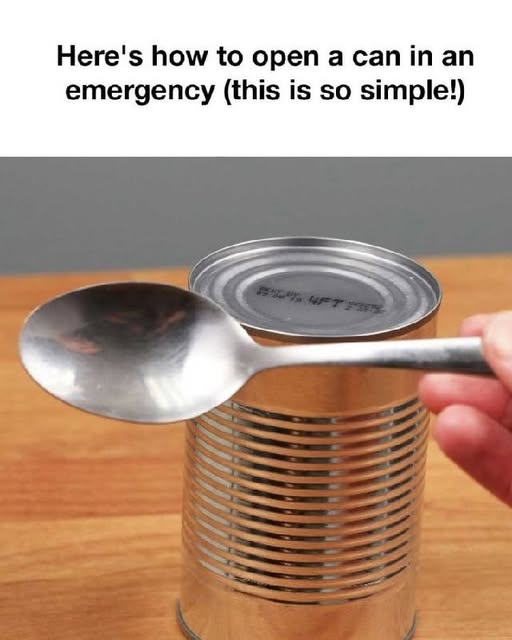
Don’t have a can opener? Learn a simple emergency method for opening a food can when you’re stuck without the usual kitchen tool, plus important safety tips to avoid cuts and contamination.
Imagine you’re preparing dinner and suddenly realize something:
You don’t have a can opener.
Maybe the opener broke.
Maybe you’re camping.
Maybe you’re staying somewhere with a very basic kitchen.
Or perhaps you’re simply dealing with an emergency and need to open a can without your usual tools.
Fortunately, there are alternative methods—but some are much safer than others.
The Spoon Method
One of the more useful emergency techniques involves a sturdy metal spoon.
First, place the unopened can on a stable, flat surface.
Hold the spoon firmly.
Position the tip of the spoon against the inner edge of the lid, close to where the lid meets the rim.
Using firm pressure, rub the spoon back and forth against the same small section of the lid.
After some time, the metal can begin to wear through.
Once you create a small opening, continue working carefully around the rim until the lid can be lifted.
Why Does This Work?
Most food cans are made from relatively thin sheet metal.
A sturdy metal spoon can gradually wear through the metal when pressure and repeated friction are applied to one spot.
You don’t need to smash the can or use excessive force.
The key is patience and controlled pressure.
Another Emergency Option: A Rough Concrete Surface
If you are outdoors and don’t have a suitable utensil, some emergency guides describe using a rough, clean concrete or stone surface to wear down the can’s sealed rim.
Place the can upside down on a clean, rough surface.
Rub the can back and forth while applying moderate pressure.
The goal is to gradually wear down the rim.
Once the seal has been weakened, the lid may become easier to pry open.
However, this method has an important disadvantage:
The surface can contaminate the can and its contents.
For that reason, it should be considered an emergency technique rather than a normal kitchen method.
Be Extremely Careful With the Lid
Once the can is open, don’t assume the metal edges are harmless.
A damaged can lid can be extremely sharp.
Use a thick cloth or suitable protective material when handling it, and keep your fingers away from the cut edge.
If the lid breaks into small pieces or metal fragments fall into the food, it’s safer not to eat the contents.
Don’t Use Your Teeth
This might sound obvious, but desperate situations sometimes lead people to attempt dangerous shortcuts.
Never try to bite, chew, or pry a can open with your teeth.
You could seriously injure your mouth or swallow a sharp piece of metal.
Similarly, avoid using improvised tools in a way that requires excessive force toward your hands or body.
Check the Can Before Eating
Opening the can safely is only part of the job.
Before eating, inspect the container.
If the can is bulging, leaking, badly rusted, severely dented, or has an unusual odor when opened, don’t taste the food.
A damaged or improperly stored can can present a food-safety risk regardless of how successfully you opened it.
The Best Solution Is Still a Can Opener
Emergency techniques are useful to know, but they aren’t intended to replace a proper can opener.
A normal manual can opener is inexpensive, easy to store, and much safer for routine use.
Still, knowing an alternative method can be useful when you’re camping, traveling, dealing with a broken kitchen tool, or simply stuck without one.
The important thing is to work slowly and carefully rather than trying to force the lid open.
Sometimes the simplest emergency skills are the ones you never realize you’ll need—until you suddenly do.