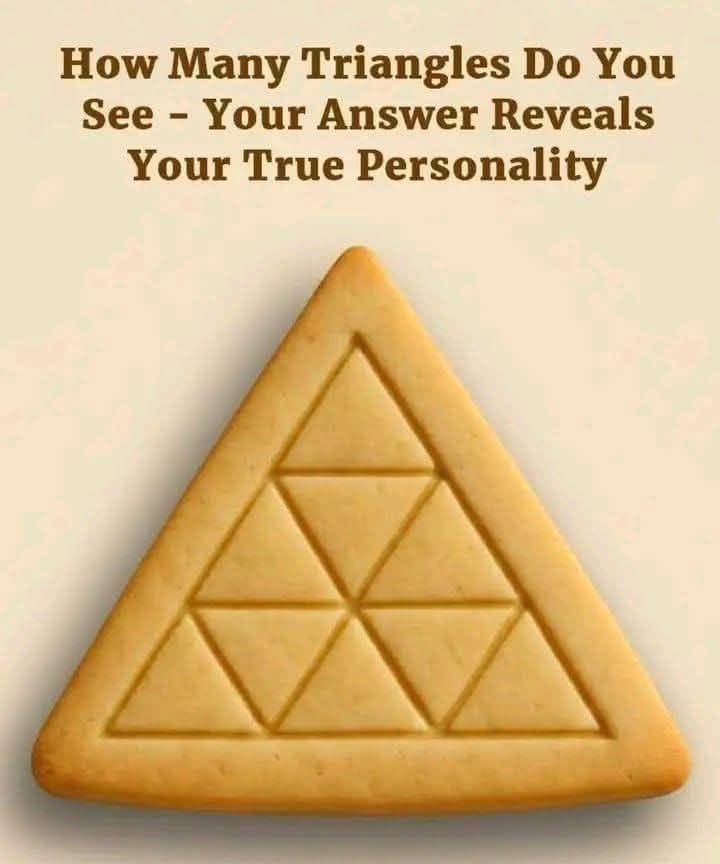
How Many Triangles Do You See? Your Answer Reveals Your True Personality
At first glance, this may look like a simple question: How many triangles can you see?
But don’t answer too quickly.
Take a few seconds to examine the image carefully. Look at the large shapes, the smaller sections inside them, and the triangles that may be formed when several lines come together.
So, how many triangles did you find?
Your answer may not scientifically reveal your “true personality,” but it can make for a surprisingly fun way to think about how you approach visual information, puzzles, and challenges.
If You Saw Only a Few Triangles
If your first instinct was to count only the obvious, larger triangles, you may have a straightforward way of approaching problems.
You tend to focus on what is immediately visible rather than searching for hidden possibilities.
That doesn’t mean you miss details. Instead, you may prefer clarity and simplicity. When faced with a complicated situation, you often try to identify the main issue first rather than becoming distracted by every small detail.
You may also be someone who appreciates direct answers and practical solutions.
If You Saw Many Small Triangles
If you immediately noticed smaller triangles hidden within the larger design, you may have a naturally observant mindset.
You tend to look beyond the obvious.
When other people see a collection of lines and shapes, you may instinctively start breaking the image into smaller sections and looking for connections.
This kind of approach can be useful when solving puzzles, analyzing information, or working on complicated tasks.
You may also enjoy challenges that require patience and concentration.
If You Kept Finding More and More
Some people answer quickly, while others continue examining the image because they suspect there must be another hidden triangle.
If that’s you, you may have a persistent personality.
You don’t necessarily accept the first answer that comes to mind. Instead, you like checking your work and making sure you haven’t overlooked something.
This can be a valuable quality because persistence often helps people solve problems that initially seem impossible.
The downside?
You may sometimes overthink things that don’t require quite so much analysis.
If You Counted the Triangles in Different Combinations
The most interesting triangle puzzles aren’t always about spotting individual shapes. Sometimes, larger triangles are created by combining several smaller ones.
If you naturally started looking at different combinations, you may enjoy understanding how individual pieces fit together to create something bigger.
You might be a person who likes patterns, systems, and connections.
Instead of seeing separate pieces, you tend to look at the bigger picture.
If You Gave Up Counting
And if you looked at the puzzle and thought, “Absolutely not,” that’s perfectly fine too.
Not everyone enjoys visual puzzles.
You may simply prefer practical challenges over abstract ones. Perhaps you would rather solve a real-world problem than spend several minutes counting shapes hidden inside a drawing.
That’s not a sign of a bad personality.
In fact, knowing what types of challenges you enjoy—and which ones you don’t—is useful information in itself.
Why Can Two People See Different Numbers?
Triangle puzzles are designed to make your brain look at the same lines in different ways.
A shape that appears to be one large triangle may contain several smaller triangles. Those smaller triangles can sometimes be combined to form larger ones.
That’s why simply counting the obvious shapes may produce a different answer from someone who carefully analyzes every possible combination.
Your eyes recognize the basic shapes first. Your brain then has to determine how those shapes relate to one another.
This is what makes these puzzles so addictive.
The Real Challenge Is Attention
The biggest challenge isn’t necessarily intelligence.
It’s attention.
If you rush, you may see only the most obvious shapes. If you slow down and examine every line, you may discover combinations you didn’t notice at first.
That’s an important reminder beyond puzzles, too.
Sometimes we miss things simply because we’re moving too quickly.
Taking an extra moment to look carefully can change what we see.
Don’t Take the Personality Result Too Seriously
It’s fun to say that your answer reveals whether you’re observant, analytical, creative, or persistent—but a triangle puzzle cannot actually diagnose your personality.
Real personality is much more complicated.
Your experiences, habits, values, relationships, environment, and countless other factors contribute to who you are.
So treat this puzzle as entertainment rather than a psychological assessment.
The real victory is discovering how you approach the challenge.
Now It’s Your Turn
Look at the triangle puzzle one more time.
Don’t rely on your first impression.
Start with the smallest triangles.
Then look for medium-sized triangles.
Finally, see whether several smaller shapes combine to create larger triangles.
How many did you find in total?
And here’s the fun part:
Did you get the same answer as everyone else—or did you discover something they missed?
Share your number with your friends and family and challenge them to solve it without looking at anyone else’s answer.
You may be surprised by how differently people interpret the exact same image.
Meta Description
How many triangles can you see? Take this fun visual puzzle, test your observation skills, and discover what your approach might say about your personality.