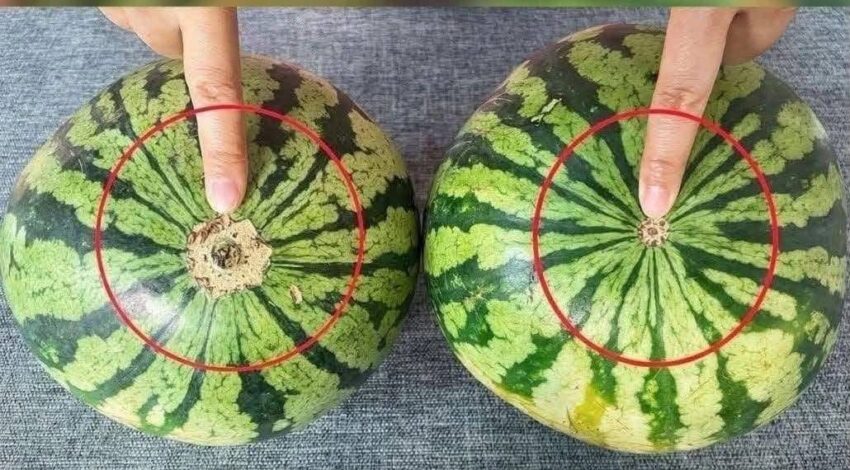
A few simple clues can help you choose one that’s more likely to be ripe, juicy and sweet.
1. Look for a Large, Creamy Yellow Field Spot
One of the best clues is the field spot—the patch where the watermelon rested on the ground while growing.
Look for a spot that is large and creamy yellow or deep yellow. A pale white or greenish spot can indicate that the watermelon was picked before reaching full maturity.
A strong yellow field spot doesn’t guarantee sweetness, but it’s one of the most useful visual clues you can find.
2. Pick It Up—It Should Feel Heavy
Watermelon contains a lot of water, so a ripe, juicy melon should feel surprisingly heavy for its size.
When comparing two watermelons of roughly the same size, choose the one that feels heavier.
This doesn’t necessarily tell you how sweet it is, but it can help indicate good water content and juiciness.
3. Don’t Be Afraid of the “Webbing”
You may notice brown, rough-looking lines or web-like markings on the skin.
These marks aren’t necessarily a bad sign.
In fact, many shoppers associate pronounced webbing with a sweeter watermelon because it can develop as the fruit grows and experiences natural pollination and other surface changes.
Don’t reject a watermelon simply because its skin isn’t perfectly smooth.
4. Look for a Dull, Not Shiny, Surface
A very shiny green watermelon may look attractive, but a duller, slightly matte appearance can be a useful sign of maturity.
The rind often becomes less glossy as the watermelon reaches a more mature stage.
Again, don’t rely on this clue alone—use it together with the field spot and weight.
5. Check the Shape
Choose a watermelon that looks symmetrical and evenly developed.
Whether it’s round or oval, it should generally have a balanced shape without major dents, bruises or unusual soft areas.
Large irregularities can sometimes indicate inconsistent growing conditions.
6. Give It a Gentle Tap
You’ve probably seen people knocking on watermelons at the market.
The traditional advice is to look for a deep, hollow sound.
While this isn’t a perfect science, the sound can provide another clue when combined with the other signs. Avoid relying on tapping alone—your ears can’t tell you exactly how sweet the watermelon will be.
7. Check the Stem
If part of the stem is visible, take a look at it.
A dry, brownish stem can indicate that the watermelon had time to mature before being harvested. A very green stem may suggest that it was picked earlier.
However, stem appearance can vary depending on harvesting and handling, so consider it a supporting clue rather than a guarantee.
8. Avoid Soft Spots and Damage
A small surface scratch isn’t necessarily a problem, but avoid watermelons with:
- large bruises
- deep cuts
- leaking areas
- very soft spots
- mold
- damaged or sunken sections
These can indicate physical damage or spoilage.
The Easy 5-Second Watermelon Test
If you don’t want to remember every tip, use this simple checklist:
Look → Lift → Check → Tap → Choose.
Look for a large creamy-yellow field spot.
Lift it and choose a watermelon that feels heavy for its size.
Check that the shape is symmetrical and the rind looks mature rather than overly shiny.
Give it a gentle tap and listen for a deep, hollow sound.
Then choose the melon with the best combination of these clues.
What About the “Sugar Spot” Myth?
You may hear claims that brown spots, webbing or certain markings guarantee an extremely sweet watermelon.
Don’t treat any single marking as a sweetness detector.
Watermelon sweetness depends on factors including the variety, growing conditions and maturity. External clues can help you select a good melon, but there is no foolproof way to measure sweetness without cutting it open.
That’s why using several signs together is smarter than relying on one viral trick.
Final Takeaway
Picking a sweet watermelon doesn’t have to be a guessing game.
The best strategy is to look for a creamy-yellow field spot, heavy weight, mature-looking rind, symmetrical shape and no signs of damage. A dry stem and deep hollow sound can provide additional clues.
No trick can guarantee a perfectly sweet watermelon every time—but these simple checks can dramatically improve your chances of taking home a juicy one.
Next time you’re at the market, don’t just grab the prettiest watermelon. Pick it up, turn it over and check the spot. Your taste buds may thank you.