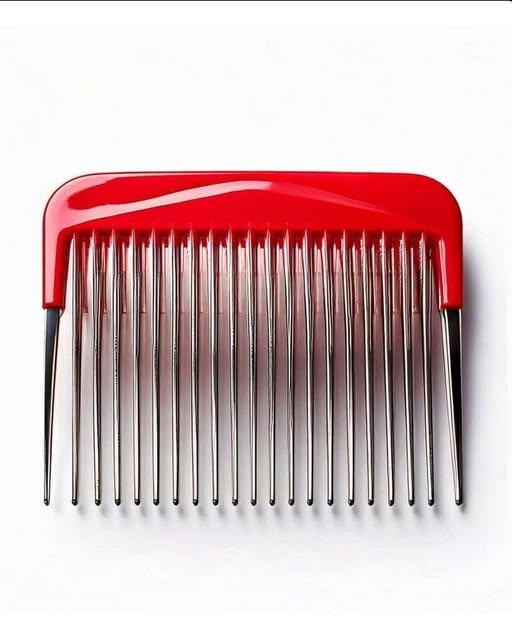
While rummaging through an old kitchen drawer, you might occasionally discover a strange little object that seems completely out of place. A small red handle attached to a row of long, sturdy metal prongs can easily be mistaken for an unusual kitchen utensil, a tiny comb, or even an old cleaning tool.
But in many cases, an object like this is actually a hair pick—a grooming accessory designed to lift, separate, shape, and style hair.
What Is a Hair Pick?
A hair pick is a type of comb with long, widely spaced teeth or prongs. Unlike an ordinary fine-toothed comb, a pick is designed to move through hair without compressing it too much.
Traditional hair picks have been particularly useful for thick, curly, coily, and textured hair, where closely spaced comb teeth can cause excessive pulling, tangling, or breakage.
The long prongs allow the user to gently lift hair from the roots, add volume, separate sections, and create a particular hairstyle.
Why Does It Look So Different From a Regular Comb?
The distinctive feature of a hair pick is its long, widely spaced teeth. A conventional comb usually has many short teeth placed close together, while a pick may have only a handful of long prongs.
This design isn’t accidental. The spacing allows the tool to move through dense hair more easily while helping preserve the hair’s natural texture.
Some vintage examples were made with metal prongs and colorful plastic handles, which can make them look surprisingly unusual when discovered decades later in a drawer.
A Tool With Cultural History
Hair picks have a particularly interesting history because grooming tools are closely connected with hairstyles, fashion, identity, and cultural traditions.
During the 20th century, hair picks became strongly associated with Afro-textured hairstyles and were commonly used to shape and maintain natural hair. Decorative picks also became popular, sometimes featuring colorful handles, carved designs, or symbolic motifs.
The hair pick therefore isn’t simply a functional comb. For many people, it can also represent the history and creativity surrounding natural hairstyles and personal grooming.
How Was It Used?
A traditional pick can be inserted gently into the hair and lifted outward to create volume. Rather than repeatedly dragging it from the roots all the way through the hair, users often use short, controlled movements.
Depending on the hairstyle, it can help:
- Lift hair at the roots
- Add volume and fullness
- Separate curls
- Shape textured hairstyles
- Refresh a hairstyle between washes
- Fluff out certain natural hairstyles
Because the prongs can be quite rigid or sharp, they should be handled carefully, particularly around the scalp.
Why Would You Find One in a Kitchen Drawer?
Finding a hair pick in a kitchen drawer doesn’t necessarily mean it was designed for the kitchen—or that something mysterious happened.
Small household drawers often become storage places for miscellaneous objects. A grooming tool may have been placed there temporarily and simply forgotten. Older homes are especially likely to contain everyday objects that have been moved from their original location over the years.
So, if you’ve discovered a tiny red object with long metal prongs, don’t automatically assume it’s a cooking utensil.
A Small Object With a Bigger Story
What initially looks like a strange little comb can actually be a piece of everyday grooming history. Its simple design reflects an important idea: different hair types require different tools.
The long prongs of a hair pick were created to work with hair that benefits from gentle separation and root lifting rather than the close, flattening action of a traditional comb.
So that mysterious red object sitting unnoticed in an old drawer may not be a random kitchen gadget at all. It could be a vintage hair pick—a simple grooming accessory with decades of practical use and cultural significance behind it.