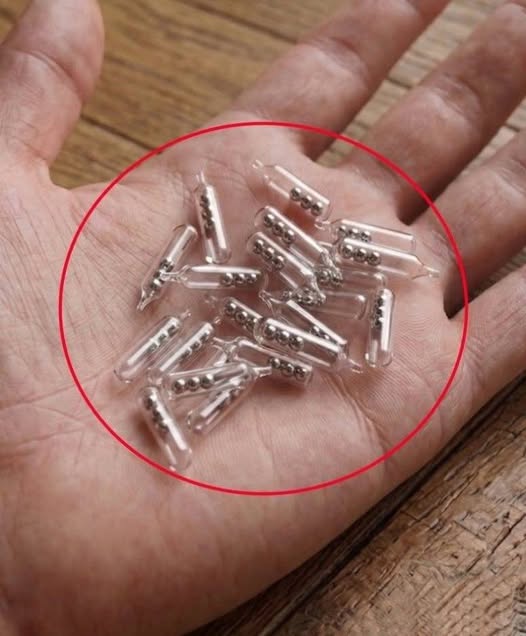
Finding an unfamiliar object in an old family drawer can instantly turn into a mystery. Glass tubes are especially confusing because they can look almost identical while having completely different purposes.
If you have discovered several thin or unusual glass tubes among your late uncle’s belongings, don’t throw them away just yet. Their shape, thickness, ends, markings, and internal construction can provide important clues about what they were originally designed to do.
They Could Be Laboratory Glassware
One of the simplest possibilities is that the tubes were used for laboratory work.
Traditional glass test tubes are designed to hold small quantities of liquids or other materials for observation, mixing, testing, or heating. They have been used in chemistry and medical laboratories for more than a century.
A typical test tube is open at one end and closed at the other, often with a rounded bottom. Different laboratory tubes can have different shapes depending on their intended use.
If your uncle worked in a laboratory, pharmacy, school, medical setting, engineering field, or industrial environment, this becomes a particularly plausible explanation.
They Could Be Capillary Tubes
Very thin glass tubes may have been used as capillary tubes.
Capillary tubes are narrow tubes designed to work with very small quantities of liquid. Historical medical and laboratory collections contain glass capillary tubes dating back many decades.
Their extremely narrow internal diameter is one of the biggest clues.
If the tubes are exceptionally thin—almost like tiny glass straws—they may have been intended for specialized laboratory or medical applications rather than ordinary household use.
Some May Have Been Used in Old Scientific Equipment
Glass tubing was also an important component of older scientific apparatus.
Specially shaped glass tubes could be bent, narrowed, joined, or modified to create experimental equipment. Laboratory glass tubes were commonly adapted for transferring gases, liquids, or reagents and for constructing specialized apparatus.
So if the objects have unusual bends, side openings, bulbs, narrow tips, or multiple sections, they may be components rather than standalone containers.
Could They Be Old Vacuum-Tube Components?
This is another interesting possibility—especially if the tubes look unusually shaped.
Historic vacuum-tube construction involved glass envelopes containing internal electrodes and other components. Museum collections include empty glass tubes that were specifically used to construct vacuum-tube arrangements.
However, a plain hollow glass tube isn’t automatically a vacuum tube. Actual identification depends on details such as internal metal components, bases, electrodes, pins, or manufacturing marks.
If you see metal parts inside the glass, do not assume it is laboratory equipment.
Look Carefully at the Ends
The ends of the tubes can provide some of the strongest clues.
Ask yourself:
- Is one end open and the other sealed?
- Are both ends open?
- Does one end have a very narrow tip?
- Is there a bulb or enlarged section?
- Is there a metal cap?
- Is there a rubber, cork, or plastic stopper?
- Are the edges smooth or broken?
- Does the glass appear deliberately melted or shaped?
A purpose-made narrow opening is very different from a tube that has simply been broken.
Look for Markings
Before cleaning the tubes, examine them carefully for:
- Numbers
- Letters
- Manufacturer names
- Etched symbols
- Measurement markings
- Logos
- Colored bands
- Small printed labels
Even a tiny marking can sometimes identify the manufacturer or original equipment.
With old glass and electrical components, permanent etched or molded markings can be more useful than labels that may have faded over time.
Don’t Test Them With Chemicals or Heat
If you don’t know what the tubes were used for, avoid experimenting with them.
Don’t:
- Heat an unidentified tube
- Put chemicals inside it
- Connect it to electricity
- Try to create a vacuum
- Scratch or cut the glass
- Force stuck caps or fittings
Old glass can be fragile, and an unidentified object may have been exposed to chemicals or other substances before it ended up in the drawer.
Why the Drawer Matters
The location where an object was found can also provide clues.
If the tubes were stored alongside:
Old electronics:
They could potentially be related to electrical or vacuum equipment.
Laboratory supplies:
They may have been test tubes, capillary tubes, or specialized laboratory components.
Medical items:
They could have been associated with older medical or diagnostic equipment.
Tools and hardware:
They may have been components used for repair or engineering work.
Perfume or cosmetic containers:
They could potentially be small containers or applicators rather than scientific equipment.
The surrounding objects don’t prove what the tubes are, but they can help narrow the possibilities.
The Most Important Clue: A Photograph
When identifying an unusual vintage object, photographs are often more useful than a description such as “small glass tubes.”
A clear photograph should ideally show:
- The entire object
- Both ends
- Any caps or fittings
- Any markings
- The inside of the tube
- Something beside it for scale, such as a ruler or coin
A close-up of the unusual end is particularly helpful.
Final Thoughts
Those mysterious glass tubes could be something surprisingly ordinary—or they could be specialized pieces of old scientific or electrical equipment.
Their length, diameter, shape, ends, markings, internal parts, and surrounding objects can help distinguish between possibilities such as laboratory tubes, capillary tubes, specialized glass apparatus, or components of older equipment.
And because several different objects can look similar, it is better to identify them from their physical characteristics rather than guessing based solely on appearance.
If these belonged to your late uncle and you want to know exactly what they are, don’t discard them. A clear photograph of the tubes and their ends may reveal much more than you expect.